

Summary
The Serbian colonization of Hungarian territories in Vojvodina (Bačka, Banat, Syrmia) unfolded over centuries amid wars and state policies. Ottoman conquests (16th century) depopulated Hungarian lands, enabling Serbian refugee inflows, including the Great Migration of 1690 under Patriarch Arsenije III. Habsburg reconquest brought further multiethnic settlement, with Serbs as border guards. By 1910, Serbs formed the largest group (33.8%) but not a majority, alongside Hungarians (28.1%) and Germans (21.4%).
After WWI, the region was forced to join Yugoslavia via Trianon. The decisive shift came post-WWII: Danube Swabians were expelled, and Yugoslavia’s communist regime settled over 200,000 South Slavs (mainly Serbs) on confiscated lands. Serbs rose from ~51% in 1948 to 68% by 2022, while Hungarians fell from ~26% to 10.5%. Earlier migrations were largely refugee-driven; post-1945 settlement was deliberate state colonization to consolidate Slavic control.
Prior to the 1900’s Vojvodina, also called “Vajdasag”, this region was historically Hungarian territory. Serbs intentionally migrated to the region & subtlety pushed all the native Hungarian population to emigrate and leave the land. Unfortunately the Hungarians were too late to notice.
The Serbian Colonization of Hungarian Territories
Vojvodina—comprising the historic regions of Bačka, Banat, and Syrmia in northern Serbia—has long been a flashpoint for competing national narratives. For Hungarians, it represents lost territories from the medieval Kingdom of Hungary and the Austro-Hungarian Empire, where ethnic Hungarians once held cultural and political dominance.
Medieval Roots and Ottoman Disruption
The territory entered Hungarian control in the 10th–12th centuries following the Magyar conquest of the Pannonian Plain. Hungarian kings established counties (e.g., Bač-Bodrog, Torontál) and settled the area with Magyar populations alongside existing Slavs. Serbs began arriving in noticeable numbers from the 14th century, often as refugees or vassals, with Serbian despots like Stefan Lazarević taking land in Syrmia.
The Ottoman conquest (1526–1552) devastated the region. Hungarians and Catholic Slavs fled northward; the demographic vacuum was filled primarily by Serbs fleeing Ottoman advances. By the late 17th century, Serbs formed the overwhelming majority in many areas. The Great Serbian Migration of 1690 under Patriarch Arsenije III Čarnojević brought tens of thousands more into Habsburg-held lands, including parts of Bačka, where they received privileges as border guards in the Military Frontier.
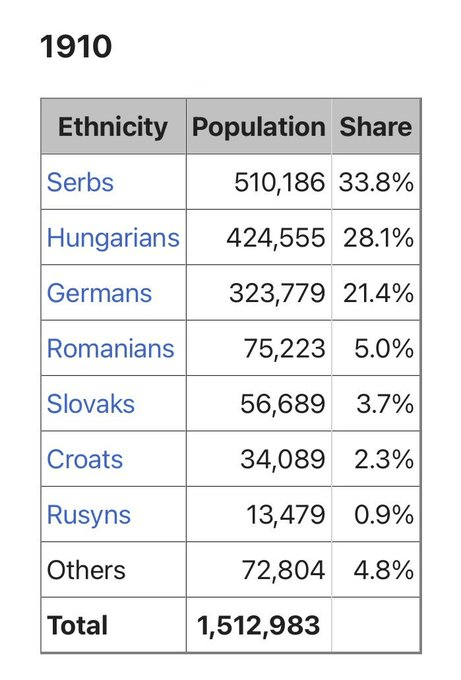
Demographics of Vojvodina in 1910
Habsburg Colonization and the Multiethnic Mosaic (18th–19th Centuries)
After the Habsburg reconquest (Treaties of Karlowitz 1699 and Požarevac 1718), Vienna pursued systematic colonization to repopulate and secure the frontier. German settlers (Donauschwaben) arrived in large numbers, alongside additional Serbs, Slovaks, Rusyns, Romanians, and Hungarians. Serbs initially retained a strong position but gradually lost their absolute majority due to this influx.
Censuses from the period reveal the shifting balance:
- 1787: Serbs 59.2%, Hungarians 10.6%, Germans 12.4%.
- 1880: Serbian-speakers 35.5%, German 24.4%, Hungarian 22.6%.
- 1910: Serbs 33.8% (510,186), Hungarians 28.1% (424,555), Germans 21.4% (323,779).
These figures—mirrored in the 1880 language map and 1910 ethnic table often shared in online discussions—show Serbs as the largest group by the late 19th century, not Hungarians. Hungarian numbers rose somewhat during the Dual Monarchy (1867–1918) due to Magyarization policies and internal migration, but the region remained a classic Habsburg “cauldron of ethnicities.” Claims of pre-1900s Hungarian predominance overlook the earlier Serbian settlements driven by Ottoman wars and Habsburg frontier policies.
Post-WWI Annexation and Interwar Tensions
After Austria-Hungary’s collapse, the 1918 Novi Sad Assembly voted to unite Bačka, Banat, and Baranja with the Kingdom of Serbia. The Treaty of Trianon (1920) confirmed the transfer to the Kingdom of Serbs, Croats, and Slovenes (later Yugoslavia). Some Hungarian administrators, landowners, and officials emigrated—estimates suggest around 40,000 Hungarians left between 1918 and 1923 amid dismissals and property reallocations. Limited Serb colonization occurred in the interwar period, but the real demographic engineering came later.
WWII Occupation, Reprisals, and the Post-1945 Colonization Program
During World War II, Hungary reoccupied Bačka and Baranja (1941–1944), implementing Magyarization and deporting or interning thousands of Serbs. In retaliation for earlier Hungarian massacres of Serbs (notably the 1942 Novi Sad raid), Yugoslav Partisans carried out reprisals in late 1944–early 1945, killing thousands of Hungarians (estimates range from 5,000 to 40,000) and expelling many from areas like Šajkaška.
The decisive shift occurred after 1945 under the new communist Yugoslavia. The entire German population—roughly 500,000 Danube Swabians who had comprised over 20% of Vojvodina’s population—was expelled, interned, or fled; their property was confiscated.
A state-sponsored colonization program then settled over 200,000–350,000 South Slavs (primarily Serbs, but also Montenegrins, Macedonians, and others) from poorer southern regions into these lands. This was explicitly designed to strengthen the Slavic element and alter ethnic proportions.
Census results illustrate the impact:
- 1948: Serbs 50.6%, Hungarians 25.8%, Germans ~1.9% (down from 21% pre-war).
- 2022: Serbs 68.4%, Hungarians 10.5%.
Hungarian numbers peaked around 442,000 in 1961 before declining steadily due to emigration (especially after 1990s Yugoslav wars), lower birth rates, intermarriage, and economic factors. During the 1990s, another wave of Serb refugees from Croatia, Bosnia, and Kosovo further reinforced the Serb majority, while tens of thousands of Hungarians left for Hungary.
References
Arday, L. “Hungarians in Serb-Yugoslav Vojvodina Since 1944.” Nationalities Papers 24, no. 3 (1996): 425–452. https://www.cambridge.org/core/journals/nationalities-papers/article/hungarians-in-serbyugoslav-vojvodina-since-1944/949480C70E1351CF0CE7891E19E67AB2.
Bjeljac, Željko. “Migrations on the Territory of Vojvodina between 1919 and 1948.” Geographica Pannonica 12 (2008): 12–20.
Janjetović, Zoran. “Die Konflikte zwischen Serben und Donauschwaben.” Südost-Forschungen 58 (1999): 119–168.
Pearce, S. “The Danube Swabians: Settlement, Expulsion, and Assimilation.” Master’s thesis, Rutgers University, 2019. https://rucore.libraries.rutgers.edu/rutgers-lib/60542/PDF/1/play/.
Statistical Office of the Republic of Serbia. 2022 Census of Population, Households and Dwellings. Belgrade: Statistical Office of the Republic of Serbia, 2023.
Vojvodina migrations. Vreme, December 9, 2015. https://vreme.com/en/dodatno/vojvodjanske-seobe.

