
by Ivana Stradner
Several years ago, I publicly raised concerns that the Russian-Serbian Humanitarian Center in Nish, Serbia, was being used as a cover for Russian intelligence activities in the Balkans. In response, the Russian Ministry of Foreign Affairs and its Embassy in Belgrade dismissed the claims as “absurd,” accusing critics of spreading “baseless propagandistic nonsense” and uncritically reprinting anti-Russian narratives.
Their statement at the time strongly defended the center, describing it as a purely humanitarian facility that helps with disaster relief, trains firefighters and rescuers, and even assisted during the coronavirus pandemic. They rejected any suggestion of espionage or military use, insisting the doors were “always open to all interested parties.”
Now we know why they reacted so strongly.
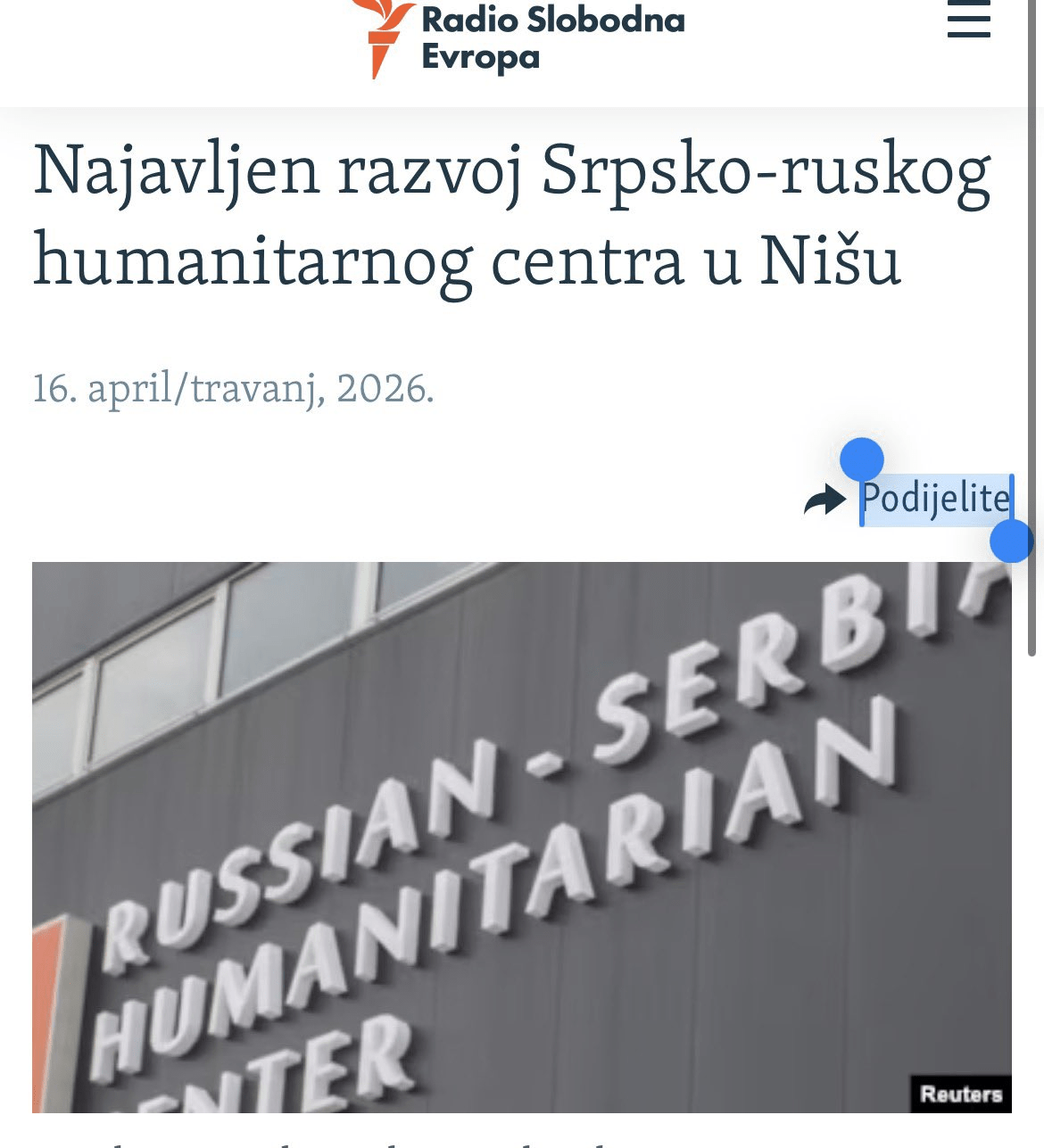
On April 16, 2026, Radio Slobodna Evropa (RFE/RL) reported on the announced further development of the Serbian-Russian Humanitarian Center in Nish. The facility — located near Nish Constantine the Great Airport — continues to receive significant Serbian state funding and is being upgraded with modern firefighting technology and a new training ground. According to RFE/RL’s investigation, Serbia has allocated nearly €2.3 million from its budget to the center over the past decade, with limited transparency on how the money is spent.
The center was officially established in 2012 as a joint project for emergency response and disaster relief. Russian officials have long portrayed it as a benign humanitarian outpost. However, Western governments, analysts, and regional security experts have repeatedly expressed concern that it serves a dual purpose — functioning as a potential intelligence hub and forward operating base for Russia in the Western Balkans, especially given its strategic location near the Kosovo border and NATO interests.
Critics point to:
Requests for diplomatic immunity for center staff (which would limit Serbian oversight).
Opaque financing and operations.
Its proximity to key regional flashpoints.
Broader patterns of Russian influence activities in Serbia, a country that maintains close ties with Moscow while pursuing EU membership.
Despite these longstanding suspicions — and even recent parliamentary proposals in Serbia to shut down the center — Belgrade and Moscow continue to deepen cooperation. In 2025 alone, the center reportedly opened a new firefighting and rescue training ground and handed over equipment to Serbia’s emergency services.
Thank you to RFERL for continuing to report on this issue with facts and transparency. Their latest coverage highlights how, years after the initial warnings and Russia’s sharp denials, the so-called humanitarian center is not only still operating — it is expanding.
When governments label legitimate security concerns as “absurd,” it often reveals more about their intentions than about the critics. The Balkans remain a strategically important region, and facilities like the one in Nish deserve genuine scrutiny, not dismissal.
True humanitarian cooperation should be transparent and accountable. Anything less invites suspicion — and for good reason.
Original post

