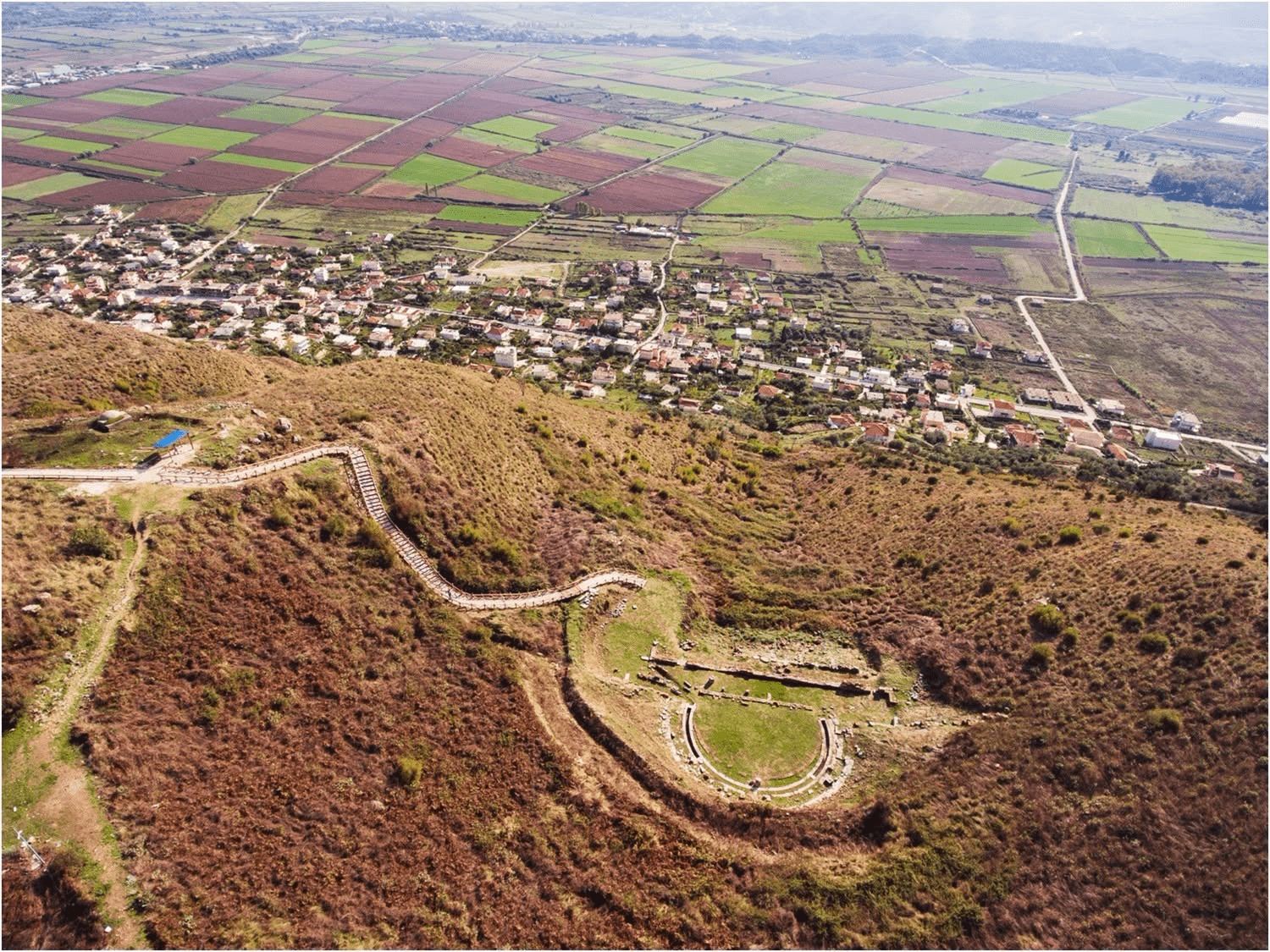

by Aleksander Hasanas
Summary
The ancient theatre of Phoenice (Finiq) near Delvinë, with around 17,000 seats, served as the democratic assembly place for the Epirotes. Larger than Dodona’s theatre in several dimensions, it featured three construction phases from the 4th to 3rd century BC. Power was exercised by three annually elected generals from the Molossian, Chaonian, and Thesprotian tribes. Italian archaeologist Luigi Ugolini chose to excavate the site in the 1920s after being impressed by its impressive Hellenistic fortifications mentioned by Polybius and its overall historical importance. Despite its significance, the theatre has not been fully uncovered.
The very large space of the theatre, with around 17,000 seats, located in the middle of the hill, served at that time as the meeting place of the “Public Assembly of the Epirotes around Phoenice”. Democratic decisions were taken there regarding peace or war, or the examination of various issues.
The passageways that divide the steps were built with great technical skill and care. The theatre constructed in this phase surpasses even the dimensions of the theatre of Dodona: the diameter of the orchestra is 19.80 metres, while that of Dodona is 19.20 metres. The diameter of the cavea from the centre to the top of the steps is 129.5 metres, while that of Dodona is 129 metres.
On the stage of the theatre, very large pedestals were found with footprints on top, which once supported very large statues of ancient gods or emperors.
At that time, power was exercised by three generals. One was the representative of power (hipparchos), the second was the secretary of the Assembly, and the third was the guarantor. They came from the three Illyrian tribes: the Molossians, the Chaonians, and the Thesprotians.
All of them were elected for a one-year term by the assembly. The religious centre of Phoenice was Dodona.
The theatre was rebuilt three times, as excavations revealed three different constructions.
The first phase dates to the beginning of the 4th century BC. The building material is local; in particular, the stone for the stage came from the same hill.
The second phase of construction belongs to the 3rd century BC.
The expansion of the stage was dictated at the moment when Phoenice became the centre of Chaonia and the capital of Albanian Epirus.
This raises the question: why did Luigi Ugolini, after two trips to Albania, choose to begin excavations in Phoenice (Finiq), having received approval from Roberto Paribeni and at the same time from his professor, Pericle Ducati?
What impressed Ugolini was the Hellenistic fortification system mentioned by Polybius, which also highlights the importance of the walls of Phoenice in the 3rd century BC.
Here is what Ugolini wrote in 1924:
«From my travels and tiring research, one city stands out in my memory for its important historical and archaeological value.
I am referring to the site of Phoenice (today Finiq), located near Delvinë.
On the hill of Phoenice one can observe the remains of fortification walls, known as Cyclopean or Pelasgian… This place is unknown to scholarship.» (Archives of the Ministry of Justice)
On the first page of the second volume of his book Albania Antica, Ugolini, in a dedication regarding the research in Phoenice, writes:
«This area left me with a very good impression, superior to what I had seen in the other areas during my journey in Albania; for this reason, from the very beginning of the works, I requested an acceleration of the underground investigations.»

