
Monday, April 20, 2026. By Ismet Azizi
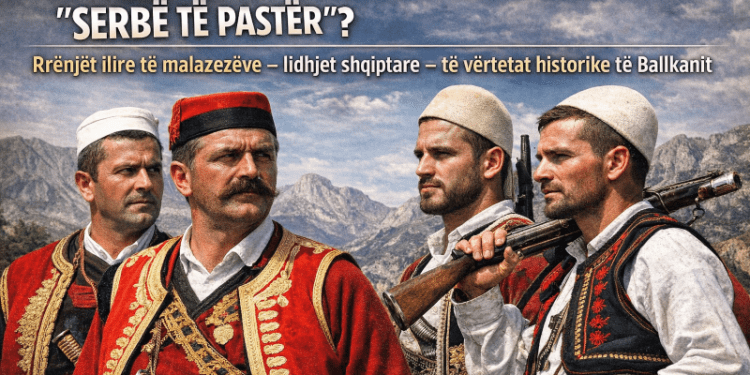
An analysis that challenges old narratives and acknowledges the role of the indigenous Illyrian population in the formation of Montenegrin identity. In the Balkans, debates about the origins of peoples are not merely academic. They are tied to identity, history, the state, and how nations see themselves. It is precisely for this reason that a text by the Montenegrin author Predrag Malbasha has attracted special attention.
In his analysis of the origins of Montenegrins, Malbasha openly opposes the old 19th-century narrative according to which Montenegrins were presented as “the purest part of the Serbian people.” According to him, this was a political thesis from the era of romantic nationalisms and Yugoslav projects, not a historical truth.
The Role of the Illyrian Substrate
The author argues that on the territory of today’s Montenegro, before the arrival of the Slavs, there lived an indigenous Illyrian population — descendants of the Docleatae, Labeatae, and other tribes — with whom the Slavs mixed over the centuries.
According to him, this indigenous substrate left significant traces in:
- folk culture
- customs
- tribal organization
- music and dances
- traditional clothing
- collective psychology
- Montenegrin historical identity
Montenegrins Are Not Only Slavs
This is the core of Malbasha’s thesis: Montenegrins cannot be explained solely through the Slavic migrations of the 6th–7th centuries.
They are the result of a long historical process in which the following were intertwined: the indigenous Balkan population, Roman and Byzantine influence, Slavic migrations, Albanian contacts, the medieval formation of Duklja and Zeta, and modern state-building processes.
The Albanian Element Is Also Acknowledged
Significantly, the author acknowledges that Albanians are the people with the strongest connection to the Illyrian heritage. This distinguishes his text from many other regional narratives that try to relativize this issue.
Furthermore, the history of today’s Montenegrin space cannot be understood without the connections to Albanian tribes such as: Hoti, Gruda, Kelmendi, Kuçi, Triepshi, and the Malësia of Ulcinj.
These relations were sometimes allied, sometimes conflictual, but they undoubtedly left historical and demographic consequences.
Unmasking Myths About “Pure Blood”
The most important message of this text is the challenge to old Balkan myths about “pure peoples.” Such notions were created mainly in the 19th century, when modern nations sought a glorious and simple past.
However, the historical reality of the Balkans shows something completely different: continuous mixing of populations, migrations and counter-migrations, changes in language and religion, alliances and conflicts, and complex processes of assimilation.
This is why no people in the Balkans can seriously claim to originate from a single ethnic base.
Why Does This Text Matter?
Because it shows that even within Montenegro itself, old national myths are being re-examined.
Instead of simplistic formulas such as “only Serbs,” “only Slavs,” or “only Illyrians,” a more serious truth is emerging: Balkan identities are products of centuries-long mixing.
Conclusion
Predrag Malbasha’s text does not provide the final answer to the origins of Montenegrins, but it opens an important debate: that the history of Montenegro is far more complex than the political narratives of the 19th and 20th centuries.
And perhaps this is the greatest truth for the entire Balkans: Peoples are not built on the myth of pure blood, but on history.
Source

