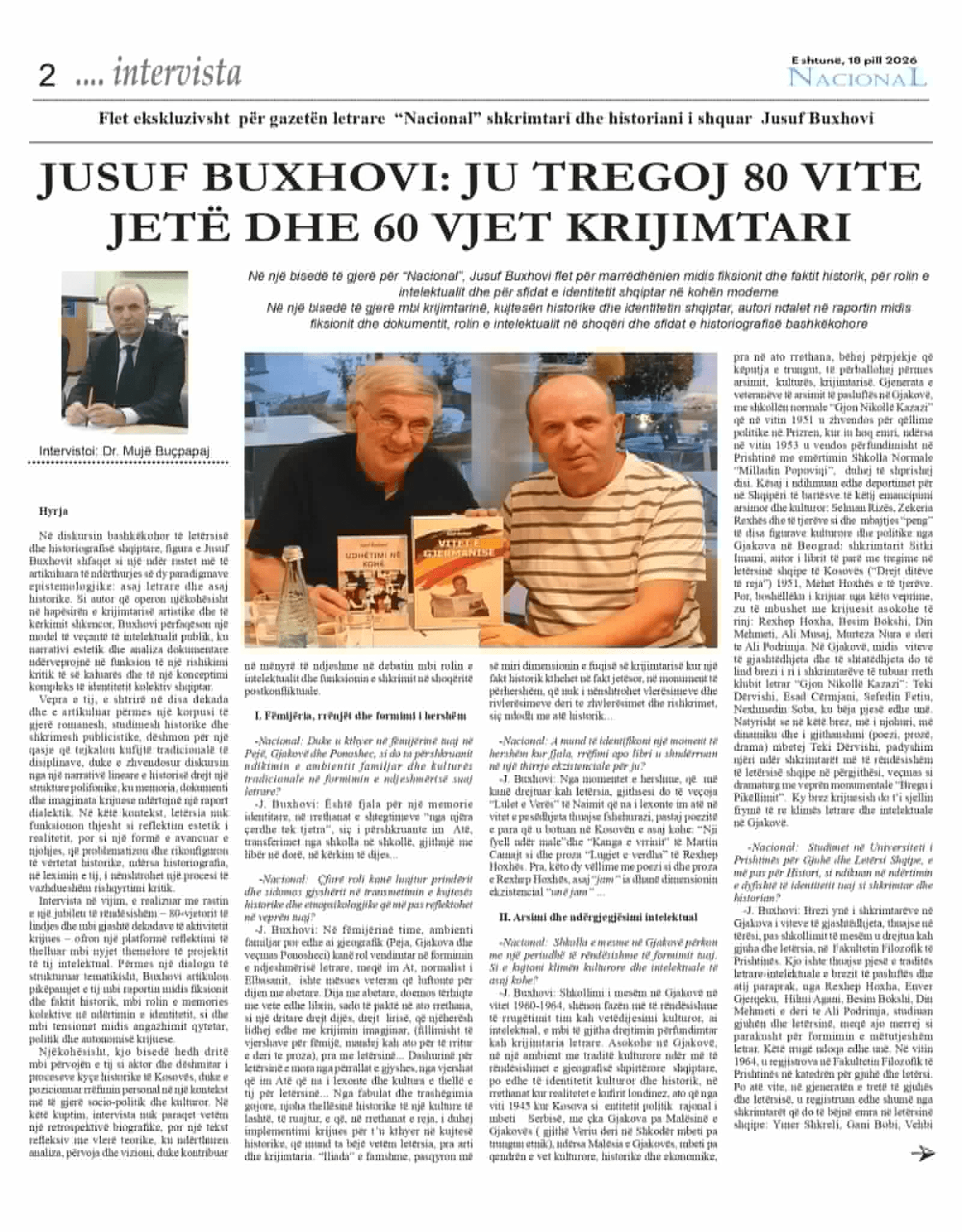

by Jusuf Buxhovi and Mujo Buçpapaj
Summary
In an extensive interview for “Nacional” on the occasion of his 80th birthday and 60 years of creative work, Jusuf Buxhovi reflects on the formation of his dual identity as writer and historian. Born in Peja, shaped in Gjakova and Ponoshec, he credits his father (a veteran teacher) and grandmother’s fairy tales for instilling a love of literature and historical memory. He describes the vibrant 1960s literary scene in Gjakova, where a new generation of creators (including Teki Dërvishi) resisted attempts to sever the city’s Albanian cultural vein. Studies in Albanian Language and Literature at Prishtina University, followed by postgraduate work in History, allowed him to merge fiction and historical fact, turning collective memory into existential and identitarian literature.
In an extensive conversation for “Nacional,” Jusuf Buxhovi speaks about the relationship between fiction and historical fact, the role of the intellectual, and the challenges of identity in modern times.
In this broad discussion on creativity, historical memory, and Albanian identity, the author also addresses the challenges of contemporary historiography…
In the contemporary discourse of Albanian literature and Albanian historiography, the figure of Jusuf Buxhovi appears as one of the most articulated cases of the intertwining of two epistemological paradigms: the literary and the historical. As an author who operates simultaneously in the space of artistic creation and scientific research, Buxhovi represents a unique model of the public intellectual, where the aesthetic narrative and documentary analysis interact in the service of a complex conceptualization of collective Albanian identity.
His work, spanning several decades and articulated through a broad corpus of novels, historical studies, and publicistic writings, testifies to a polyphonic structure in which memory, document, and creative imagination build a dialectical relationship. In this context, literature does not function merely as an aesthetic reflection of reality, but as an advanced form of knowledge that problematizes and reconfigures historical truth, while historiography, in his reading, is subjected to a continuous process of critical re-examination.
The following interview, conducted on the occasion of an important jubilee — the 80th anniversary of his birth and more than six decades of creative activity — offers a platform for deep reflection on the fundamental nodes of his intellectual project. Through a thematically structured dialogue, Buxhovi articulates his views on the relationship between fiction and historical fact, on the role of collective memory in the construction of identity, and on the tensions between civic and political engagement and creative autonomy.
At the same time, this conversation sheds light on his experience as an actor and witness to key historical processes in Kosovo, positioning his personal narrative within a broader socio-political and cultural context. In this sense, the interview is not only a biographical retrospective but a reflexive text of theoretical value, where analysis, experience, and vision intertwine, contributing sensitively to the debate on the role of the intellectual and the function of the writer in post-conflict society.
Nacional: Returning to your childhood in Peja, Gjakova, and Ponoshec, how would you describe the influence of the family environment and traditional culture on the formation of your literary sensitivity?
J. Buxhovi: It is about an identitarian memory, in the circumstances of migrations “from one nest to another,” as my father described the transfers from school to school, always with a book in hand, in search of knowledge…
Nacional: What role did your parents, and especially your grandparents, play in transmitting the historical and ethnopsychological memory that later reflects in your work?
J. Buxhovi: In my childhood, both the family environment and the geographical one (Peja, Gjakova, and especially Ponoshec) played a decisive role in the formation of literary sensitivity, since my father, a graduate of the Normal School of Elbasan, from the first post-war days when Albanian-language elementary schools began to open in Kosovo, was a veteran teacher who fought for knowledge with the primer. Knowledge with the primer inevitably brought with it the book, however few there were in those circumstances, as a window toward knowledge, toward freedom, which at the same time was linked to imaginary creation (initially children’s verses, then those for adults, and up to prose), that is, with literature…
I acquired the love for literature from my grandmother’s fairy tales, from the poems that my father read to us, and from his deep culture of literature, especially world literature, since he knew several languages (Italian, German, Turkish, Serbian)… From fables and oral heritage, I deeply understood the historical depth of an ancient culture that had been preserved, and which, in the new circumstances, needed creative implementation to turn into historical memory — something that only literature, that is, art and creativity, can do.
The famous Iliad best reflects the dimension of the power of creativity when a historical fact becomes a vital fact, an eternal monument that does not submit to evaluations and re-evaluations up to devaluations and rewritings, as happens with the historical one…
Nacional: Can you identify an early moment when the word, the narrative, or the book became an existential call for you?
J. Buxhovi: From the early moments that directed me toward literature, I would certainly single out Naim’s Lulet e Verës (Flowers of Summer), which my father read to us almost secretly in the 1950s, then the first poems published in Kosovo at that time: “Nji fyell ndër male” and “Kanga e vrrinit” by Martin Camaj, as well as the prose “Lugjet e verdha” by Rexhep Hoxha. So, these two volumes of poetry and Rexhep Hoxha’s prose gave the existential dimension “from me — to I am.”
Nacional: High school in Gjakova coincides with an important period of your formation. How do you remember the cultural and intellectual climate of that time?
J. Buxhovi: Secondary education in Gjakova in the years 1960–1964 marks the most important phase of my journey toward cultural awareness, intellectual awareness, and above all the final direction toward literary creation. At that time in Gjakova, in an environment with one of the most important cultural traditions of the Albanian spiritual geography, but also of cultural and historical identity, in circumstances where the realities of the London border — those from 1945 when Kosovo as a political entity remained autonomous under Serbia, with which Gjakova lost the Gjakova Highlands (the entire North up to Shkodër remained without its ethnic trunk), while the Gjakova Highlands remained without its own cultural, historical, and economic center — in those circumstances, efforts were made to counter the severing of the trunk through education, culture, and creativity.
The generation of post-war education veterans in Gjakova, with the “Gjon Nikollë Kazazi” Normal School that in 1951 was moved for political reasons to Prizren, when its name was removed, and in 1953 was permanently placed in Prishtina under the name “Milladin Popoviqi” Normal School, had to be somehow dismantled.
This was also helped by the deportations to Albania of the carriers of this educational and cultural emancipation: Selman Riza, Zekeria Rexha, and others, as well as the holding “hostage” in Belgrade of several cultural and political figures from Gjakova: the writer Sitki Imami, author of the first book of short stories in Kosovo Albanian literature (Drejt ditëve të reja, 1951), Mehet Hoxha, and others. But the vacuum created by these actions began to be filled by the then-young creators: Rexhep Hoxha, Besim Bokshi, Din Mehmeti, Ali Musaj, Murteza Nura, and up to Ali Podrimja. In Gjakova, between the 1960s and 1970s, the new generation of writers gathered around the “Gjon Nikollë Kazazi” literary club was born: Teki Dërvishi, Esad Cërmjani, Sefedin Fetiu, Nexhmedin Soba, of which I was also a part.
Naturally, in this generation, the best-known, most dynamic, and most versatile (poetry, prose, drama) remained Teki Dërvishi, undoubtedly one of the most important writers of Albanian literature in general, especially as a playwright with the monumental work Bregu i Pikëllimit (The Shore of Sorrow). This generation of creators would bring a new spirit to the literary and intellectual climate in Gjakova.
Nacional: Studies at the University of Prishtina in Albanian Language and Literature, and later in History — how did they influence the dual construction of your identity as a writer and historian?
J. Buxhovi: Almost our entire generation of writers from Gjakova in the 1960s, after secondary school, turned toward language and literature at the Faculty of Philosophy in Prishtina. This was almost part of the literary-intellectual tradition of the post-war generation and the previous one; from Rexhep Hoxha, Enver Gjerqeku, Hilmi Agani, Besim Bokshi, Din Mehmeti, up to Ali Podrimja, they studied language and literature, as it was considered a prerequisite for further literary formation. I followed this path as well.
In 1964, I enrolled in the Faculty of Philosophy in Prishtina in the department of language and literature. In the same year, in the third generation of language and literature, many writers who would make names in Albanian literature also enrolled: Ymer Shkreli, Gani Bobi, Vehbi Kikaj, Ibrahim Kadriu. It was another fortunate circumstance, because after the Brioni Plenum in July 1966 when Ranković fell, the study of Albanian language and literature gained great momentum, as did publishing activity in Albanian within “Rilindja.”
Our generation, which besides literary writings also engaged a little in journalism, one day almost all found ourselves as journalists at “Rilindja.” This happened in 1967 when, in the culture section of “Rilindja,” on the initiative of editor Vehap Shita (theater critic and one of the most valuable translators from Serbian of Yugoslav and world works into this language), we came together: Ymer Shkreli, Gani Bobi, and a year later: Ibrahim Kadriu, Eqrem Basha, Mensur Raifi, Sylë Osmanaj, Musa Ramadani, a little later also Mehmet Kraja, Mahamedin Kullashi, and eventually Jusuf Gërvalla.
In the other sections of the newspaper, other writers also worked: Rushit Ramabaja, Nexhat Halimi, Flora Brovina, A. Konushevci, F. Kajtazi, and others. But what was important was that, alongside the culture editor Vehap Shita, there were also the most important pens of Albanian literature: Anton Pashku, assistant culture editor, Fahredin Gunga as education journalist, Ali Podrimja — proofreader.
During my literature studies, curiosity about history also arose in me. Especially when its study, after the fall of Ranković, was no longer a “party duty” but a free research profession. At that time, encouraged by academician Ali Hadri, who had detected in my publicistic and literary writings a tendency toward history, I continued postgraduate studies in the history department with the master’s thesis topic “The Albanian League in German Documents,” which I completed in 1979, while at that time I was the permanent correspondent of “Rilindja” in Bonn, Germany.
There, I had the opportunity to access the Political Archive of the German Foreign Ministry, where the documents of the Congress of Berlin (held in Berlin from June 13 to July 20, 1878) were located. Research in the Bonn archive, and later in those of Berlin, Munich, and others, connected me with historiography — a track that intertwined closely with my literary creativity, because through it I turned historical facts into vital ones. That is why my literary work (prose and drama) is closely linked to the historical component as identitarian and existential memory.

