

Summary
In 1019–1020, Emperor Basil II issued charters reorganizing the Archbishopric of Ohrid after defeating Tsar Samuel. The 1020 decree exposed a jurisdictional conflict as Ohrid seized territories formerly under the Metropolitan of Durrës, reflecting power struggles during Samuel’s reign (997–1014). A contemporary Bulgarian text labels Albanians (Arbanasi) as “half-believers,” confirming their early ethnic presence. These documents illustrate that medieval Albania transcended political borders, embodying ethnic continuities rooted in Roman and Byzantine administrative traditions amid Slavic and Byzantine influences.
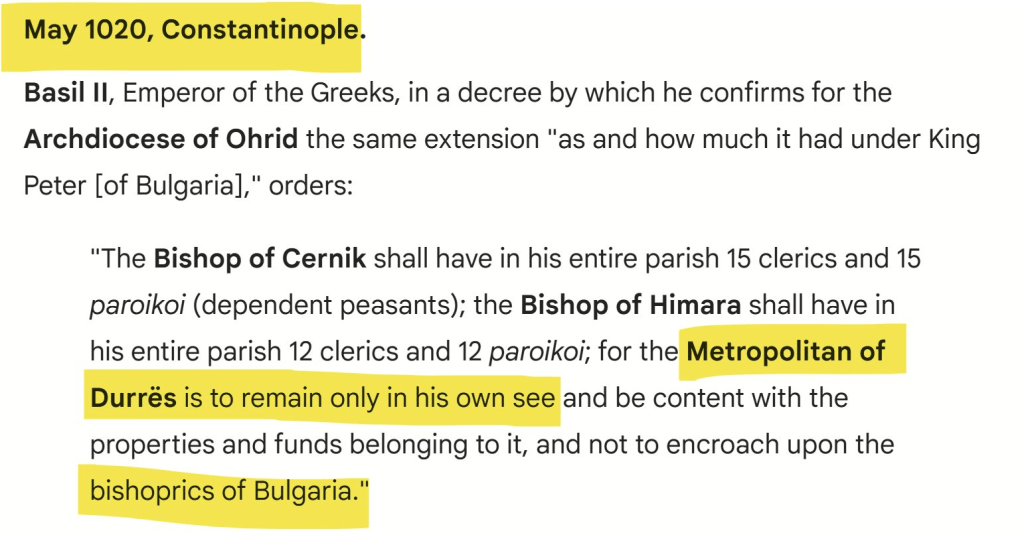
The 1020 Emperor decree shows a power struggle between the Archbishopric of Ohrid and the Metropolitan of Durrës over territorial jurisdiction. This shows that Albania was not just a political boundary but an ethnic reality linking the medieval Albania to older Roman and Byzantine administrative.

1019 AD: While Tsar Samuel classifies Albanians (Arbanasi/Арбанасин) as ‘half-believers,’ Basil II’s 1019 charters reveal how the Archbishopric of Ohrid seized territories from the Metropolitan of Durrës during Samuel’s rule (997-1014 AD).
The 1020 Emperor Decree and the Power Struggle over Medieval Albania
After conquering the Bulgarian Empire of Tsar Samuel in 1018, Byzantine Emperor Basil II (r. 976–1025) issued a series of imperial charters (sigillia) to reorganize the ecclesiastical structure of the newly annexed territories. The first charter appeared in 1019, with a key follow-up—the second sigillion—in 1020. These documents formalized the Archbishopric of Ohrid as an autocephalous see under Byzantine oversight, downgrading the former Bulgarian patriarchate while granting it jurisdiction over numerous dioceses across the Balkans.
A central point of tension in the 1020 charter involved territorial jurisdiction. The Archbishopric of Ohrid expanded its authority by incorporating bishoprics and lands previously under the Metropolitan of Durrës (Dyrrhachium), an ancient coastal see on the Adriatic with roots in Roman and early Byzantine administration.
During Samuel’s rule (997–1014), Ohrid had already seized control of several territories in the region, a shift that Basil II’s decrees largely confirmed or adjusted to consolidate imperial control. This ecclesiastical power struggle highlighted competing claims over parishes, clergy, and revenues in areas inhabited by diverse populations, including Slavs, Greeks, and Albanians (referred to as Arbanasi).
Contemporary sources also illuminate ethnic realities. A Bulgarian text from Samuel’s era, preserved in a legendary fragment, classifies the Arbanasi (Albanians) among “half-believers”—non-Orthodox Christians alongside groups like Armenians, Croats, and Franks—indicating they formed a recognized distinct linguistic and cultural community by the early 11th century.
The decrees reveal that medieval “Albania” was not merely a fleeting political label but reflected deeper ethnic and administrative continuities. The region around Durrës and inland areas linked back to Roman provinces (such as Praevalitana and parts of Epirus Nova) and Byzantine themes, where local populations—likely including proto-Albanian groups—maintained distinct identities amid Slavic and Byzantine influences.
References
Basil II’s sigillia (1019, 1020, 1025), as analyzed in Predrag Komatina’s studies on the diocesan structure of the Archbishopric of Ohrid.
Fragment on the origins of nations (early 11th century Bulgarian text), translated in Robert Elsie, Early Albania.
Secondary analyses: Works on the Ohrid Archbishopric post-1018 and ecclesiastical history of Durrës.
Source
In collaboration with x.com/albanx and history.al

