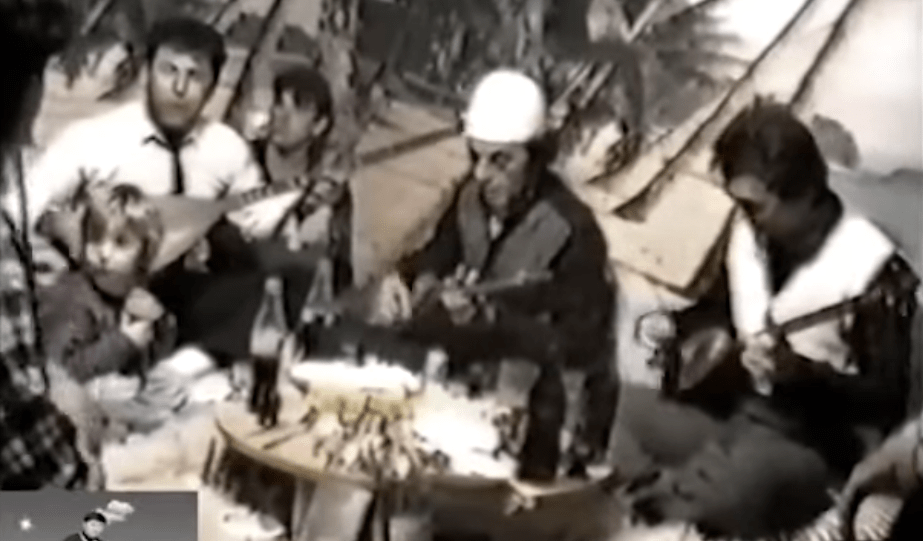

At first glance, the scene appears disarmingly simple: a group of men seated cross-legged around a table, food and drink within reach, voices rising in what could be mistaken for an informal evening gathering. Yet under the guidance of Augustin Ukaj, this setting unfolds into a remarkably sophisticated musical system—one that fuses narrative drama, micro-coordination, modal fluidity, and timbral experimentation into a tightly controlled expressive form.
Informality as Structure: Distributed Musical Authority
The central thesis emerges clearly: what appears as spontaneity is in fact a highly codified interplay of vocal layering, gestural conducting, rhythmic elasticity, and instrumental narration. The performance operates through a principle of distributed authority. Ukaj does not conduct in a formal sense, yet through subtle nods, eye contact, and embodied cues, he regulates entrances, dynamics, and structural pacing with striking precision. These gestures function as anacrustic signals, cueing singers and shaping phrasing without interrupting the organic flow.
Vocal Architecture: Fragmentation and Tension
The vocal architecture is defined by fragmentation and tension. Singers deliver only a few syllables per beat, creating a compressed, breath-driven declamation that resembles a condensed form of recitative. This sparse text setting produces a sense of urgency while leaving space for instrumental elaboration. The vocal line does not unfold continuously; instead, it appears in punctuated bursts, each entry acting as a dramatic marker rather than a lyrical extension.
Octave Displacement: Registral Intensification
A defining structural device is the persistent use of octave displacement. Vocal phrases are frequently elevated into higher registers, producing a form of registral intensification. Each upward shift functions as a dramatic escalation, not merely a technical flourish. The result is a cumulative rise in tension, achieved spatially in pitch rather than through harmonic progression.
The Violinist: Improviser, Narrator, Percussionist
The violinist serves as the primary catalytic force within the ensemble. His role extends far beyond accompaniment into the realm of active heterophony and narrative shaping. He shadows the vocal line, diverges from it, and fills the interstitial space with rapid ornamentation and rhythmic variation. His improvisation maintains continuity when the vocal texture becomes sparse, effectively binding the structure together.
At key moments, the violinist abandons pitched material entirely and engages in percussive tapping on the instrument’s body. This technique, mirrored by the lute (çifteli), introduces non-pitched sonic elements that function as programmatic sound. These gestures evoke the auditory image of footsteps, aligning with the implied narrative of a protagonist ascending stairs with urgency and intent. The ensemble thus incorporates acoustic sound effects, transforming instrumental performance into a form of embedded sonic dramaturgy.
Sonic Realism: Percussive Effects and Instrumental Gesture
The lute’s percussive strikes reinforce this layer of realism. Rapid, repeated knocking produces a tightly synchronized rhythmic texture that suggests acceleration and physical motion. These sounds are not ornamental; they act as iconic signifiers, linking musical gesture directly to imagined action.
Interstitial Density: Continuity Through “Filling”
Between vocal phrases, the music intensifies rather than relaxes. Interstitial passages are filled with dense rhythmic subdivision and ornamental interplay. What might be perceived as filler is in fact a structural necessity: these passages maintain momentum and prevent any dissipation of dramatic energy. The continuity of the performance relies on this constant underlying activity.
Rhythmic Meter: Elastic Pulse over Asymmetrical Structure
Rhythmically, the piece operates within an elastic metric framework. While the surface suggests freedom, there is an underlying additive structure typical of Balkan traditions, likely oriented around asymmetrical groupings such as 7/8 divided into 3+2+2 or 2+2+3. However, this meter is rarely articulated rigidly. Instead, the performers stretch and compress time through agogic rubato, creating a fluid relationship to pulse. The beat is not abandoned but negotiated collectively.
A clear stratification emerges between vocal and instrumental layers. The voices are rhythmically sparse and declamatory, often floating above the pulse, while the violin and lute maintain a more continuous subdivision. This produces a heterometric texture in which different layers imply different degrees of metric stability.
The percussive effects play a crucial role in reinforcing rhythmic clarity. During moments of heightened tension, such as the passage evoking rapid movement, the ensemble tightens into a more motoric drive. The tapping gestures align rhythmically, briefly stabilizing the pulse and intensifying forward motion.
Modal Structure: Centered Pitch and Fluid Intonation
Modal structure further distinguishes the performance from Western tonal systems. The music is organized around a central pitch, or finalis, which functions as a point of return rather than a goal of harmonic resolution. There is no dominant–tonic relationship; stability is achieved through repetition, emphasis, and collective reinforcement.
The scalar material suggests a diatonic base with modal inflections, often resembling minor-like structures such as Aeolian or Dorian. However, the system remains flexible. The violinist and singers introduce microtonal inflections through slides and subtle pitch deviations, expanding the expressive range beyond fixed semitones. These inflections are integral to the modal identity rather than ornamental additions.
Texture is predominantly heterophonic. Multiple performers render variations of the same melodic line simultaneously, each introducing slight rhythmic and ornamental differences. This creates a dense, internally active sound without relying on harmonic progression. The music evolves through variation and intensification rather than chordal movement.
Rhythm and Mode in Interaction
The interaction between rhythm and mode is central to the performance’s dramatic effect. When the rhythmic structure loosens, modal exploration increases through ornamentation and pitch flexibility. When the rhythm tightens, pitch stabilizes and the emphasis shifts toward propulsion and intensity. Metric tension and modal freedom operate in inverse relation, shaping the overall contour of the piece.
Embodied Conducting: Gesture as Control System
Ukaj’s role as an embodied conductor becomes especially evident in this context. His gestures regulate not only entries but also the balance between rhythmic elasticity and structural cohesion. Authority is subtle, distributed, and embedded in social interaction, yet the coordination remains precise.
Cumulative Form: Intensification Without Harmonic Resolution
The overall form can be understood as cumulative intensification. Octave rises, rhythmic tightening, percussive effects, and improvisational density all contribute to a progressive build of dramatic energy. Resolution is not harmonic but textural, achieved through saturation and release.
Conclusion: The Illusion of Simplicity
What appears to be a casual gathering is, in reality, a highly refined musical system. It integrates vocal fragmentation, modal fluidity, rhythmic elasticity, instrumental improvisation, and programmatic sound into a unified expressive language. The performance does not merely accompany a narrative; it enacts it.
It is not any single element that is unique, but the precise integration of all of them: micro-conducting, heterophonic texture, asymmetrical meter, modal flexibility, and acoustic sound symbolism. Together, they form a musical syntax deeply rooted in Albanian cultural practice and transmitted through embodied knowledge rather than notation.
The result is a form of music that operates simultaneously as social ritual, narrative medium, and dramatic performance, transforming a domestic setting into a space of heightened expression where every gesture, pitch, and rhythmic nuance contributes to a vivid and collectively constructed sonic drama.
Full video: https://www.youtube.com/watch?v=O-SuI6t63IQ

