

Quote:
“Albanian colonies are very numerous in Greece. Not counting the regions that the latter was able to take from Albania after the Balkan Wars, the Albanian element makes up one-seventh of the total population of Greece. The exact era of the arrival of these colonies in Greece is not known, but it is assumed that the first ones date back to the time of the Slavic invasion.
At the beginning of the 15th century, Albanians were so numerous and so powerful in Morea (Peloponnese) that, to subdue them, the Sultan was forced to send a large army against them under the command of Turahan. Defeated, they withdrew from the field and formed strong centers in the region of Lala and in Bardounia. From that time or shortly thereafter, they spread throughout Corinthia and Argolis and populated the cities or villages of Attica right up to the Acropolis, where, just a few decades ago, only Albanian was spoken.
They are found in Arcadia, in Laconia, and in Messenia. Before the 16th century already, these colonies had advanced into Aulis, in Boeotia, at Thermopylae, and as far as Euboea. From the Peloponnese, Albanians crossed over to the islands of Hydra, Spetses, Poros, Psara, Salamis, and even as far as Cyprus.
In Hydra, as well as in the other three islands, until a few years ago the Greek element did not exist at all. “There are no Hydriots—writes Pouqueville (Voyage de Grèce, VI, 35)—except for about twenty Greeks who have been granted permission to settle there for trade; the rest are natives who speak Schype or the Albanian idiom.”
This Albanian population, full of energy and courage, hardworking and warlike, with simple and pure customs, has raised Greece from its ruins. “The Shkipetars, whom historians call Epirotes, are the current inhabitants of the city of Argos, no less famous than Sparta. They stand out among the inhabitants of the peninsula for their cleanliness, courage, and zeal.
Like the ancient Argives, they are breeders, no longer of horses destined for hippodrome games, but of strong and sturdy horses, dedicated to the noble labors of agriculture. These labors do not absorb all the zeal of these people, who are found in all parts of the Morea, wherever there is land to cultivate.
Their activity takes them, according to the seasons, to Patras, to Elis, and as far as the Ionian Islands. But always Shkipetars, they live among themselves, help each other in their needs, and never fail every year to send their savings to the bosom of their families.”
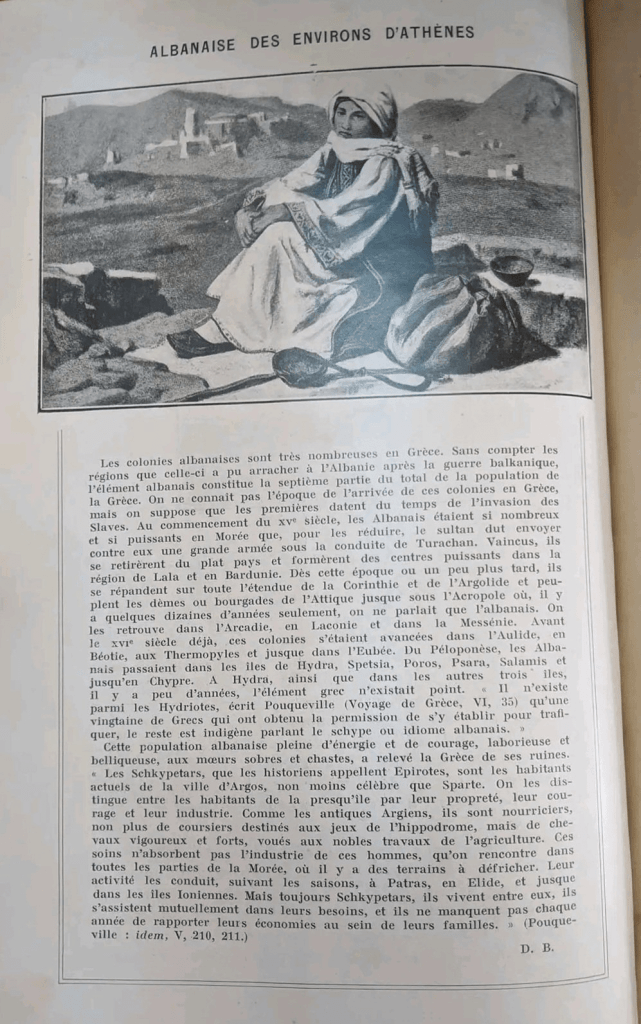
Source
(Pouqueville: ibid., V, 210, 211.) D. B.

