
Cited:
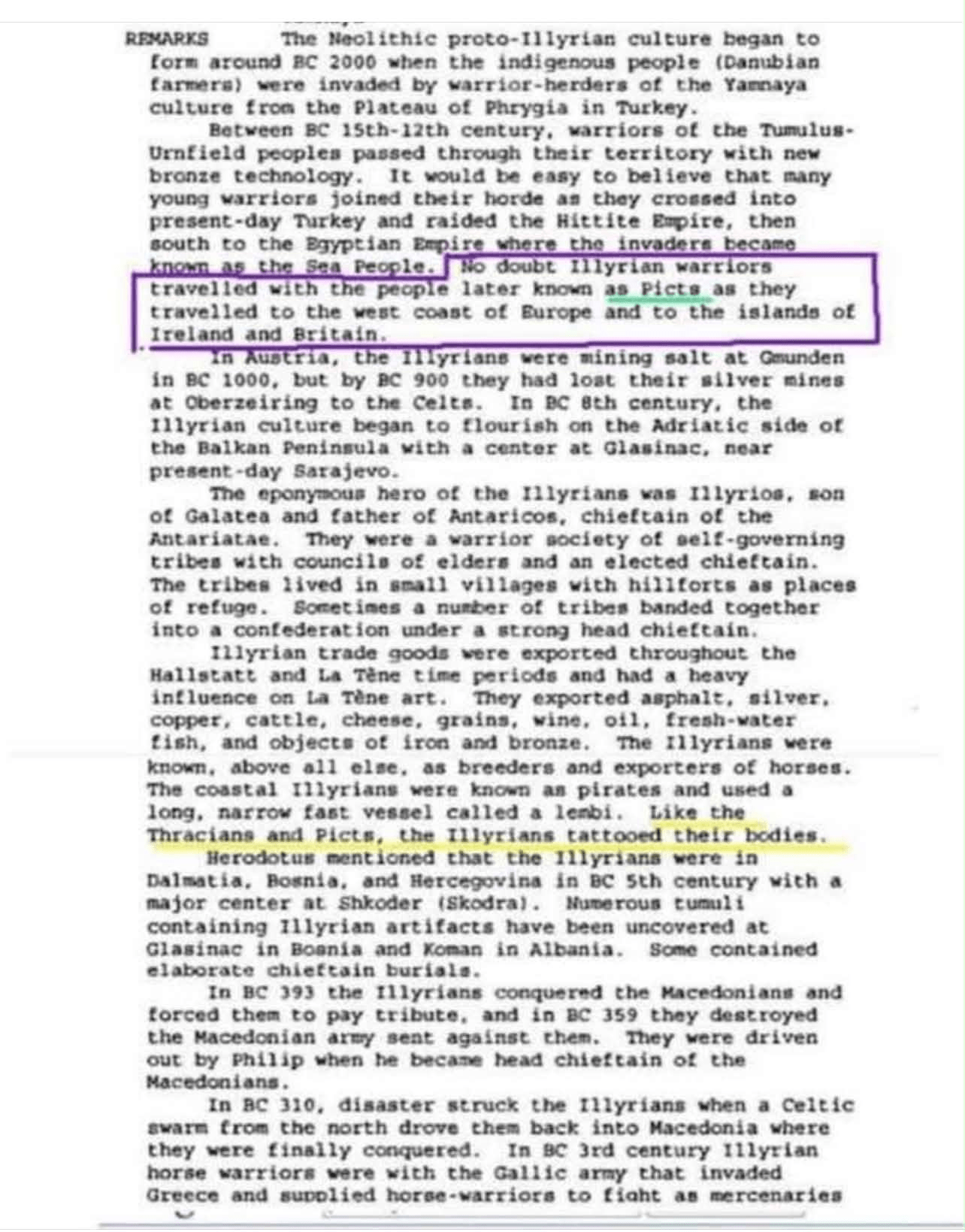
“The Neolithic proto-Illyrian culture began to form around BC 2000 when the indigenous people (Danubian farmers) were invaded by warrior-herders of the Yamnaya culture from the Plateau of Phrygia in Turkey.
Between BC 15th-12th century, warriors of the Tumulus-Urnfield peoples passed through their territory with new bronze technology. It would be easy to believe that many young warriors joined their horde as they crossed into present-day Turkey and raided the Hittite Empire, then south to the Egyptian Empire where the invaders became known as the Sea People. No doubt Illyrian warriors travelled with the people later known as Picts as they travelled to the west coast of Europe and to the islands of Ireland and Britain.
In Austria, the Illyrians were mining salt at Gmunden in BC 1000, but by BC 900 they had lost their silver mines at Oberzeiring to the Celts. In BC 8th century, the Illyrian culture began to flourish on the Adriatic side of the Balkan Peninsula with a center at Glasinae, near present-day Sarajevo.
The eponymous hero of the Illyrians was Illyrios, son of Galatea and father of Antarios, chieftain of the Antariatae. They were a warrior society of self-governing tribes with councils of elders and an elected chieftain. The tribes lived in small villages with hillforts as places of refuge. Sometimes a number of tribes banded together into a confederation under a strong head chieftain.
Illyrian trade goods were exported throughout the Hallstatt and La Tène time periods and had a heavy influence on La Tène art. They exported asphalt, silver, copper, cattle, cheese, grains, wine, oil, fresh-water fish, and objects of iron and bronze. The Illyrians were known, above all else, as breeders and exporters of horses. The coastal Illyrians were known as pirates and used a long, narrow fast vessel called a lembi. Like the Thracians and Picts, the Illyrians tattooed their bodies.
Herodotus mentioned that the Illyrians were in Dalmatia, Bosnia, and Hercegovina in BC 5th century with a major center at Shkoder (Skodra). Numerous tumuli containing Illyrian artifacts have been uncovered at Glasinae in Bosnia and Koman in Albania. Some contained elaborate chieftain burials.
In BC 393 the Illyrians conquered the Macedonians and forced them to pay tribute, and in BC 359 they destroyed the Macedonian army sent against them. They were driven out by Philip when he became head chieftain of the Macedonians.
In BC 310, disaster struck the Illyrians when a Celtic swarm from the north drove them back into Macedonia where they were finally conquered. In BC 3rd century Illyrian horse warriors were with the Gallic army that invaded Greece and supplied horse-warriors to fight as mercenaries.”
Source
https://www.celtsite.com/TCE/Section%20I/Cultures.htm

