
Summary
In November 1905, Albanian patriots in Monastir founded the secret committee “For the Freedom of Albania” under Bajram (Bajo) Topulli. The organization aimed to achieve autonomy or full independence through national propaganda and armed struggle. It rapidly established branches across Albania and coordinated patriotic activities. The committee promoted Albanian language education, unity between Muslims and Christians, and resistance against Ottoman reforms and neighboring states’ bands. It supported the creation of armed çetas (guerrilla bands) as the main tool for liberation. Although cautious toward revolutionary violence, Austria-Hungary provided limited cultural support. This marked a new, more organized and radical phase of the Albanian National Movement between 1905 and 1908.
THE COMMITTEES “FOR THE FREEDOM OF ALBANIA”. THE ARMED STRUGGLE OF THE ÇETAS (1905–1908)
In 1905, the national movement began to take new organizational forms, shaped both by its internal development needs and by external circumstances in the Balkans, particularly in European Turkey after the Mürzsteg Agreement.
The Mürzsteg decisions did not permanently eliminate contradictions between the European powers over influence in the Balkans, especially the Italo-Austrian rivalry in Albania. Rome could not accept the superiority that Vienna, together with Russia, had secured in the reform action in Macedonia. In meetings between the foreign ministers of the two countries (in Abbazia, Italy, in April 1904 and in Venice in April 1905), Vienna and Rome reaffirmed their commitment to maintaining the status quo in the Balkans.
Regarding the Albanian question, at the Venice meeting both sides concluded that if events made it impossible to preserve the status quo and a new organization were established in Macedonia (meaning the vilayets of Salonika, Monastir, and Kosovo), the Albanian-inhabited areas (excluded from reforms in 1904) should be separated and united with the vilayets of Shkodra and Janina to form a single territorial unit.
This orientation of Italy and Austria-Hungary caused concern in the ruling political circles of Belgrade and Sofia. In April 1904, Serbia and Bulgaria signed a Treaty of Alliance for the partition of Albanian and Macedonian territories in European Turkey, with Russian arbitration.
The Balkan states were also encouraged to intervene in European Turkey by Article 3 of the Mürzsteg Agreement, which required Turkey, once calm was restored, to make changes in the administrative boundaries to ensure “a better and more regular grouping of the different nationalities.” This demand, although correct in principle, became a source of new conflicts between Balkan governments and the political forces of the Christian nationalities in European Turkey.
Serbia, Bulgaria, and Greece began publishing statistics on the ethnic composition of the population in the so-called Macedonian vilayets that distorted the real situation and could serve as support for their territorial claims. Completely false and tendentious data were presented regarding the population of the Albanian vilayets of Kosovo, Monastir, and Janina, where each neighboring state claimed to have the majority of inhabitants.
The activity of committees and bands sent by Bulgaria, Serbia, and Greece into European Turkey increased. They resumed bloody clashes among themselves and exerted pressure on the local populations to forcibly change their ethnic character and expand the territorial space of the Serb, Bulgarian, and Greek nationalities. Their goal was to secure the sanctioning of these changes by the Great Powers when Article 3 of the Mürzsteg decisions was implemented.
The bands operated especially in the Vilayet of Salonika, the Sanjak of Skopje (Vilayet of Kosovo), the Sanjak of Monastir, the Sanjak of Korça, and the southern part of the Vilayet of Janina, near the Greek border. According to official Ottoman data, during 1905–1907 the bands killed more than 1,800 people each year in these sanjaks, a large part of whom were innocent inhabitants of those regions. This meant an average of one murder per 1,500 people.
A direct threat to the Albanians came from Greek bands, which began operating on a larger scale in 1904–1908, especially in the Vilayet of Janina. Through terror and Pan-Hellenist propaganda — in which Greek bishops of the region were also involved — they tried to distance the population of Southern Albania from the national movement.
Greek bands were responsible for numerous terrorist acts in the Vilayet of Janina. In February 1905, a Greek band of 40 men brutally massacred the patriot priest and poet Papa Kristo Negovani, together with several fellow villagers in the village of Negovan, because they promoted Albanian writing and national ideas in general. This crime caused deep anger not only among patriotic intellectuals but also among the Albanian people, who saw it as an open and organized attack by Greek political circles against the Albanian National Movement.
Under these circumstances, the exclusion from the reforms of the greater part of Albanian lands in the vilayets of Kosovo and Monastir, as well as the entire vilayets of Shkodra and Janina, was not sufficient to guarantee the territorial integrity of Albania.
The growing influence of national liberation ideas propagated by patriotic circles inside the country, together with the need for self-defense against interventions by neighboring states and the terror of their bands in Albanian lands, made it necessary to reorganize the Albanian National Movement on new foundations.
There arose an urgent need to form, following the example of European and Balkan peoples, a secret, central, and general political organization that would coordinate the actions of all societies and patriots according to a single program, reaffirm through organized armed struggle the rights of the Albanian nation in its own territories, and force Turkey and the European states to recognize them.
A whole generation of radical patriots — mainly intellectuals, journalists, publishers of Albanian newspapers, teachers in Turkish schools, state officials, and people from various professions coming from the patriotic bourgeoisie, beys, small urban and rural bourgeoisie, and the common people — had now become active and influential in the national movement.
Representatives of this intellectual generation took the initiative to create a secret organization. After meetings and discussions held by Albanian patriots in Dibra, Elbasan, Tirana, and other cities, in November 1905, on the initiative and under the leadership of the patriot Bajram (Bajo) Topulli, deputy director of the Turkish gymnasium in Monastir, the secret Albanian committee “For the Freedom of Albania” was founded there.
This marked the beginning of a general national organization. Its founders and members also included Halit Bërzeshta (colonel and head of the pharmaceutical service of the III Army Corps), Fehim Zavalani (landowner), Sejfi Vllamasi (Novosela, veterinarian of Monastir), Gjergj Qiriazi (translator at the Austrian consulate in Monastir), and Jashar Bitincka (gymnasium teacher).
The committee issued its own political program, which responded to the demands of the Albanian National Movement at that time. According to the statute (kanonizma) of the committee, published in Sofia, the goal of the organization was “to awaken Albania by sowing brotherhood, love, and unity; by spreading the path of civilization through books that will be printed; by sending people throughout Albania to spread these ideas; by keeping men in the mountains to assist in every way the goals of the committee; and by using every means for the progress of the nation and its salvation from the yoke and darkness in which it finds itself today.”
The statute contained the most general objectives of the Committee “For the Freedom of Albania.” However, as other documentary sources show, the new organization set as its fundamental and ultimate goal the liberation of Albania from Ottoman slavery. Immediate tasks included uniting all national forces for “the defense of the Albanian homeland from the external danger threatening it,” recognition of Albanians as a distinct nation and Albanian as the national (official) language, its introduction into state institutions and schools throughout Albania, appointment of only Albanian officials, etc.
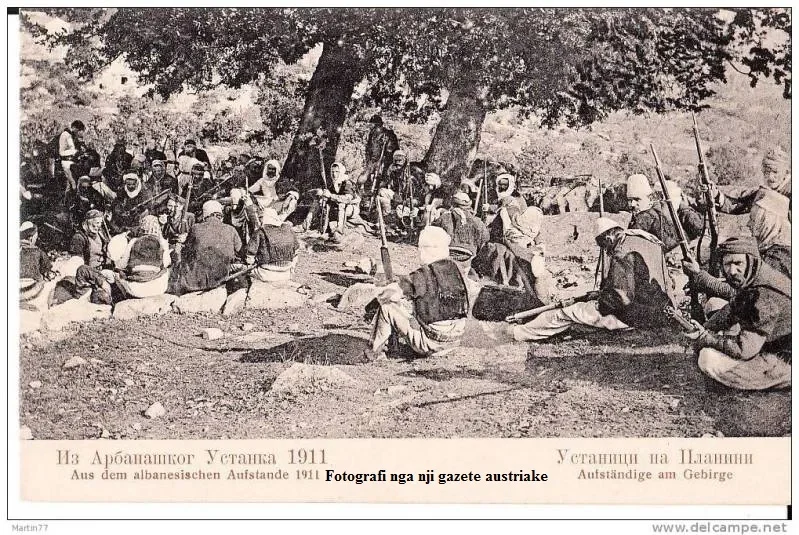
The main means to achieve these demands, besides national propaganda, was the creation of patriotic çetas (armed bands) and their armed struggle. According to the statute, the committee planned to create a broad organization open to true Albanian patriots, men and women. To extend its activity throughout the country, the Monastir Committee — called the Central Committee — sent representatives to various regions of Northern, Central, and Southern Albania. It established contacts with dozens of Albanian patriots from different regions, both Muslim and Christian, who supported its national program.
By early 1906, local committees or branches had been established in many centers of Albania, including Skopje, Peja, Gjakova (which also included Bajram Curri), Prishtina, Tetovo, Dibra, and other places. Idriz Gjakova (Soroviçi), sent by the Monastir Committee, provided special assistance in establishing branches in the Vilayet of Kosovo.
The committee also worked to create branches in the cities of the Vilayet of Janina. In the spring of 1906, such a committee was operating in Janina. According to Ottoman administrative documents, it had been founded on the initiative of patriots from the western regions of Albania and had made significant progress in that area.
In March–April 1906, the Monastir Committee established relations with patriotic societies abroad, especially those in Bucharest and Sofia, which supported its program and activity.
In addition to Albanian books and newspapers brought from the colonies in Sofia and Bucharest, in the spring of 1906 the Monastir Committee distributed circulars in the most important centers of Northern, Central, and Southern Albania explaining its aims to secure autonomy or even independence for Albania. “We,” stated one of these committee documents, “are a people of more than 2,500,000 souls, and we should not be deprived of this right.”
To secure the support of a Great Power such as Austria-Hungary, the leaders of the Committee “For the Freedom of Albania,” through its consulate in Monastir, requested material assistance and general political support from Vienna. In accordance with instructions given by Foreign Minister Goluchowski to Austrian consulates in Albania, in April 1906 the consulates adopted a reserved and cautious attitude toward the committee “due to its revolutionary goals.”
Meanwhile, Vienna supported the committee’s cultural program and promised financial aid to establish schools, pay teachers, publish Albanian books, support the girls’ school in Korça, and increase the number of students. At the same time, however, it asked the committee “not to go beyond the limits of peaceful means and not to use violent methods.”
Source

