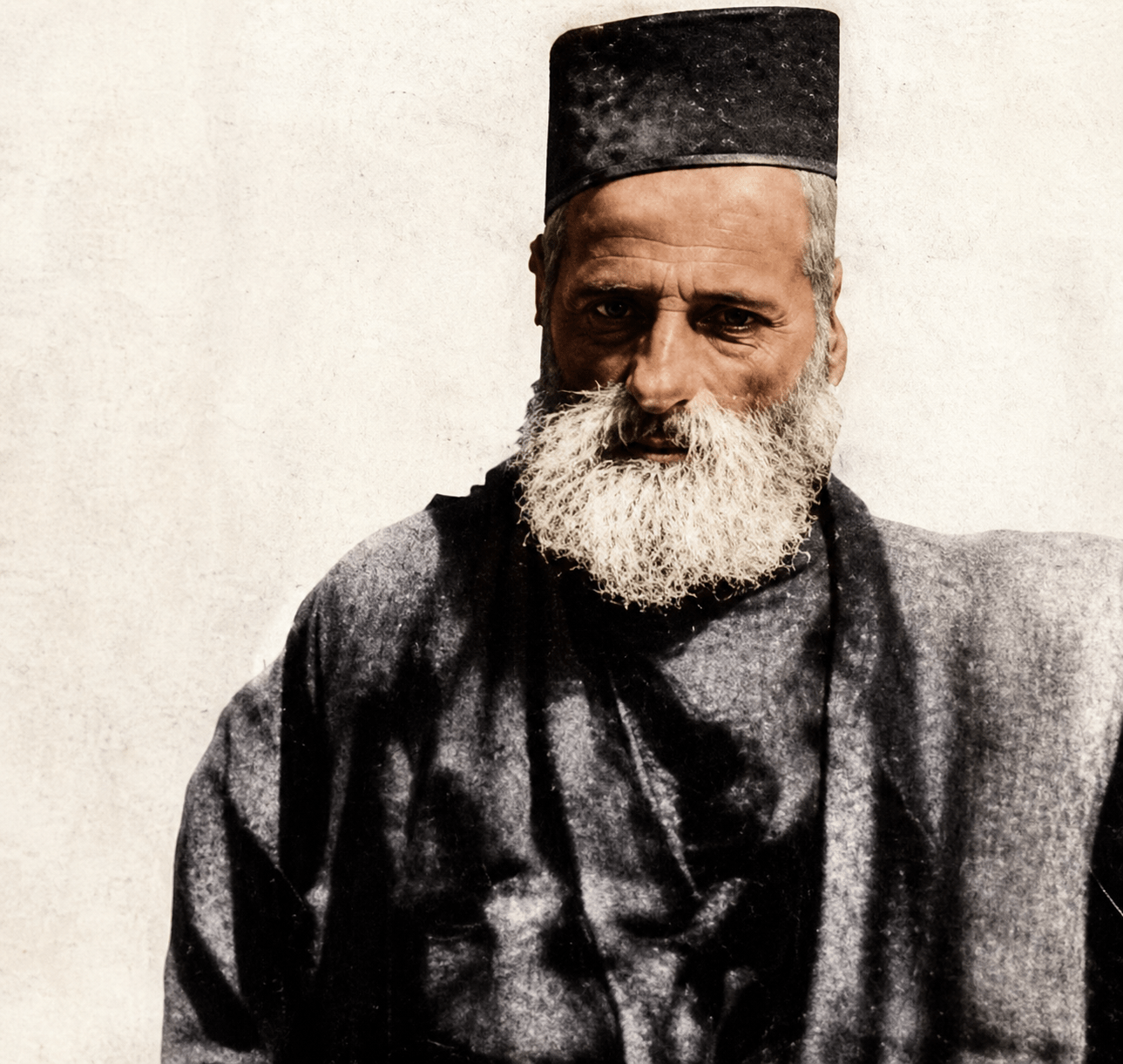

Abdurrahmani, also known as Hoxhë Kuta (1844–1947), was born and raised during the Albanian National Renaissance. He was educated in the madrasas of Albania and Istanbul. Even at an advanced age, he distinguished himself not only as a warrior but also as an organizer and leader of the fighters from Çidhna in the wars against the Serbo-Slavic occupiers during the years 1913–1920.
Contemporaries have recorded one of the bravest and wisest deeds of Hoxhë Kuta:
“In 1913, Serbian forces crossed to the western side of the Drin River, committing unheard-of atrocities in the villages of Çidhna, Sina, and the surrounding areas. One day, while the Hoxha was traveling from Çidhna to Upper Sina to perform a funeral ceremony, he suddenly encountered an armed squad of Serbian soldiers in the Bokas neighborhood of Çidhna. There, beside a water channel, he sat down in the ditch with his weapon in hand, facing the Serbian soldiers, and told his companions to do the same.
When one of his companions suggested it would be better to hide in the forest and escape through the Setë stream to the caves of Gjalica and Sheu i Thatë, where the women, children, and the population of Çidhna had taken refuge, Hoxha replied:
‘It is better for us to be killed here where we are than to flee and have those Serbs chase and kill us there, together with the women and children, all at once.’”
In the same year, after a fierce battle that took place in Lower Çidhna and Grykë-Nokë against the Serbian occupiers, Isuf Herçaku and Sali Krrashi distinguished themselves among the Albanian fighters. In that battle, Halil Xheçi fell as a martyr. His body was retrieved and taken to his home in the “Brethë” neighborhood. Because of Serbian reprisals, many villagers wanted to postpone the funeral. However, Hoxhë Kuta, with the calmness, determination, and civic responsibility that characterized him, addressed those present directly:
“Alive or dead, we will hold the funeral tonight. And if I am killed during the janazah prayer, I leave you with the testament that you should bury me in the same grave together with the martyr Halil Xheçi.”
The martyr Halil Xheçi was buried that night in the place called Fushë-Dheç.
Hoxhë Kuta’s deeds are numerous. An eyewitness from Lower Çidhna, Seit Tola, recounted:
“The Serbian soldiers had set up an observation post on Kodër-Leshe, on the western side of the Drin River, where their headquarters was also located. The villagers of Lower Çidhna, Grykë-Nokë, and both Sinas had not left their villages. The Serbs had announced that a road would be opened to Kodër-Leshe. For this purpose, they had gathered about 80 men of various ages, all with pickaxes and shovels, but none armed.
As soon as we arrived there, the Serbian soldiers surrounded us and, with bayonets in hand, prepared to massacre us.
Hoxhë Kuta was immediately informed. He came to Kodër-Leshe and met with Marku, the merchant from Çidhna, an Orthodox Christian from Belica near Struga. Since he rented his shop in the house of Ferë Krrashi, he was known as ‘Marku i Ferës’. Through him, the Hoxha arranged a meeting with the Serbian commander and requested our release. The commander refused to yield. Then Hoxha gave him this ultimatum:
‘Mr. Commander, look through your binoculars toward Sheu i Thatë! There stands Hoxhë Kuta with twelve thousand armed men. God forbid, but if you undertake any foolish action, know well that neither you nor your soldiers will survive.’
The Serbian commander immediately ordered our release, and we all returned safely to our homes.”
Hoxhë Kuta never removed the pistol from his belt. That is why the people also called him “Hoxhë Kuta me Kobure” (Hoxhë Kuta with the Pistol).
Once, the kadi of Peshkopi asked him:
“Ho Hoxhë, they tell me you carry a pistol even when performing religious ceremonies. Is that true?”
“Yes, kadi efendi, here it is,” replied the Hoxha, showing it.
“But why do you carry the pistol?”
“Kadi efendi, even Prophet Muhammad (peace be upon him) carried a sword with him.”
“But that was a different time, and now is a different time.”
“Kadi efendi, here where you are, in the town, the place is governed by Sharia and is called ‘topallti’ (civilized). Where I am, the place is called ‘malësi’ (highlands). Çidhna is one of the Nine Mountains of Dibra, which govern themselves by the Kanun. When I cannot convince people with Sharia, I also turn to the Kanun. But when their Kanun does not recognize the Sharia, then I turn to another law, which is this: my pistol. When I show them the pistol, then they follow both: the Sharia and the Kanun.”
He then added:
“I have carried this pistol in my belt for more than 70 years. Have you ever heard that I killed someone, or that I even fired it into the air among people, or even at weddings, as custom sometimes requires?”
The kadi replied:
“No, I know nothing of that.”
Then Hoxha concluded:
“As long as my legs, hands, and eyes work, as long as I am alive, I will keep the pistol in my belt. I grew up and became a man with a pistol; with a pistol in my belt I will die for the homeland. Because where I live and preach, both are needed: the Quran and Sharia, but also the pistol.”
In terms of religious education, Hoxhë Kuta was a well-prepared preacher and also a popular philosopher. Many of his sayings and advice became proverbial expressions in the gathering rooms (odas) of Çidhna and beyond.
During Zog’s regime, Hoxhë Kuta had passed his eighties but remained strong. In every religious ceremony he held the place of honor in the odas of Çidhna and among the local notables, such as Haxhi Noka, Dervish Lusha, Murat Kaloshi, Dine Hoxha, and others. He was brave, wise, a cleric of authority, and a figure of great moral and social weight.
When Mehmeti, the son of Murat Kaloshi, was killed in Tirana in the 1930s by Halil Alia, Hoxhë Kuta happened to be in Murat’s house. The Hoxha was sitting in one chief seat of the oda, while Murat was on the other side of the fireplace. The news of Mehmeti’s murder had arrived, but no one dared tell Murat. At one moment, Murat left the room. Then one of those present approached the Hoxha, told him the news, and asked him to break it to Murat.
After careful preparation with Quranic words about life and death, the following dialogue took place between Hoxhë Kuta and Murat Kaloshi:
“Murat, my friend, is it better to drive or to be driven?”
“Yes, Hoxhë.”
“And is it better to kill or to be killed?”
“Yes, Hoxhë, by my word, it is so.”
“Then, Murat, be a man and patient. May you live long and have your other sons, for they have killed your son, Mehmeti.”
Murat replied with deep pain:
“They have killed my best one, alas…”
And at that moment he was struck by epilepsy.
Hoxhë Kuta also knew well the allegory of the Dibra oda. On another day in Murat Kaloshi’s oda, in his presence, Miftari and some friends were sitting at a table with meze and raki. After a while, Miftari, heated by the raki, turned to the Hoxha:
“Hoxhë, why do men beat their wives? Does religion allow this?”
“Have you ever been to a mill, Miftar?”
“Yes.”
“Why does the miller beat the millstone?”
“He beats it when it doesn’t produce flour.”
“Well then, a man also beats his wife when she does not obey him, for her mistakes or faults.”
Then Miftari asked again:
“But why didn’t Llan Kaloshi beat his wife, but instead put her forward?”
The Hoxha replied:
“If our wives were as wise as Murrja, the wife of Llan Kaloshi, then the rest of us, starting with me, would put our wives forward and honor them as Llan Kaloshi did his. But our wives are not at the level of Murrja of Llan Kaloshi. Moreover, our Prophet never beat his own wives.”
Hoxhë Kuta also lived through the years of the Second World War, but without any visible activity, as he was very advanced in age. He had passed the century mark, had gone blind, and could no longer recognize people. Nevertheless, he continued to be respected as before and still performed religious services.
His son, Ademi, recounted:
“In the spring of 1946, we had run out of dairy products. I did not go to the market in Peshkopi myself, but gave sufficient money to a relative and instructed him to buy one kilogram of cheese curd for my father. When he returned from the market, he gave us the curd and we prepared dinner for father.
The next morning, as soon as he got up, father called me and said:
‘Take that curd you brought me last night, take it out of the house and give it to the one you bought it from. Let him eat it himself or take it wherever he wants, because it is not for me. I have never eaten anything haram.’
I went to the seller and asked for the truth. He told me:
‘I went to a merchant selling curd. I asked him to weigh one kilogram for me. While talking, I took the curd but cunningly did not pay him. Then I returned to the same merchant, paid him, and asked for another kilogram. I brought both together so that the Hoxha would get an extra kilo.’”
This event shows that people had begun to attribute to Hoxhë Kuta the aura of a saintly man.
Even his death came peacefully, gently, and with honor. On a day in March 1947, Hoxhë Kuta was escorted to the other world by an unprecedented crowd, with all the honors due to such a man.
Sources:
319 Ali Hoxha, nephew of Hoxhë Kuta, oral information.
320 Mevlud Buci, “Myftinia e Dibrës” and Ruzhdi Lata, Tirana, 2008.
From: Ergen Alia

