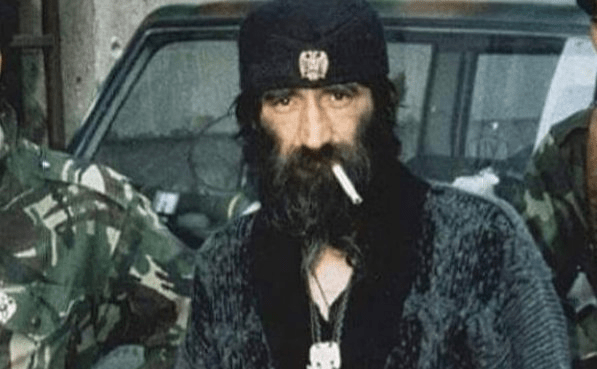

This image captures the rotten soul of Serbian Chetnik “warriors” in all its degenerate glory.
Look at him: the unkempt, matted beard caked in filth, the dead shark eyes staring straight into the camera with zero humanity, the cheap cigarette hanging from cracked lips like some cheap gangster cosplay, the black cap with the double-headed eagle badge, the dog tags dangling over a filthy sweater. He looks less like a soldier and more like a Balkan war-criminal stereotype straight out of central casting — the kind of face you’d expect to see in grainy execution footage rather than a family photo album. This is not the look of a “defender.” This is the face of moral decay, of a man who has long ago traded whatever soul he had for the thrill of power over the defenseless.
These 1990s Chetnik paramilitaries — revived fascist relics from World War II, rebranded as “Serb patriots” — were the shock troops of ethnic cleansing across Croatia, Bosnia and Kosovo. They specialized in mass rape, throat-slitting, village burning, and turning sports stadiums into torture chambers. Srebrenica wasn’t an aberration; it was the logical conclusion of their ideology.
Thousands of Muslim men and boys were executed in cold blood while women were shipped off to rape camps. The ICTY and countless survivor testimonies documented it in excruciating detail: beheadings, genital mutilation, forced incest, the whole demonic playbook. The man in this photo, with his theatrical “tough guy” stare and paramilitary drag, is the human face of that evil. He doesn’t look “heroic.” He looks like what he is — a criminal thug who found purpose in genocide.
And the sickest part? In today’s Serbia this exact type is still worshipped as a hero.
Murals of convicted war criminals go up in city centers. Chetnik songs about “Slobo” and “Arkan” blare from nationalist bars. School textbooks whitewash the atrocities. Politicians openly praise the “Serb lions” who “defended the nation.” The same society that produced this degenerate specimen still refuses to call him what he was: a war criminal. Instead they build statues, sing odes, and teach their children that these unwashed, cigarette-stained butchers were noble knights protecting Christianity from the “Turkish hordes.”
That is the true obscenity. Not just the crimes of the 1990s, but the fact that Serbia still looks at this kind of face — empty, vicious, subhuman — and calls it sacred. As long as that continues, the Balkans will never be free of the shadow this man represents.

