
Summary
The Albanian press emerged in the late 19th century as a key force in the national awakening. Early publications, often produced abroad due to Ottoman censorship, spread national ideas and defended Albanian rights. Newspapers like Fiamuri i Arbërit, Drita, and Albania promoted cultural development, language unity, and political awareness. While some supported gradual reform, more radical voices called for autonomy or full independence through armed struggle. The press also addressed social issues, opposed foreign influence and religious division, and criticized neighboring states’ ambitions. Overall, it played a crucial role in shaping national consciousness and preparing Albanians for unity and independence.
The first steps of the Albanian press were made with the publication of the monthly organ “Fiamuri i Arbërit”, which began to be published in Calabria in the years 1883–1887, in the speech of the Arbëresh of Calabria and in Italian, under the direction of Jeronim de Rada.
A great importance in the political-cultural life of the country had the publication in Istanbul, on the initiative of Sami and Naim Frashëri, of the monthly magazine “Drita” and later “Dituria” (1884–1885).
At the end of the 19th century and at the beginning of the 20th century new organs of the Albanian press are published, which played an important role in the spreading of national ideas and in the defense of the rights of the Albanian people. In the conditions of the absolutist regime of Sultan Abdyl Hamit, Albanian newspapers and magazines could not be published in Albania, therefore they were issued abroad in the Albanian colonies of emigration. Most of them were issued in the Albanian language, some were bilingual.
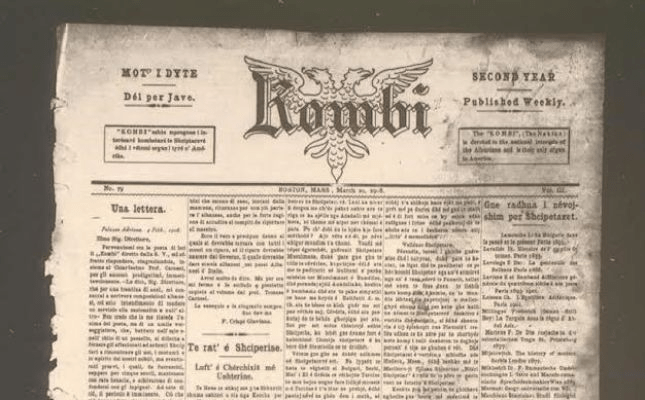
Among these the most important were: “Shqiptari” (Bucharest, 1888–1903), under the direction of Nikolla Naço; “Shqipëria” (Bucharest, 1897–1898), under the direction of Visar Dodani and Jorgji Meksi, as organ of the society “Dituria”; “Albania” (Brussels and later in London, 1897–1909), by Faik Konica; “Kalendari kombiar” (Sofia, 1897–1915), which was published as organ of the society “Dëshirë”, at first under the direction of Kristo Luarasi and Kosta J. Trebicka and later of Mithat Frashëri (Lumo Skëndo); “Drita” (Sofia, 1901–1908), under the direction of Shahin Kolonja; “Besa-Besën” (Cairo, 1900–1904), by Milo Duçi; “Albania” (Belgrade, 1902–1905), by Jashar Erebara; “Shpnesa e Shqypnisë” (Ragusa, Trieste and Rome, 1905–1908), under the direction of Nikollë Ivanaj; “Kombi” (Boston, 1906–1908), by Sotir Peci; “Shqipëria” (Cairo, Magaga, 1906–1908); “Pellazgu” (Cairo, 1907); “Shkopi” (Cairo, 1907–1908) etc.
Although they were not published in Albania, they by roads and by different means were spread also in the homeland, where they passed hand to hand and were read with great eagerness. A special popularity enjoyed the newspaper “Drita” of Sofia, which in 1904 had a circulation of 670 copies. This was owed in the first place to the patriotic content of the articles that were published in this newspaper. The newspaper “Shkopi” had an even larger circulation, 900–950 copies in the years 1907–1908.
Valuing the role of the press organs in the Albanian National Movement, some of the Great Powers and especially Austro-Hungary, which showed itself more active in this direction, making use also of the financial difficulties of their publishers, promised to the patriotic societies of emigration and to national personalities that directed the Albanian press organs financial subsidies, on condition that their activity should not extend into the political field, should not touch the status quo in the Ottoman Empire and the power of the Sultan in Albania. Most of the Albanian press organs and their publishers stood against this pressure of foreign states and especially of Vienna and, although they suffered great financial difficulties, continued their independent political activity.
Meanwhile, Faik Konica accepted the financial help of Vienna, with the conditions set by it and in agreement with them entered, in December of the year 1897, into a kind of agreement with the Ministry of Foreign Affairs of Austro-Hungary. Faik Konica did this, as he himself admits, driven by financial difficulties, but also because he thought that Albania could not develop without external help, that this would be a way to face the Italian danger which he considered more real and finally to make Vienna “unshakable in the support of Albania”. However, this stance of Faik Konica was criticized at that time by a good part of the activists of the national movement who thought differently from him.
After the first four issues of the magazine “Albania”, which Faik published independently, without any subsidy, in the later writings was felt the influence of this “agreement”, both in the support by this organ of Vienna’s policy, as well as in the softening of the stance toward Sultan Abdyl Hamit and the Ottoman Empire. However, Faik Konica with his magazine generally found himself even after this in the same track as the other revivalists, devoted himself to the struggle for the cultural progress of the Albanian people, for the raising of its national consciousness, having as aim to prepare it in the future to free itself from Ottoman bondage. The magazine “Albania” preserved its patriotic character, remained one of the main organs of the Albanian press of the National Awakening and with its literary, journalistic and encyclopedic publications gave a valuable contribution to the enrichment of Albanian culture as a whole and especially to the cultivation of the Albanian literary language, to the unification of its writing.
In the conditions when other publications were still limited, the organs of the press became the main tribunes of Albanian political and social thought. In them found reflection first of all the struggle of the Albanian people for the autonomy of the country, which was the fundamental demand of the national movement and, connected with this, the stance of different political forces on the means and ways for achieving it. The most advanced part of the patriots, especially intellectuals with radical ideas, defended through the press organs the program of territorial-administrative autonomy of Albania and expressed themselves for its fulfillment by means of armed uprising.
Tribunes of this current became especially the newspapers “Shqipëria”, “Drita”, “Albania” (Belgrade), “Kombi”, “Shpnesa e Shqypnisë” etc., where published their writings Shahin Kolonja, Dervish Hima, Jashar Erebara, Çerçis Topulli, Mihal Grameno, Fan Noli, Asdreni, Çajupi, Hilë Mosi, Nikollë Ivanaj, Visar Dodani, Sotir Peci etc. “Shqipëria” of Bucharest, in a series of articles published in the year 1897, putting the emphasis on the demand of the recognition of the Albanian nation and of the autonomy of the country, wrote that “we want (Turkey) to recognize us as a nation, to make us administrative autonomy, to govern ourselves…” (“Desire of the Albanians” and “Albania of the Albanians”, 1897).
But the more radical patriots, in the writings published in these newspapers, went even further, raised the necessity of the formation of an independent Albania or, as they expressed themselves, of its separation and complete division from the Ottoman Empire. They had already formed the conviction that the High Porte could not secure to the Albanians any national rights, that the Ottoman Empire itself was destined to be destroyed and that the policy of coexistence of Albanians with the Turks within its borders is wrong and with heavy consequences for the future of Albania; the only road of salvation, they emphasized, is the complete and immediate separation of Albania from this Empire, its independence (“Albania”, Belgrade, articles “The right path of the Albanian”, “The contempt of the Albanians”, 1902–1904; “Drita”, Sofia, articles “Turkey and the Albanians”, “How the Macedonian question will be done”, 1903–1904 etc.).
In the years 1902–1907, when the Albanian National Movement had taken an organized character, when the armed resistance against the Ottomans had broken out, almost, in every side of the country and had begun the war of the bands led by the committees “For the freedom of Albania”, many of the organs of the Albanian press supported this resistance and became propagators of the idea of armed struggle, seeing it as the main means for the liberation of Albania from the Ottoman yoke.
But in the Albanian press, especially in the magazine “Albania” (Brussels–London), in the newspaper “Shqiptari” (Bucharest), “Dashamiri” (Trieste) and in some other organ, appeared also other viewpoints, which expressed more the stance of the more moderate elements, who limited the Albanian National Movement only to cultural and economic demands, such as “the opening of Albanian schools, the spreading of national books and of railways”, which they thought to secure with the help of the Turkish government. These were, without doubt, important and necessary measures, which would influence the further raising of the national and political consciousness of the people, but they were not sufficient for its liberation from the Ottoman yoke. In these organs were published also articles in which was opposed the political struggle and especially the demand of autonomy and of separation of Albania from Ottoman rule, the necessity of armed struggle was not accepted. The authors of such articles, calling the Albanian people to try to gain their national rights through reforms, wrote: “Let us leave aside politics…, let us take our rights from the hands of the supreme king Hamit”, “without disturbances and wars…, only with gentleness and wisdom”; “we want the insurgent movement to cease, which seeks to tear into pieces our dear homeland, the Ottoman Kingdom” (“Some others”, in “Albania”, Brussels, 1897; “A word for the readers”, in “Shqiptari”, Bucharest, 1903).
Many of the other organs of the press called these opinions harmful for the liberation movement, because, as was emphasized in them, they raised among the Albanian people “false hopes” and illusions in the “beneficence” of Sultan Abdyl Hamit. In the writings published in these organs it was said that “we do not like the ideas of those who say that Turkey must be kept and exist for the good of Albania”, that “Turkey does not make any reform that gives rights to peoples…”.
In the political thought of the Albanian press found reflection also the Russian Revolution of the years 1905–1907. In the writings published, especially in such newspapers as “Drita” of Shahin Kolonja, “Shpnesa e Shqypnisë” of Nikollë Ivanaj etc., Albanian patriots saw the struggle of the Albanian people and of other oppressed peoples of the Ottoman Empire, as well as that of the Russian people, as a common liberation struggle directed against the same enemies, “two dirty kingdoms, that are called Russia and Turkey…, that have over their heads two bloody and vile men who were not satisfied from sucking human blood” (“Drita”, Sofia, 1905).
In the Albanian press have found their reflection, although to a smaller degree, also the economic-social questions, such as those of the struggle against economic oppression, of the role of different social forces in the national movement etc. In the articles and correspondences from Albania, published in the newspapers “Drita”, “Kombi”, “Shkopi” etc., in the years 1901–1907, is described with strong colors and in a shocking way the miserable economic and cultural condition of the people, especially of the peasantry which was sunk in ignorance. This condition was explained by Ottoman rule and the oppressive policy of the Sultan and in some article by the unjust division of lands, by the domination of large property of the landlords and of the Ottoman state.
Different opinions were expressed in the Albanian press regarding the role of the feudal-landowning elite or, as the press expressed it, the “oxhakësia”, in the national movement. While moderate patriots thought that the liberation movement should rely on this elite, which they called “the hope of the salvation and freedom of the homeland”, the more radical representatives of the National Awakening saw it as part of the ruling political elite of the Ottoman Empire. They called on the people to rise not only against the power of the Sultan, but also against the Albanian elite, which, as was said in their writings, had become “a tool of the Turkish government to squeeze the blood of the poor and to skin humanity” (“Drita”).
Different were the opinions of the Albanian political groupings, expressed in the press, about the role of the common people in the national movement. While moderate patriots considered the people a crowd “that has no security except in the elite”, the more radical elements considered the common people, “the small folk”, as they were called then, as “the true carriers of patriotism” and determined fighters for the liberation of the homeland from the Ottoman yoke.
But the problem treated more widely in the pages of all the organs of the Albanian press was that of the struggle for the freedom of the Albanian language and of the Albanian school, which all patriots, without exception, evaluated as a very important means for the raising of the national consciousness of the Albanian people, for its national consolidation and for the unification in the struggle against foreign occupiers. But the more far-sighted patriots treated the struggle for the Albanian school and writing as an inseparable part of the political movement for the recognition of the Albanian nation and for its autonomy.
Through the press, the revivalists opposed the efforts of foreign clerical centers to divide the Albanians according to religious beliefs, to sow discord between the Muslim population, on one side, and the Christian population, on the other side. This activity, which the press called anti-national, became more harmful for the nation, because it found supporters also among certain high clerics, conservative and fanatical Albanian, Muslim and Christian, connected with economic and spiritual interests with the Ottoman rulers, with the Sultan Caliph as well as with the Greek Patriarchate of Istanbul. In the articles published in the press organs during the years 1907–1908 by Fan Noli, Mihal Grameno, Hilë Mosi and other patriots it was emphasized that these categories of clerics served foreigners and had become “political tools” in their hands.
Being themselves believers and respecting the religious feelings of all Albanians, the revivalists distinguished from the clergy and the majority of clerics of the three religious beliefs these specific representatives of clerical circles, who acted in contradiction with the interests of Albania, calling them “enemies just as dangerous for the nation as the Turkish government”, and they came to the conclusion that Albanians could not secure either national unity or liberation without overcoming their divisive activity.
An important place in the organs of the press was occupied also by articles and calls directed against the chauvinistic policy of the neighboring Balkan states and against the dismissive attitude of the Great Powers toward the Albanian question. In the writings and calls published in the Albanian press in the years 1902–1908 by Asdreni, Fan Noli, Shahin Kolonja, Çerçis Topulli and by many other anonymous authors, was especially struck the chauvinistic policy of the political circles of Athens, Belgrade, Sofia and Montenegro, which in their aims to prepare the occupation of Albanian lands did not stop before anything, used all means, from attempts for the assimilation of Albanians through schools and the church up to the organization in Albanian lands of armed bands, which terrorized the population. They also condemned the policy of some of the Great Powers and especially of Russia, which supported the annexationist appetites of the neighboring states toward Albanian lands, as well as the interventions that they undertook in the years 1902–1907 for the implementation of reforms in European Turkey, which led to the partition of Albanian territories.
The progressive and democratic ideas of the press played a great role for the ideological and political preparation of the Albanian people in the struggle for the national unity and for the national liberation of the country.
List of newspaper referenced
Albania. Brussels and London, 1897–1909. Edited by Faik Konica. Albania. Belgrade, 1902–1905. Edited by Jashar Erebara. Besa-Besën. Cairo, 1900–1904. Edited by Milo Duçi. Dashamiri. Trieste, n.d. Dituria. Istanbul, 1884–1885. Drita. Istanbul, 1884–1885. Drita. Sofia, 1901–1908. Edited by Shahin Kolonja. Fiamuri i Arbërit. Calabria, 1883–1887. Edited by Jeronim de Rada. Kalendari Kombiar. Sofia, 1897–1915. Edited by Kristo Luarasi, Kosta J. Trebicka, and Mithat Frashëri. Kombi. Boston, 1906–1908. Edited by Sotir Peci. Pellazgu. Cairo, 1907. Shkopi. Cairo, 1907–1908. Shpnesa e Shqypnisë. Ragusa, Trieste, and Rome, 1905–1908. Edited by Nikollë Ivanaj. Shqipëria. Bucharest, 1897–1898. Edited by Visar Dodani and Jorgji Meksi. Shqipëria. Cairo and Magaga, 1906–1908. Shqiptari. Bucharest, 1888–1903. Edited by Nikolla Naço.

