by Niko Stylos
Summary
This study explores the etymology of “Shqiptar” through ancient coins. Olympia staters (352 BC) show an eagle with the inscription interpreted as “Djal e Ion” (“Son of Ion”), linking to Ionian and Pelasgian origins. Epirote coins (232–168 BC) depict the eagle with “ΑΠΕΙΡΩΤΑΝ” (Apeirotan), read in Albanian context as the land ruled by Apis. Roman amulets and coins identify Zeus of Dodona (Pelasgian Zeus) with Sarapis, supported by Herodotus, Homer, and Apollodorus. The eagle symbol and inscriptions suggest deep connections between Pelasgian, Ionian, Epirote, and Albanian identity, proposing “Shqiptar” derives from ancient roots tied to Ion, Apis, and the eagle.
On the designation “Albanian”
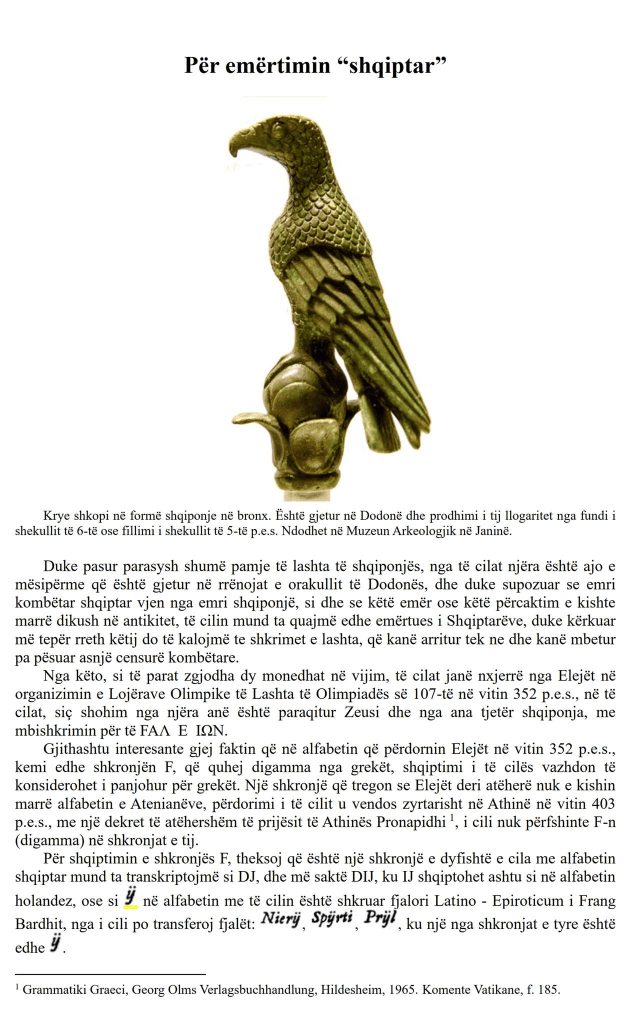
Main staff head in the shape of an eagle made of bronze. It was found in Dodona and its production is dated to the end of the 6th century or the beginning of the 5th century BCE. It is located in the Archaeological Museum in Ioannina.
Taking into account many early depictions of the eagle, one of which is the above piece found in the ruins of the oracle of Dodona, and assuming that the Albanian national name comes from the name of the eagle, and that this name or designation was adopted by someone in antiquity—whom we may call the namer of the Albanians—then, in order to learn more about this, we should turn to ancient writings that have reached us and have remained without undergoing any national censorship.
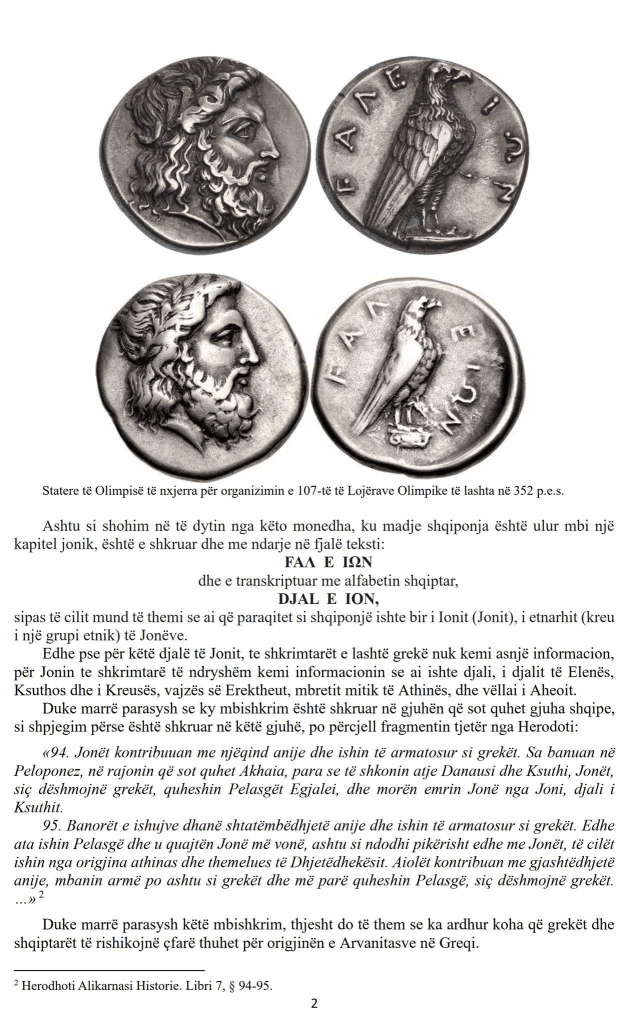
From these, as the first evidence, we select two coins shown below, which were minted by the Eleians during the organization of the Ancient Olympic Games of the 107th Olympiad in the year 352 BCE. On them, as we see, on one side Zeus is depicted and on the other side the eagle, with the inscription “FAΛE IΩN.”
It is also interesting to note the fact that in the alphabet used by the Eleians in the year 352 BCE, we also find the letter F, which was called digamma by the Greeks, the pronunciation of which continues to be considered unknown in Greek. This letter shows that the Eleians until that time had not adopted the Athenian alphabet, the use of which was officially established in Athens in 403 BCE by a decree of the then archon of Athens, Eucleides, which did not include the F (digamma) among its letters.
Regarding the pronunciation of the letter F, I emphasize that it is a double letter which in the Albanian alphabet can be transcribed as DJ, or more precisely DIJ, where IJ is pronounced as in the Dutch alphabet, or as “ÿ” in the alphabet in which the dictionary Latino–Epiroticum by Frang Bardhi is written, from which I am transferring the words: Nierÿ, Spÿritÿ, Prÿjl, where one of their letters is also “ÿ.”
¹ Grammatici Graeci, Georg Olms Verlag, Hildesheim, 1965. Vatican commentaries, p. 185.
Here is the English translation of the Albanian text in the image:
Staters from Olympia, issued for the organization of the 107th Olympic Games in 352 BC.
From the images of these coins, as can be seen, the eagle is depicted much larger than the Ionic capital, and it is also engraved with the following text:
FAA E ION
and transcribed into the Albanian alphabet,
DJAL E ION,
which literally means “son of Ion (Jonit)”, and is also known (believed) to belong to a certain ethnic group of the Ionians.
Even though for this “son of Ion”, researchers and Greek historians have very little information, for the Ionians the researchers provide more information, as they are the tribe of the Eleans, the Kuthos (or Kuthians), the descendants of Erechtheus, the inhabitants of Athens, and also the Achaeans.
Many scholars believe that this inscription is engraved on coins that are very old, and that they belong to a very ancient period, but according to a fragment preserved from Herodotus:
“94. The Ionians contributed with some other peoples to the arming of the Greeks. In the Peloponnese, in the region that is now called Achaia, before the time of Danaus and Xuthus, the Ionians, who were called Pelasgian Aegialeis, and were named after Ion, son of Xuthus.
95. The Banorians and the Ishuvites were another people who contributed to the arming of the Greeks. They were of Pelasgian origin and lived in the same place as the Ionians before, and it is believed that they originated from Athens and the Themelians of Djetëdhekesit. They contributed with a large number of armed men, but they were not of the same race as the Pelasgians, and thus they were not Greek.”
Many scholars consider this inscription, therefore, as very important evidence for the Greek and especially for the Albanian researchers, regarding the origins and the Arvanitas (Arvanite) presence in Greece.
Footnote:
² Herodotus of Halicarnassus, Histories, Book 7, §§ 94-95.
Without going further into details about Ion or Ion in other known forms, and seeking information about his children, I will simply say that the only thing we find in ancient Greek writers is that they were four, called Geleon, Aigikoris, Argadis, and Oplis. From them, according to what Herodotus writes, the four ancient tribes of Athens took their names: the Geleontes, Aigikoreis, Argadeis, and Oplites. Ion, the son of Xuthus, became a general of the Athenians, and the people who were initially Pelasgians, called “Kranaoi” and later “Kekropidae,” took the name Ionians.
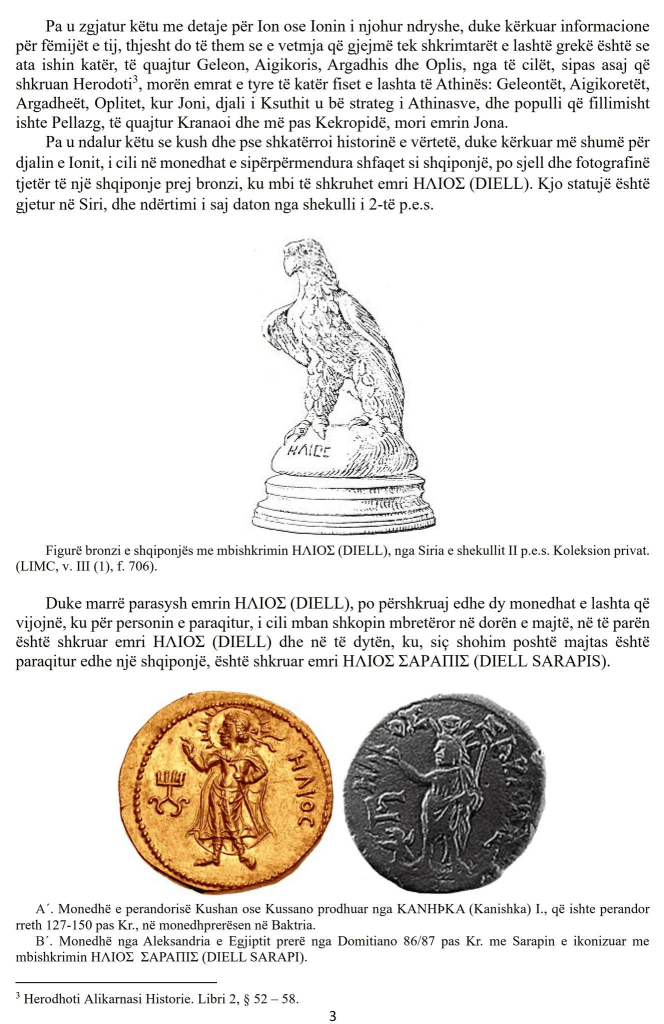
I paused here to see who and why is distorting the true history, and by searching more about the son of Ion—who on the above-mentioned coins appears as an eagle—I present here another photograph of a bronze eagle, on which is written the name HΛΙΟΣ (DIELL). This statue was found in Syria, and its construction dates to the 2nd century BCE.
Bronze figure of an eagle with the inscription HΛΙΟΣ (DIELL), from Syria, 2nd century BCE. Private collection. (LIMC, vol. III (1), p. 706).
Taking into account the name HΛΙΟΣ (DIELL), I also describe the two ancient coins that follow, where for the depicted person—who holds the royal staff in his left hand—on the first coin is written the name HΛΙΟΣ (DIELL), and on the second, where as we see below the left side an eagle is also depicted, is written the name HΛΙΟΣ ΣΑΡΑΠΙΣ (DIELL SARAPIS).
A’. Coin of the Kushan Empire or Kussano, produced by KANHΡKA (Kanishka I), who was emperor around 127–150 CE, in the mint of Bactria.
B’. Coin from Alexandria in Egypt, minted under Domitian in 86/87 CE, with Serapis depicted and the inscription HΛΙΟΣ ΣΑΡΑΠΙΣ (DIELL SARAPIS).
³ Herodotus of Halicarnassus, Histories, Book 2, §§ 52–58.
It is supposed that one of the names or one of the names of the son of Ionit, which appears on the coins as an eagle, was Sarapis, but another fragment from Apollodorus also brings this:
“Okeanos and Tethys gave birth to a son, Inakhos, and from him a line in Argos was named Inakhos. Inakhos had with Melia, daughter of Okeanos, Foroneu and Egealeu. Egealeu died without offspring, and thus the whole place was called Aigealeja. Foroneu, the king of the whole land that is now called Peloponnesus, had with the nymph Teledhike, Apis and Niobe. Apis abused his power and became a tyrant and harsh and named the land Apia. Eventually, he was killed in a conspiracy organized against him by Telksioni and Telhinos and the place remained without a ruler. After his death, his name was honored with the name Sarapis.”⁴
The fragment according to which it is hypothetically possible to think, is taken as evidence that Sarapis is the second name of Apis, since Apis and Niobe were children of Ionit. For this assumption, some evidence is found in the inscription and the mention mentioned earlier by Herodotus:
“Between the Banonians in the Peloponnese, in the region that is now called Akhaia,… thus the Greeks say, the Pelasgians Egialiti lived and took the name Ionë from Ioni, son of Ksuthos”
It is understood from the inscription and the mention mentioned earlier by Apollodorus, that Egialia from Apis was called Apia.
It is supposed that the Peloponnese was only a part of the land of Apias and Egialias, which was previously called, but according to both coins issued in Epirus, as can be seen, we have the repeated illustration of the eagle, and moreover with the national name ΑΠΕΙΡΩΤΑΝ (APEIROTAN) engraved around it. The name that, as it appears and is read in the letters ΑΠΕΙ ΡΩΤ ΑΝ (APEI ROT AN), in the Albanian language, or in the Epirote language as Franc Bardhi, with the letters of the other would say: the land where Apis ruled (the Iapetons?).
Footnote:
⁴ Apollodorus Bibliotheke, Book 1, Chapter 1.
Caption under the coins:
Silver drachma of the Epirote Commonwealth (232 – 168 BC).
What is more interesting in these coins is that, on the other side, Zeus of Dodona is also depicted, known overall as the Pelasgian Zeus. It is understood from those written by Herodotus⁵ that the oracle of Dodona was not only the first, but also the only one in the time of the great issuance, which also brings two very interesting amulets that depict Sarapis, where on the front is written: META TO ONOMA TOY ΣΑΡΑΠΙΣ (The great is the name of Sarapis), and on the back, from the other side: EIC ΖΕΥC CEΡΑΠΙC (one is Zeus Sarapis). A text which, interpreting EIS as one or the first, we can identify Zeus Sarapis with Zeus of Dodona.
Amulettes issued in the Roman period with the figure of Sarapis on carnelian.
Considering this identification as accurate, and having evidence from the inscription of Homer and the prayer of Achilles to Zeus for the protection of Patroclus:
«Ζεῦ ἄνα, Δωδωναῖε, Πελασγικέ, τηλόθι ναίων, Δωδώνης μεδέων δυσχειμέρου …»⁶
And in translation:
«O Zeus the king, Dodonas Pelasg, who lives far away and rules over Dodona of the cold winters; …»
we can explain the overall precedence and the name ΑΠΕΙΡΩΤΑΝ (APEIROTAN) and with the reading ΑΠΕΙ ΡΩΤ ΑΝ (APEI ROT AN).
It is taken as evidence that in one of the two coins or in two of the coins of the very widespread Epirote Commonwealth (around 232–167 BC), for Zeus of Dodona is also written the name or characterization ΑΡΗΝ, which in the local dialect was also used then as a form of albanianized ΑΓΙΟΣ (Shën), identifying Zeus of Dodona with Sarapis, as well as the two later Roman coins, where, as can be seen, for SARAPIDIN, which is depicted on them, is also written the characterization DEO SANCTO, which in translation would mean: The Holy God.
Roman coin of Sarapis with the inscription DEOS SANCTOS SARAPIDI, from the years 360 – 363 AD.
Footnotes:
⁵ Herodotus of Halicarnassus, Histories. As mentioned above.
⁶ Homer’s Iliad, Rhapsody P (16), verses 233-234.
It should also be taken into consideration that on the first coin among the coins mentioned of the Epirote League, the eagle is found within a wreath of oak leaves, also known by the name figos, as the sacred tree (wood) of Dodona. I considered it worthy to mention that the fruit of this tree, which we have also presented on the other coin, is found hanging in place of the cross at the lower part of the cantilevers in the old churches of Epirus and on the Ionian Islands.
Silver drachma of the Epirote League (232–168 BCE)
Nikos Stylos