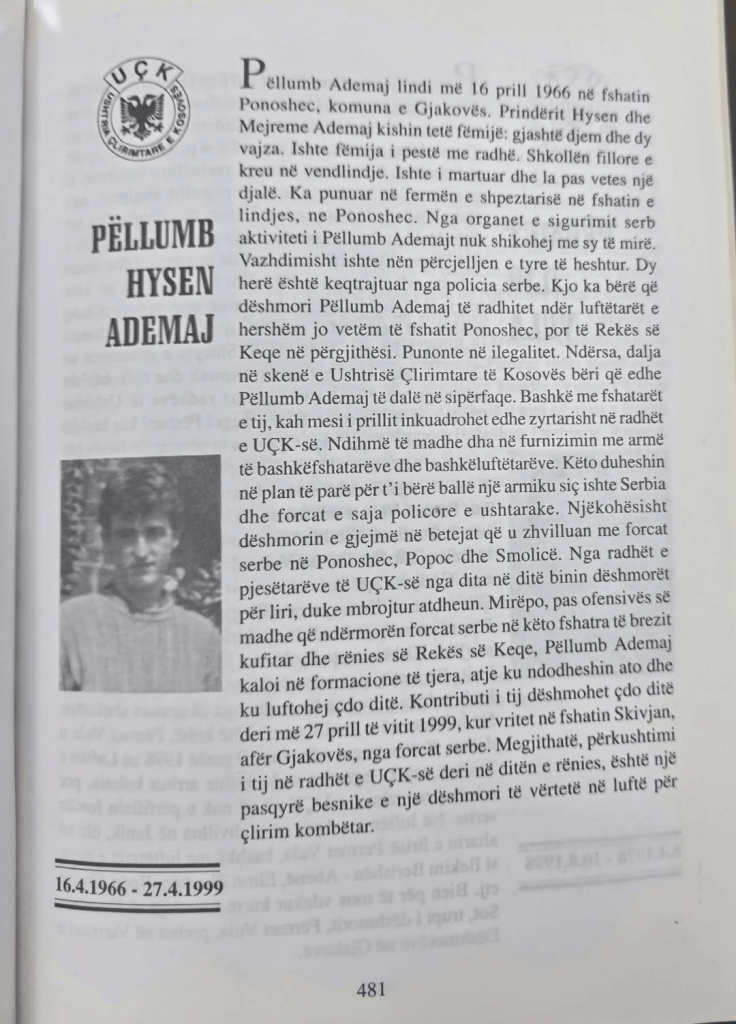
Dukagjin R Vula
09.06.1978 – 25.04.1999
Dukagjin Vula was born on June 9, 1978 in Gjakova, He comes from a family that always had problems with the Serbian police. Father Ruzhdiu and mother Drita, were the first children in this family. He completed primary school with four children: two boys and two girls. Dukagjin was his birthplace. He did not continue high school, since his father died very young, so he was forced to work to exist, even though he did not have more than the Agricultural Combine “Ereniku”, respectively at the age of fifteen.
He worked as a manual worker in the Juice Factory. When the war in Kosovo began, he was deported with his family to Albania. Upon arriving in Krumë in Kukës, he met Haki Drenica and without guessing, he mobilized in the ranks of the Kosovo Liberation Army to contribute to the war against the Serbian occupier who was depopulating Kosovo. It was March 31, 1999 when he joined the ranks of the KLA, as a soldier in the 138th Brigade “Agim Ramadani”.
He crossed the Albanian-Albanian border and found himself in the legendary Koshare. His commander was Aqif Blyta, while his comrades-in-arms were Mustafa Kastrati, Bujar Gllogjani and many others. Here he spent many days fighting against Serbian forces, who attacked Koshare and its fighters every day. During the war, he was wounded. They sent him to Bajram Curr for treatment, and later to Tirana, but from the wounds he received, Dukagjin Vula died – on April 25, 1999.
Here, in Tirana, he was buried. As Dukagjin’s war comrades recount, he was a great, courageous brave man. An hour before the martyr Agim Ramadani was killed, Dukagjin Vula had sent ammunition to the front line. In the battle where the martyr Dukagjin Vula was wounded, according to witnesses on the battlefield, 17 Serbian soldiers and police were killed. The martyr’s reburial took place after the war in his hometown, in Gjakova, on which occasion the war commanders, Ramush Haradinaj, Daut Haradinaj and Avdullah Babalia, also honored him.
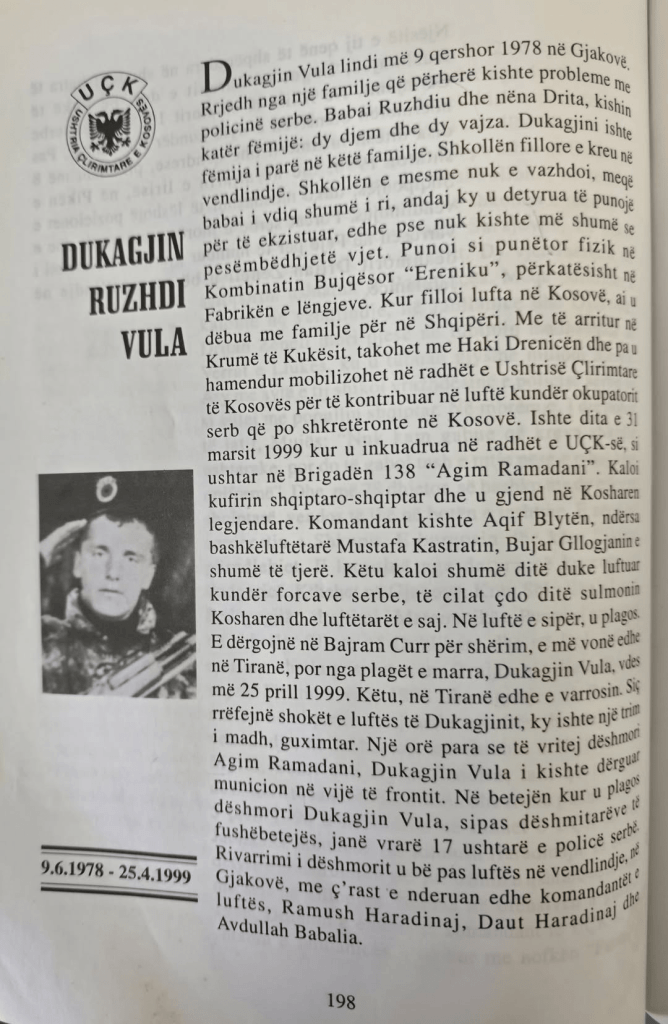
Isuf B Dinaj (14.05.1975 – 27.04.1999)
Isuf Dinaj was born on May 14, 1975 in the village of Skivjan, municipality of Gjakova. They were always at the forefront of the popular resistance that Albanians made against the Serbian regime. The young people of this family participated in the 1981 demonstrations in Gjakova. In 1993, the martyr’s house was raided, allegedly for weapons.
In these circumstances, martyr Isuf Dinaj was raised. His parents, Brahim and Ajne Dinaj, had eight children: six boys and two girls. Isuf Dinaj was the youngest among his brothers and sisters. He completed primary school in his hometown, while secondary school in Gjakova. In civilian life, he was involved in housework.
Since there was no proper organization of the KLA in the village of Skivjan and there was a comrade Milazim Shala, now a martyr, respectively after the withdrawal of the population of the village of Baballoq to other villages, on April 23, Milazim Shala from Baballoq was seriously wounded. Isuf Dinaj went and took him. He placed him in his own house, which his brothers took care of for recovery.
Thus, the martyr’s house became a nursery where the wounded were recuperated. Meanwhile, Isufi went and joined the ranks of the Kosovo Liberation Army, on April 24, 1998, at the local KLA Headquarters in Baballoq, with commander Faik Dodajn. Meanwhile, Milazim Shala recovered, so together with Isuf Dinaj, around mid-May they went to Albania for armament, from where they brought various weapons. Martyr Isuf Dinaj performed various tasks at the Baballoqi Headquarters, such as acting as a guard, fighting on the front lines, etc.
In June, he also went to Albania for armament. He performed these tasks until August 10, 1998, when, as assigned by the Drini Plain Headquarters, he went to Albania to meet with I. Mazreku. This work was quite dangerous. He continued performing various tasks until April 23, 1999, when fighting broke out on the Kosovo-Albania border, namely in Koshare, while Isuf Dinaj was engaged in meeting with his superior Agim Thaçi, who was fighting in the Drini Plain, a task entrusted to him by his comrades in arms and which Isuf Dinaj accepted with pleasure.
But – this engagement was discovered by the enemy forces and his men, who were not few. Thus, on April 27, 1999, the martyr was ambushed and killed by the bloody hand of the Serbs, right in his native village, in Skivjan, together with the martyr Pëllumb Ademi from Ponoshec.

Muhamet L Bardheci
01.01.1980 – 27.04.1999
Muhamet Bardheci was born on January 1, 1980 in the village of Baballoq, Deçan municipality. Parents Lan and Zyhra Bardheci had nine children: six boys and three girls. Muhamet was the third in line, respectively the eldest son in this family. During the communist rule, this family was often mistreated by the government under the pretext of seeking weapons, something that only happened to Albanians.
Muhamet Bardheci completed primary school in Gramaqel, the first year of high school in Irznic, while the second year was interrupted by the Serbian military offensive, in which case Muhamet was listed in its ranks from the first days, precisely on April 18, 1998 when he wore the uniform of the Kosovo Liberation Army, which he did not take off until he donated the most sacred thing to the homeland, his young life.
At first, Muhamet Bardheci was in Baballoq, and later in Gllogjan, in military training, which he successfully completed and returned to his hometown, in Baballoq, to his superior Faik Doda. The young man participated in many battles in the Dukagjin Plain, especially in his native village, in Baballoq, and later in Reka i Keqe, in the municipality of Gjakova, with the 134th Brigade “B.Shala”, as well as in the villages of Ramoc, Madanaj and in Jahoc, a village where in a fierce battle, neck for neck, he was martyred by the bloody forces of the Belgrade rule, by the Serbs.
This is the date April 27, 1999, when the Serbian military and paramilitaries burned his corpse. A part of the body, which was found burned, was buried by a villager from Jahoc six days later, when Serbian forces removed him from the area. His body today rests in the Martyrs’ Cemetery in Baballoq.

Pëllumb H Ademaj
16.04.1966 – 27.04.1999
Pëllumb Ademaj was born on April 16, 1966 in the village of Ponoshec, municipality of Gjakova. Parents Hysen and Mejreme Ademaj had eight children: six boys and two girls. He was the fifth child in a row. He completed primary school in his hometown. He was married and left behind a son.
He worked on a poultry farm in his native village, Ponoshec. The Serbian security forces did not look favorably on Pëllumb Ademaj’s activity. He was constantly under their silent surveillance. He was mistreated by the Serbian police twice. This has led the martyr Pëllumb Ademaj to be ranked among the early fighters not only of the village of Ponoshec, but of Reka e Keqe in general.
He worked illegally. Meanwhile, the emergence of the Kosovo Liberation Army on the scene also brought Pëllumb Ademaj to the surface. Together with his villagers, in mid-April he officially joined the ranks of the KLA. He provided great assistance in supplying weapons to his fellow villagers and fellow fighters.
These were needed in the first place to face an enemy such as Serbia and its police and military forces. At the same time, we find the martyr in the battles that took place with the Serbian forces in Ponoshec, Popoc and Smolicë. From the ranks of the KLA members, martyrs for freedom fell day after day, defending the homeland.
However, after the major offensive that the Serbian forces undertook in these border villages and the fall of Reka e Keqe, Pëllumb Ademaj moved to other formations, where they were located and where fighting was taking place every day.
His contribution is evidenced every day until April 27, 1999, when he was killed in the village of Skivjan near Gjakova, by Serbian forces. However, his dedication in the ranks of the KLA until the day of his fall is a faithful reflection of a true martyr in the war for national liberation.