

Extract from Osman R. Shala’s book “MË THIRR SIÇ E KAM EMRIN (Etimologji)” from 2026.
English tanslation: Petrit Latifi
English Title:
CALL ME BY MY NAME (Etymology)
Original title of the work:
MË THIRR SIÇ E KAM EMRIN (Etimologji)
Reviewer:
Aleksandër Hasanas (Mili Butka) – Korça Besim Perjuci – Peja
Language editor:
author
Editor technology:
Xhavit Thaci
Ballina:
Berat Thaci
Cover photo: Doni Prebibaj
Press:
FAB ADVERTISING – Peja
Publisher: Libri in
All copyrights are reserved.
Osman R. Shala
CALL ME BY MY NAME (Etymology)
Peja – 2026
Aleksander Hasanas (etymologist): – My esteemed friend, Osman Shala, your works convey light, reality, sincerity, and kindness, and for me it was and remains a pleasure when I read such works.
Article writer: Aleksandër Hasanas, Korça, 20/2/2022.
BOOK REVIEW: “Call Me by My Name.”
The Albanian language is now being evaluated every day by foreign and local linguists and scientists as not only an Indo-European language, but as a “MOTHER” language of the Pelasgian Mediterranean languages, as a centric language; central, including both the properties of the ancient languages, Centum and Satem…
An ancient language is not simply a means of communication, but a living archive of the human spirit and the history of a people: it is the “key” that opens the door to cultural heritage; through it are transmitted the myths, legends and songs that shape the consciousness of a nation.
Ancient languages, like our Albanian (one of the most unique branches of the Indo-European family – its mother), serve as linguistic fossils that help researchers understand the movements of peoples and early human discoveries.
It functions as an invisible thread that connects the past to the future, ensuring that the wisdom of the past is not lost to oblivion. The loss of a language means the disappearance of a unique way of seeing the world.
Linguistic studies (especially German ones of the 19th century) see Albanian as a key to understanding the deeper structures of European history. Despite some borrowings from Latin, ancient Greek and Turkish, Albanian has preserved its originality in phonetic and grammatical structure, surviving centuries of assimilation.
Author, writer and researcher, Mr.Osman Shala,who is presenting us with this etymological study on many different settlements and toponyms from Malësia e Madhe, treats the construction of words very correctly, based on dialectal speech, following his expression: “The truth of the word is within it.”
It is the very antiquity of the Albanian language that has these properties and the ability to protect and motivate its words from even the most diverse and “corrupt” ones – by supporting them like a rock on linguistic-scientific laws and principles.
The esteemed Auror, Osman Shala, focuses mainly on the names of his area around Rugova, and even further afield, such as: Bjeshkët e Namura, Rugova, Neqinati, Drelaj, Pepiç, Reka e Allagës, Rrzhanica, Vraqeva, Bistrica, Vardar, … And he is absolutely right that our Bjeshkët, the Albanian Alps, the Bjeshkët e Namës (Namuna) originate from completely pure Albanian words – explanations that you will find in this study, by the author himself, interesting and qualitative explanations, so it is not up to me to repeat them …
Except that I must remember that for us Albanians, language was and remains the fundamental element that has held us together as a nation, even when in some periods we did not have our own solid state, so the power of the divine Albanian language has served as the “spirits of the ancestors” that speak through us … (March 3, 2026).
Aleksander Hasanas, Korça
Review
“Book-scientific study””Call me by my name,”author Osman Shala
“Toponymy, macrotoponymy and microtoponymy of the Rugova Region and its surroundings /Pasbjeshka/, their treatment, explanation, clarification and multidimensional structure in the field of scientific and etymological research”
“We all need the truth”
Uran Butka
The historical linguistic facts, archaeological traces, toponyms, macrotoponymy and microtoponymy, their treatment and analysis, explanation and clarification, sources and meanings in terms of scientific research and etymological and other lexical aspects, have enabled the author Osman Shala, thanks to the knowledge and expertise he possesses as a linguist, with a fair and honest point of view, always without prejudice, as well as with his intellectual and creative courage, to preserve and update these issues so important for the Branch of National Onomastics, which clearly testify to Albanian authenticity and autochthonism, neatly summarized and composed with comprehensibility and fluent Albanian language in this book – study entitled “Call me by my name”and that naturally pleases us with our everyday speech.
The centuries-old changes, the configuration of settlements in the Rugova Region and its complex features with all the historical social, morphological, geographical and ethnogeographical, etymological, linguistic and ethnotoponymic formations, have always aroused the curiosity of students, research scientists, geologists and anthropologists, etymologists, linguists and writers, but also other interested individuals who practice different professions, perhaps without enjoying the professional calling of etymologist, as is the case with our professor of the Albanian language, the author of this scientific study book, Mr. Osman Shala, and as such should be studied and presented in detail and comprehensively, in the sense of completing more profound knowledge in terms of advancing this field and discovering the immovable original source truth, as evidence of the evaluative judgment of the names of some villages separately in the Rugova Region.
Rugova and its surroundings /Pasbjeshka/ with necessary explanatory explanations. However, we add for the reader’s information that, Rugova, battered by many historical events, now gathered in its entire geographical and ethno-geographic region, with all its natural and human resources, includes thirteen/13/ villages /settlements/ with geographical width and length and are administered by the Municipality of Peja as,Drelaj, Shkreli, Sh. i Madh, Sh. i Vogël, Dugaiva, Malaj, Koshutani, Pepiqi, Reka e Allagës, Kuqishta, Haxhaj, Stankaj and Bogë.
Naturally, they lie in the northwestern part of the Dukagjini Plain and are characterized by mountains and hills rich in flora (phytonimi) and fauna (zoonimi), with numerous streams, springs and water bodies (hydronim), then with rich valleys and pastures, deep gorges and ravines (the picturesque Rugova Gorge, known far beyond our lands), where the sides of both banks are wetted by the Bistrica River, which with its clear, icy waters has deepened the bed over the centuries and thousands of years that it is not remembered when this natural phenomenon occurred.
The antiquity of these villages is evident and cannot be denied, inhabited by a population with distinctive qualities /highlanders and men of faith, honor and generosity/, with characteristic features that distinguish them from others according to historical tradition, clothing, dialectal speech, bravery and insubordination in the face of great storms invading our indigenous lands.
Thus, in the spirit of my persuasive impressions, I was reading not only the manuscript study, but also the vivid thoughts of the author Shala, always to benefit and extract the creature/reality/ and the ultimate etymological truth of regional toponymy, as the only way accepted by my faith and increased curiosity to see the sayings or half-sayings known until now.
In this scientific research journey, the author tries to avoid superficiality and incompleteness in order to be said and written accurately and clearly, as a debatable issue with or without excess, temporarily prejudiced, until we are satisfied if all of this is in cohesion with the truth, as proof of his scientific and mental power.
Given the fact, role and importance, that etymology is a science, a branch of linguistics that deals with the origin of words, their history and terminological and scientific formation with many influences from foreigners, who first stepped on it throughout history, it has undoubtedly stimulated the attention and encouraged the curiosity of the author Shala, to devote himself to this little-trodden field, to find the original truth and the historical and linguistic meaning, focusing occasionally on the branch of comparative historical linguistics, as an aid to the implementation of accurate terms in the Rugova Region.
Therefore, the author considers that the book-study “”Call me by my name,”Although not voluminous, written in a few pages, it has scientific attributes by shedding light from several perspectives, both from the etymological and structural semantic aspects.
The book articulates a certain number of toponymic terms with the aim of purifying the language from foreign influences, which erases Slavic, Turkish, Greek, Italian or Roman ones, and raising awareness among our public and the media about the linguistic diversity that these regions possess.
The author says, as it is expressed: -“I am convinced that some researchers have lazily undertaken the research-duty to explore the matter of the etymology of place names down to its most extreme /most detailed/ tissues, because any stagnation or work left half-done diminishes and shrinks the desired fruit!
If the author’s claims are based on solid foundations, verified by scientific, archival data and other study documents of importance for the etymological subject, which is not in doubt, then it can be said that the subject sufficiency of the toponymy of this region, naturally dictates the necessity and necessity of a scientific obligation for all those who think differently until they understand more.
Although there are numerous reactions and replies that require direct explanation, scientific, historical, research, analytical work, impartiality, facts and a dignified and reasonable attitude, to clarify every opinion, even if distorted, and to place every controversial place name in a meaningful and important relationship. The author does not hesitate to refute untruths and, with the means he possesses, to defend the truth with dignity from the prejudices of such people.
For example, the toponym “Lost Mountains”, today it was used incorrectly “MountainsThe Unfortunate”. /Prof. Ibrahim Çavolli, in his book”I am a Kosovar…” he also writes: “…in the lap of the Defeated Mountains…”So, what is the reason for these mountains being called “poor people”, – asks the author? However, the lack of coherence between those who know the toponymy of the Rugova Region and those with insufficient knowledge /pseudoetymologists/, will have consequences in the science of professional etymology.
This is what certainly brought the disappointment, which is increasingly deepening in the author’s mind. These toponyms and many others are explained in literary and artistic works such as,“Genealogy of Drelaj and the Drel people-Rugovë e Moçme”, “O today or never!”, “Mountain aroma” etc.
The author’s time commitment does not invalidate the edge of sound criticism, as a judgment of value, although there may be subjectivity. However, this nevertheless makes it more open to anyone who takes sides to judge from different perspectives. Otherwise, “”The truth must prevail over all truths!”, the author states. However, the author considers that he has begun his scientific study with great desire and reasonable judgment in the selection of the subject, seeking time itself, inclined as a whole to enter into details corresponding with evidence from local experts /ELDERS/, and after having recorded in his memory all the conversations and in the meantime having easily and accurately memorized what he heard in the field, he will transform them into sources of oral and written references, which argue for the antiquity and existence of those place names.
Out of a total of ten /10/ the names treated in this study book, as a good connoisseur of this area, the author Shala tries to give distinctive, more detailed explanations compared to anyone else, with the claim of rounding the accuracy of thought.
The explanatory explanation of the meaning of each source word, he considers an obligatory duty that builds stable ideas to realize the vision previously determined. Therefore, it happens that he thinks of showing a smaller space in the field of toponymic terminology, as a process that requires constructive analysis of the word and scientific research, to be quite clear and explainable for the names/words/ that come from Albanian stones, in contrast to those that capture some explanatory forms without fully explaining the etymological embryomorpheme of the word.
The author stubbornly insists on his position that place names/toponyms/ must preserve their historical antiquity in the Albanian language, avoiding baseless influences, especially Slavic ones, such as, for example,Bistrica-a/Albanian/ -Bistrica/pronounced sll…/,Pepic/according to the dialect of Rugova with”ç”/ – Pepiqe/sll…/, Stankaj – /nga Staka/sh./ – Jacket/sll…/, Llutovo-a/sh/ – is a pure Albanian name changed without reason with the name, Ujëmir, with the claim that, Llutovë is a Slavic name…/etc.
The first pages of the book-study, speak of the importance of the Albanian language, its unification in today’s standard, the use of its right as a key element of our identification as a people and as a nation, in the face of the written world, always taking into account the genealogical trunk /place/tree/ of Indo-European languages, as the first language in this world. /Adrian Doka, prof. at the Department of Cosenza of Calabria, writes:”To know the Albanian language, one must first have a taste and love for one’s mother tongue”.
Then, its historical-dialectical development, spelling and orthography in speech and writing, not only in the science of onomastics and linguistics, but also in the media and literary and artistic creativity, to continue with ten topographical descriptions of settlements in the Rugova Region such as,Bještët e Namuna, Rugova, Neqinati, Drelaj, Pepiqi, Reka e Allagës, Bistrica e Rugova, Vardar, Zhanica/Rrzha nica/ and Vraqeva.
The author will identify most of these toponymic names as very old, whose names were also changed from the early forms of Albanian to Slavic ones, directly translated, during the conquests. As an exceptionally good expert of this region /its resident since birth/ he speaks with great enthusiasm about Rugova, which has many toponyms, macrotoponyms and microtoponyms, for which the author has special consideration in terms of their etymological treatment, researching through scientific books, archives, magazines and various treatises such as, / Dr. Jusuf Osmani, “”Settlement Areas of Kosovo – Peja – Deçan”, Prof. Agron Dalipaj: “Etymology of the Albanian Language”, “Cosmic Language” etc., from Pogradec, as well as by the scientist-etymologist Aleksandër Hasanas /Mili Butka/ from Korça etc.,as a study sample of great interest.
The method of treatment and methodological work aimed at discovering the etymology of names has inevitably required great authorial efforts in the deliberate analysis and conclusion of the origin of old Albanian toponyms, as many as are true, with understandable and accessible arguments.
In the following, the author Shala reflects the toponymy of Rugova with its large and small villages, with a few geographical, historical data and aspects of tradition that, through additional work, lends to the etymological clarity of some toponyms that have remained in the drawers of oblivion as unexplained, and even likely distorted, because they have something in common with Slavic names, either through the dialectal speech of this region, or in archaeological evidence, but they always remain Albanian.
For example, the neighborhood or village “Llutova”, this hostile microtopo name comes from the Albanian word “mud”, “lluder”, which means”soft soil”, “melted”, “worked soil”.So, this microtoponym holds the characteristics of the land in a geographical context.
Then, the name “Rugova”, is explained in a simplified way and has the basic word “ROADS”…But with the village mapDrelaj-Old Rugova, complements this study with some data that identifies oikonyms, oronyms, fitonyms, zoonyms, hydronyms, etc.,”…as an early settlement with 3 – 4 stone towers, meticulously crafted, with 12 – 15 houses, 1 mosque and 3 centuries-old mills”/nga Prof. dr. Jusuf Osmani:”Kosovo settlements, Peja – Deçan”/.
At the same time inseparable from the ethnohistory and ethnoculture of the inhabitants of the village of Dre Laj, articulated as a customary heritage, the author will mention the two founding tribes of Lajçi and Shala with their wombs and brothers. This locality includes approximately 90 toponyms, macro and microtoponyms, as evidence that this settlement dates back to a very old age.
Macrotoponymy
Neqinati
Thousand years old, it consists of three toponyms, such as,Neqinatii Where are you?, Neqinatii Drelaj and Neqinatii Malay. Topo nimi Neqinati i Drelaj, has over80 microtoponyms and is explained by the merging of morphemesYes– qin – nat/s, and /100 nightsthe stay of shepherds during the summer pastures/, and not as some write and assume that this name comes from the word“lake”, “ lake – ni /+ ti/ = “the lake” /and when I wake up. “i” turns intoI will.the word is spoken”like nati. In hydronyms, the author explains the wordBistrica /wordsourceEnglish/ and lists several rivers in the Illyrian Peninsula with the same name, which some wrongly call “Lumbard”.
Toponyms
Pepiq, is associated with the names of brothers, among whom wasPaperorPepaj, while place namePepiq. We also encounter the place name “TasteandAllagas”, which is directly related to property and owner /Again/. The author continues with the explanation of many other toponyms such as,Vardar, Zhanica/Rrzhanica/, Vraqevaand another one.
This book-study offers explanations and real facts about the toponymic etymology of the Rugova Region and contains invaluable values of particular interest in the field of new research, always in the spectrum of formation at the appropriate levels of national onomastics, as a very important science for the development of new etymologists in the science of linguistics with its laws.
The book has been written using a scientific-research-essay methodology, based on scientific literature, archival materials, etymological dictionaries, references, studies and reports by prominent Albanian and foreign etymologists, as well as old oral sources from local elders of different time periods, always taking into account the correct development of the subject matter, the historical and social circumstances, the geographical position and the lexical linguistic facts, the structural semantics and the phonetic and morphological word formation of this region.
Therefore, all these analyzed and synthesized data speak to us both in statistical and physical terms, as well as in the surrounding traditional cultural aspects with all its natural characteristics and unimaginable advantages that, as the saying goes: “Only God has forgiven us!”
This study book “”Call me by my name,”by the author Osman Shala, is dedicated to passionate readers and those for research purposes in the field of topon etymologyAbove all, it’s worth spending some time reading!HAPPY AUTHOR, SHALA!
By Besim PERJUCI
AUTHOR’S WORD
My reader!
In this work you will find my research work, done with seriousness and dedication, which will serve you and future generations in their work, on the way of working in the field of Etymology. It will also serve the broad mass of readers to know the truth about the names (toponyms) that I talk about in this work of mine.
In this work, “”Call me by my name,”I have made an effort to clearly explain the origin of toponyms and “whistle” with the force of argument to pseudo-etymologists who try to show that they know something…
The special feature of this book is that I have made an effort to explain clearly and thoroughly not only the way in which the toponyms are constructed, but also their historical side, researching early historical periods as a good connoisseur of my country and the tradition of these localities. When I talk about the etymology of these names (toponyms), I have offered the reader, along with these toponyms, some historical and geographical information so that they can become better acquainted with the place to which they belong.
Without knowledge of these three elements: history, geography, and tradition, you will not find the truth in scientific research.
My studies, on some of the toponyms that belong to these mountain localities, such as Rugova and Pasbjeshka, are valuable for future generations to better understand and know Albanian history and language.
With the decision of the Provisional Government of the Republic of Kosovo to register names, removing the names of the previous system in the Serbian language, working groups were formed from the field of linguistics and others, with which a proper job was done where necessary, but here and there many omissions were made, not recognizing the etymology of the names of the Albanian language, which sounded Slavic to them, and a massacre was made of some original names of the Albanian language from the Pelasgian – Illyrian – Dardanian times, by changing their names in a campaign. In this case, great damage was done, by bastardizing the old names of the Albanian language.
Changing old names (toponyms), used from generation to generation, is a great loss that over time can lose the identity of that locality, as a treasure rich in Albanian national heritage, which for centuries has preserved history, culture and heritage across generations.
I did my work, an etymological study, on historical, scientific and traditional local grounds and it may not suit those who did such things, with these names, but the science of etymology with the method of embryomorphemes tells the truth about the origin of the words of the Albanian language.
Changing names, even for the sake of language norms, should not be done, but should be preserved as such. Such actions, due to ignorance of the etymology of names, intentionally or out of ignorance, are anti-national and aim to weaken the Albanian language, a language nourished with the sweet milk of its mother and protected with blood for centuries in its own lands.
This book of mine will be an important work for our national history and culture. I believe that these toponyms with etymology and historical data will be a valuable contribution for scholars of the Albanian language, but also for the locals themselves so that they do not have dilemmas about the correct pronunciation of old words, which their mothers taught them from the cradle, and so that they do not fall prey to these changes in names.
The title itself: “”Call me by my name,”is a deeply meaningful title that reflects the importance of names and identity in our culture. It is a book that every scholar and reader should have in their library.
STANDARD LANGUAGE IS NECESSARY FOR THE PRESERVATION OF OUR ALBANIAN NATIONAL BEING
Why do some people disagree with the standard Albanian language, the language that we use and all Albanians should use? Just as we have one homeland and one common blood, we should also have one language.
We are one nation, we have one language, one blood and one homeland! On the contrary, those who cannot agree with the STANDARD language, agree with all other national values, but with the language being one, why not! How can this happen?! Those who do not align with these four common and indivisible values that our people have, how can they devalue it, when all of Albania is proud of them.
Therefore, as Albanians who we are, a nation of one blood and a homeland that we have, we also have a language that we must all speak and write the same, wherever we are, and this is the standard language! This unites us even more strongly and we prove to the world that we are the most valuable nation in front of other nations.
Our language has an ancient tradition of 6000 years, among the oldest Indo-European languages, the mother of all other languages, therefore every intellectual, creator and writer of Albanian letters must be careful in speaking and writing the pure standard Albanian language! The correct use of the Albanian language defines and strengthens the national feeling.
Our enlightened Renaissance people highly valued their native language as the most distinctive feature that makes you feel Albanian. Language is the blood that has nourished us and kept our national consciousness alive.
The Albanian language is also loved by foreigners, because it is captivating, beautiful and unique. It is the oldest, where all the historical events of the Balkans have passed over the shoulders of Albanians. In order to learn our language, foreigners must learn the standard language to get to know our history, the time of settlement and the cultural heritage in our lands. So, in the research field, the Albanian language is the basis for foreign researchers specializing in various fields of research, etymology and history since the arrival of the Illyrians in the Illyrian Peninsula.
By learning and applying the use of the standard Albanian language, it does not mean that the dialects of the Albanian language lose their value and disappear, on the contrary, they will be preserved even better, because they have values that stem from the root of the language of the nation according to the way of speaking in different Albanian regions. Foreigners are interested in learning our language from the field of dialectology. Without knowing and loving your language, foreigners will not know you either.
Ardian Doka, prof. at the Department of Cosenza in Calabria, in his work: “The Albanian Language in Practice – for Everyone”, says about the Albanian language: “To know it, one must first have a taste and love for one’s mother tongue”. This work is an important contribution to the studies of the Albanian language.
Even foreigners have no difficulty learning the standard language, let alone us.
Until recently, the Albanian language was considered a branch of the Indo-European languages, but with subsequent studies by Albanian language scholars and etymologists, it turns out that the Albanian language is an ancient language that has its roots from the birth of man on this earth. It is a true gem, a great asset to the entire European culture and civilization.
So, the Albanian language is a language of origin, the first among the Indo-European languages and not among foreign languages. One of the early foreign scholars of the Albanian language, the Austrian, Johan Von Hahn, came to the conclusion that Albanian derives from Illyrian and Illyrian from the Pelasgian language – his most famous work: “Albanian Studies” (Albanian Studies, published in 1854).
The history of the Albanian language is very ancient and we cannot say that it is 3000 years old, but not as old as the “Messari” of Xhon Buzuku (1555), and even earlier with the “Formula of Baptism” (1462) by Pal Engjëlli, an Albanian Catholic cleric and archbishop of Durrës, but even earlier than these, is the writing of Teodor Shkodrani written on 308 pages in manuscript and signed with his own hand in the Albanian language, but with the Latin alphabet and found in the Vatican.
With the latest studies of 33 scientists from the most prestigious universities, they have analyzed 161 Indo-European languages, where the Albanian language is ranked among the oldest languages, 6000 years old. This was published in the prestigious American scientific journal “Science”, in 2023, two years later than when I wrote my poem: “The Albanian Language” which matches the work with poetry: “Hope Walled Me”, where I show in verses its age and matches this publication of scientists on Indo-European languages.
ETYMOLOGY
Etymology is the explanation of the true meaning of a word. Not to write it as you think or guess, but as the literal truth of the word in the Albanian language is.
“Etymology based on the embryomorphic theory completely exposes the current pseudoscience in etymology and finally establishes the appropriate scientific standard in this field of science.” – in the work: “Pseudoorientalisms in the Albanian language (“Turkisms”)” – Agron Dalipaj (published 2020).
Thanks to the theory of embryomorphemes in etymology, I have elucidated the genesis of the creation of some words (toponyms), their ethnic affiliation.
Here I will address the etymology of these names that I lived with here, surrounded me, and knew well all my life:The Defeated Mountains, Rugova, Neqinati, Drelaj, Pepiçi, Allaga River, Zhanica (Rrzhanica), Vraqeva, Bistrica, Vardar…,with which I have lived my whole life, I know them well and I have noticed that there is a need to explain their etymology to the current and future generations. The changes in the meaning of some toponyms, for a long time, Bjeshkët të Namës, but also in recent times, only harm the Albanian language and the identity of that locality.
– Who dares to change the sweet Albanian language, nourished with mother’s milk and protected with blood?
over the centuries? The Albanian language is among the oldest Indo-European languages. An ancient language of the Pelasgian tribes – a seafaring people who have preserved words in their vocabulary with a strong “divine” connection in the construction of words that are still used today in dialectal speech. The truth of the word is within it. It explains its construction by relying on linguistic laws and principles that can be very clearly decomposed.
Replacing some old names with new names, such as:The Lost Mountains -in the Bjeshket e Nemuna, The dead are born- in the Lakes (there and there), Pepiçi- in Pepaj, Bistrica e Rugova -in Lumbardha, They are not accurate at all. Seeing these changes, I couldn’t help but react in the proper scientific manner.
In my War Diary: “Today, Never” (2014), I did not use Pepaj, but Pepiç, as we have always called it. I did not want to leave this confusion with two names for the same village in my works. Likewise, why did we change the name of the river, Bistrica, to Lumbardh?! The people of Rugova, the city of Peja, or even Dukagjin have never called it anything else, only Bistrica in Rugova and Peja. Now count how many Bistricas in Kosovo have been turned into Lumbardhas.
So what was done now with the change of some names, supposedly with Slavic suffixes, with the aim of separating them from Slavic (Serbian) is not at all appropriate.
These are old Albanian names that have nothing in common with Slavic. Slavic took the name Bistrica from Albanian and could not change it, which is why, with their migration to the Balkans, they found these rivers with this name, such as the Illyrian Bistrica with over 13 other rivers. They could not translate them into their own language.
The Namuna Mountains (Namës) in the Nemuna (Slavic, “Prokletije”), which unfortunately the name Nemuna is used in speech and writing by “bajagi” linguists, the ones who know the language. Even boasting as a “great” word rather than diluting its meaning, even though it is an Albanian word.
Why nemuna?! Even until recently there are such locals who have cursed this place “it is not Nemun and we must leave as soon as possible, and even in the neck it goes with iman”! From what has been said, it is seen, besides a little bit of poverty and the difficult living conditions dictated by the invaders with the aim of emptying this place of Albanians to make it their own.
The name changers (toponyms) according to a decision of the provisional government of the Republic of Kosovo, of a not small number of names, did a very bad service to the Albanian language. Unprofessional commissions from the field of the Albanian language acted who did not know the science of etymology and acted as they pleased, not science.
This ignorance was exploited by anti-nationalists to literally denationalize Albanian and there is no other explanation, except that they had a clear program to massacre our thousand-year-old language.
You can clearly see such an action in my research on macrotoponyms and toponyms, such as:The Lost Mountains(not the Plague),Neqinati, Bistrica, Vardaretc.
With this form of action on the old Pelasgian-Illyrian words, they have trafficked the words (organs) of the Albanian language, as every reader of the work should now understand:”Call me by my name.”
From Nama these mountains have taken the surname of NAMUNA, but they can also be called the Blessed Mountains of the Albanian Alps, and be officially named. These mountains are our national pride. The Academy of Sciences and Arts of Kosovo should do its job as competent for this.
So, much earlier, there was a bastardization of old names of Pelasgian-Illyrian origin, a mishmash of new names, with the meaning that they are of Slavic origin.
I am paraphrasing the statement of my esteemed professor, Dr. Idriz Ajeti, (I can call him the last Renaissance man of our time), when he told us that there are foreign words that we use that over the centuries have passed through the sword and the axe (part of the century) of the Albanian language and are words that we still use today. Later, he dealt with etymology: “Etiological Studies in the Field of Albanian”, (1984).
The such a drastic change of several other names after the last war (1999), especially toponyms, was done in a frantic manner, in an unworthy manner, neither linguistically nor historically, thinking of them as names, with Slavic suffixes, with the aim of separating them from Slavic.
Toponyms and objects preserve the origin of the ancient Albanian language since we are on this Earth. On these toponyms I have studied the genealogy of my village, Drelaj. The ancient names find light through reasoned explanations and are given the key to the words, that is, the true meaning. It is necessary to know where the names of our Albanian language originate.
My involvement with etymology is a profession of free will, and I have always been interested in the genesis of words in the Albanian language. I have been involved in etymological research of words for years, ever since the war when they made this wrong move with names.
THE MOUNTAINS OF NEMUNA (Accursed)
It is not right to call them “The Accursed Mountains”, but The Lost Mountains(of the Nama) of our Alps; the dirty, in many places untrodden, wild, unreached, free with a pastoral life, greed to have and to achieve.
Who can call these mountains with their beautiful valleys, the pearls of the European Alps?!
If they are “Unlucky”, then tell me you like this perverted and ugly name. 1. Who named them, cursed them, tricked them, betrayed them and finally gave them this name of shame and delusion? 2. Who can name these mountains with beautiful valleys of tears.
3. Amos, is it impossible for us to change my name?!
Therefore, I ask: Is it in the nature, feelings and tradition of the Albanian to curse the country, the mountains, the graves, the land, the bread and the faith? These are not in the Albanian soul full of heroic wars for national liberation. These mountains that carry all these values, we cannot and should not call them Blessed. This only suits the enemy to sow fear, insecurity and hatred among the inhabitants of these Blessed Mountains.
These mountains are famous where the brave men of these lands made their name in wars against enemies that are synonymous with
They had the conquest of these mountains with the reputation of their beauty that many covet.
Good etymologists use the name:“The Lost Mountains!”
During my research into the etymology of the name of our mountains, the Nama mountains, which have been named because they are ugly and not appropriate, “The Mountains of Nemu na”, I have come to the conclusion that: they are not named by foreigners, from the Slavic “Prokletije” (nemuna, a curse) and translated into Albanian, “Nemuna”, but by those Albanian linguists who have not properly distinguished the word ‘malein thethere is no, treating them as words with the same meaning (the mother has the “name” e ka nam, it says, instead of saying and writing: the mother has the ‘name’ e ka nam), so they are two words with different and pure meanings in the Albanian language.
But for this truth I am completely right when I say that our Mountains, the Albanian Alps, have this name from the word ‘Nam’ and should be written, Bje shkët e Namuna (of Namës) from which it has both meaning and source. But it is even better and more correct to call them the Albanian Alps, or the Blessed Mountains of the Albanian Alps, and not at all “Nemuna”. The name ‘Nemuna’ only suits the enemy.
The name, Bjeshkët e Nama, is an old name and has been used in their writings by locals, good connoisseurs of the Albanian language, such as the author from Peja, Prof. Ibrahim Çavolli, with higher studies at the Faculty of History – Philology in the branch, History – Geography, at the University of Tirana, in his work: “JAM KOSOVAR 1”…, he wrote, among other things, about the etymology of Peja:
– “Imagine now that, where these majestic mountains descend to melt into the endless space of the Dukagjini Plain, precisely in the lap of the Namuna Mountains, Peja sits and stands adorned, like a beautiful bride.
Its name comes from pe-peri. So one hundred percent Albanian. They say that once, in its beginnings, there was a silk factory. Those who coveted it and fell in love with it, the manlins, called it Ipek, i.e. silk, which expresses the truth even more beautifully and is not far from its own genus pe (in Turkish: iplik)”.
See the first book, “The Golden Stone”, p. 170 (2007).
– “Don’t call me, mountain, how they named me, but bless me how I am!”- Bujana Malaj, Tropoja. (from her comment in my interview given to Radio Kosovo).
So I ask once again: who will name them, curse them, or betray them and in the end name them backwards with a name of fame and ignominy?! Who can name these mountains with fabulous beauty?! It is not in the nature, feelings nor in the tradition of the Albanian to curse himself, his country, the mountain, the bread, the faith, the graves and lands of our ancestors.
These are not in the Albanian soul full of heroic wars in the defense of their lands, the voice of which echoed beyond the Balkan Mountains. So, the word ‘Nam’ has the meaning of good. They have made NAM. The men of these mountains have made a name for themselves, by protecting their lands and have never left them in the hands of enemies! Here, national values have been preserved for generations, from ancient times to the present day, with bravery, faith, friendly hospitality, generosity and manliness.
They have known how to take revenge on friend and enemy. These mountains with high and sharp peaks, as if they are piercing the sky, are the very miracle of this world. For a friend, the door is always open and welcome, but for an enemy, the door is narrow to enter, and the more one enters, the narrower it is to leave without taking revenge. This is how my Rugova always acted, with strong, knowledgeable and patriotic men.
A complement, an explanation for the etymology of the name Bjeshkët e Namura, but not to call them “Nemura”. We must call them Bjeshkët e Namuna and we have told you, as they are named, known as namatisura, a word that shows the belonging that these Blessed Mountains belong to the one who lives in them, the Gegian highlander, the heritage of our ancestors, Albanians – Dardans.
They have made NAM, they have made Nam in defense of the homeland and have never left them in the hands of the enemies! Here, national values have been preserved for generations more than anywhere else.
This issue should be taken up by our two scientific academies to change this unjust name. Scientific symposia should also be held on many other names that massacred the old names of the Albanian language due to lack of knowledge of etymology, especially after the last war (1999).
RUGOVA
Rugova is known primarily for its stunning geographical position, history and tradition in its 13 villages. Once they were full of houses, livestock and spiritual and brotherly prosperity. Today they are no longer what they used to be. The villages have largely been emptied of their indigenous inhabitants and have been transformed – generally into rural and family tourism.
After all this great change, both in appearance with beautiful buildings and by other residents, not Rugova, with their own businesses, we can now say: both pride and pain, because Rugova no longer looks like the same as it did many years ago with its indigenous residents, even though it has changed for the better.
What worries me the most is the change of some inappropriate names (toponyms) and the lack of knowledge about toponyms, as well as the unnecessary increase in the number of villages after the war (1999)?!
Popular saying: “The water is running out, the people are drowning”. The villages were largely emptied, with few inhabitants (except seasonally), and the number of villages was increased, naming the neighborhoods villages, this capricious division… of village neighborhoods within a village, without inhabitants, with the claim that each one has its own way of removal. Look at the village of Malaj! Its neighborhood, Llutova (previously), is now a village. They even changed its name, from Llutova to Ujëmir, with the conviction that it is a Slavic name. Since I took Llutova as an example, I want to explain it briefly:
The toponym, Llutovë, is a pure Albanian name and not a Slavic name. There is no way it could be related to the Slavic word “lud”. If it is meant that way, it means “crazy”, wild”. No!
It has more to do with the geographical context, related to the characteristics of the land where the Llutovë Neighborhood is located. But, the most believed is that this toponym comes from the Albanian word “llutë”, “lludër”, which means “soft land”, “worked land”. It is an old word in the dialectal speech of the area, therefore it is not found in the standard dictionary of the Albanian language, just as a large number of Albanian words are not found., such as names (toponyms) that end with the suffix’drink’, (Pep-drink, etc.)
The ancient words of the Albanian language refer to the “Language of Aton.” “Aton” is an old variant that means “the first”, “our parents” (our ancestors), one of the oldest inhabitants of the Balkans.

Osman Shala. Contact info: osmanshala1@hotmail.com
Abstract
This study examines the cultural, linguistic, and demographic transformations of Rugova, a mountainous region historically composed of 13 villages. Once characterized by dense settlement, pastoral life, and strong kinship structures, Rugova has undergone significant depopulation and socio-economic change, increasingly oriented toward rural and family tourism after the 1999 war. While these developments have improved infrastructure and aesthetics, they have also introduced tensions between modernization and the preservation of local identity.
Central to the discussion is the alteration and misinterpretation of traditional toponyms. The paper critiques the postwar proliferation of administratively redefined villages and the renaming of places based on incorrect assumptions of Slavic origin. Through the example of Llutovë (renamed Ujëmir), the author argues for the Albanian etymological roots of local place names, grounded in dialectal vocabulary and geographical context.
The study further explores the etymology of Rugova, linking it to indigenous Albanian linguistic structures rather than external influences, and emphasizes the importance of preserving macrotoponyms such as Neqinati and Bistrica. Drawing on historical, archaeological, and oral evidence—including material findings from Drelaj—the work underscores Rugova’s deep antiquity and cultural continuity. Ultimately, it advocates for safeguarding linguistic heritage as a vital component of national identity and scientific truth.
The Etymology of “Rugova” by author Osman Shala
The name, Rugova, is a well-known, very ancient name in this mountainous region, with which other linguistic scholars also agree that the name ‘Rugovë’ is based on the word ‘road’, since this entire mountainous region is crossed by streams, valleys and numerous ‘o-’Va’s. So we are dealing with the word road, road + va’, vau (low part), the valleys where the easiest passage of pedestrians and horsemen could be found that connected all the villages and the only main road that connected Peja with Shkodra.
That is why Rugova was also called ‘Rrugova’, (I made a road). So, ‘o’ va, is a suffix of the Albanian language. Here we are not dealing with the “Slavic” suffix ‘ova’ and we did not even need to add it to the Albanian word in any other toponym in Rugova. Slavicism has never been able to influence the names in the Rugova region, except in the village of Stankaj and that in official documents, Jashanica, but never in the popular language.
Three lines of evidence are a strong basis for scientific truth: historical evidence, archaeological evidence, and oral narratives. Stones placed by human hands are evidence that three tell a story for specific purposes.
In Rugova there is a lot of unexplored archaeological evidence, such as those in the village of Drelaj, which I have published and written about in my work: “Aromë bje shke”. – See page 76, titled: Evidence for the village, Drelaj – Rugova e Moçme.
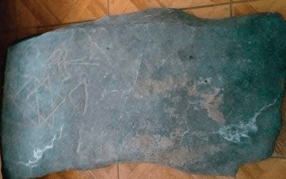
Photo: Tombstone in the village of Drelaj
This is the tombstone that was found in the village of Drelaj, which proves the antiquity of these lands, inhabited since the Stone Age. According to some ethymologists, this stone is thousands of years old, which needs to be deciphered precisely.
Neqinati
The Albanian language is among the oldest Indo-European languages. An ancient language of tribes, Pellasgiote – Mediterranean, which has preserved words in its vocabulary with a strong divine connection in the construction of words that are still used today in dialects and are in the dictionaries of the current Albanian language.
No one has the right to change the name of an old macrotoponym, a pure name of the Albanian language, such as the name of our mountain, Neqinati, and the name of the river, Bistrica. These two names Neqinati (macrotoponym) and Bistrica (toponym) are written and preserved even in official documents of past colonial systems. Anyone can ask where it got its name from, but in no case should they change the old name with another name.
The Drelaj Valley begins: from the Mill Bridge to Guri i Kuq (2,522). On the right is the Kuqishtë Valley to the Peak of the Mountain, while on the left is the Malajve Valley to the third kilometer of the “Vija Ferata”
The Neqinati of Drelaj
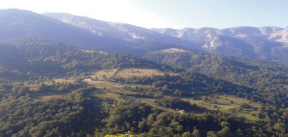

Photos of the Drelaj Neighborhood with the topographic map (location no. of the toponym).
Register of microtoponyms on the Neqinat side of Drelaj
- Rieka e Tahiralajve
- Dardhat e Syle
- Orrnica e Zenelit
Bregu i Verrave - Bregu i Haxhitahirve
- Bregu i Elezit
- Qetina e Muçës
- Gurra e Ftoftë
- Lugu i Huse
- Kërrshi i Gjopapës
- Bria e Selimit
- Bregu i Zenel Agës
- Bregu i Syle
- Bregu i Hutës
- Molika e Bajrame
- Gurra e Bicit
- Vorri i Sokol Alisë
- Gropa e Bacit
- Bregu i Zeke
- Kodra e Zeke
- Sheu i Pllane
- Gurra e Tahir Husit
- Gropa e Isuf Veselit
- Barqja e Cufës
- Llazet
- Kodra e Vorrëve
- Gurra e Derrashit
- Gropa e Demë Metës
- Gropat e Sadike
- Briat e Kërrshi Mazëz
- Lugu i Zharit
- Llazi i Madh
- Bregu i Zharit
- Gropat e Sh. Akullit
- Kërrshat i Graboce
- Dëbantë e Graboce
- Qafa e Vërrithit
- Kodra e Fishekve
- Bira e Sharampovit
- Shkalla e Kuqe
- Guri i Kuq
- Lugu i Madh
- Lugu i Shtrunge
- Gurtë e Qobane
- Gurtë e D. Husit
- Krojt
- Rudinat
- Lugu i Shkodrës
- Konaku i Malësorit
- Rrugat e Malësorit
- Bregu i Smajl Brahimit
- Puzi i Verdhë
- Bregu i Sulit
- Qafa e Jelenkut
Maja e Malësorit - Liqeni i Drelajve
- Vrella e Liqenit
- Shkalla e Liqenit
- Sheu i Tisit
- Bregu i Juricës
- Kërrshi i Karamuji
- Gurra e Tahirit
- Kërrshinat
- Lugu i Vogël
- Lugu i Madh
- Gurra e Dëbanit
- Dëbani i Verës
- Orrnica e Elezit
- Lugu i Juricës
- Sheu i Qelë Dedës
- Lama e Huse
- Lugu i Fierit
- Bregu i H. Hajdarit
- Kërrshat e Zesë
- Verrat e Dërvishe
- Briat e Sheut
- Mullini i Imërselime
- Mullini i Shaban Rrustemit
- Bregu i Verrave, Maja e Malësorit.
Neqinat
So, Neqinati is a macrotoponym that includes an area of thousands of hectares of land. A mountain that starts from the Peak of the Mountain and ends at the third kilometer, where it is now, “Vija Ferata”. It is the mountain of three villages of Rugova: Neqinati i Kuqishtës, Neqinati i Drelajve and Neqinati i Malajve. Recently, those who are ignorant of the name of the mountain have poked their noses here, mountaineers who come from the city as well as those who were born yesterday and do not know the history or geography of this place, struggling to extract the origin of this name today and in vain they insert it, as if it got its name from the lakes and they call it: ‘Lake’.
But they cannot avoid the word ‘nat’ at the end, because if it were so, they would get: ‘nit’- Lake-nit, not Lake-nat!? So, they cannot escape the true name, NEQINAT = Ne – qin – nat = Neqinat. For those who have no connection or knowledge about the etymology of the name, Neqinat, and who assume that the name came to us from the lake, they still have no right to replace it with another name even if it were true.
How well and correctly they write, Neqinati, the villagers of the village of Kuqishte.
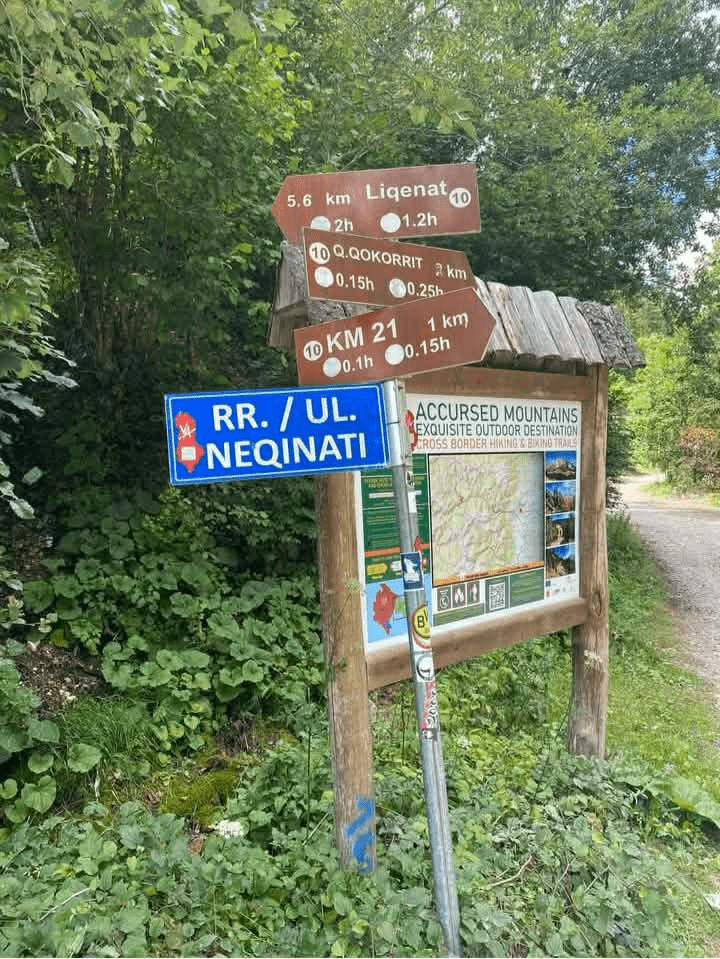
Living conditions over the years have been difficult, with great efforts to survive and severe winters, up to two meters of snow in those days. We, the locals, have a saying: “Six months of winter and six months of summer. Shmiter and shnjergj, shnjergj and summer”.
They did the same thing backwards with the name of our river, BISTRICA. Only those who are ignorant in the field of etymology do this and only those who are part of this action insist, a foreign offspring or even a grafted plant, crossed with the Slavic and Slavicism of Qubri llović, who has not managed to change the meaning of this name either.
The name-changing commission, in a strange place, with linguists who do not know the etymology, managed to change the name from Bistrica to Lumbardh, considering it a Slavic name. Shame! For me and my Rugova people, it will never be changed!
Only Bistrica of Rugova! Only those who know it and deal with etymology can speak about names and names. First, you have to know the history, geography and methods of scientific research and analyze it according to the methodology of embryomorphemes! The locals know these thousand-year-old names well, NEQINATI, and BISTRICA. We have been telling them this all along.
It is painful when even in the dictionaries of the Albanian language there is a considerable number of words with a pure Albanian source that are treated as borrowed from Slavic, Greek, Italian, etc. without being studied etymologically. A correct explanation for Albanian words is given by my friend from Pogradec, the etymologist, Agron Dalipaj, like no one before, well and correctly, based on the method of embryomorphemes.
Drelaj
My village, Drelaj, with the other 12 villages of Rugova, are so OLD, inhabited by Albanians, that in the Pelasgian period, and NO how some forecasters try and have tried to find the time when the first inhabitants came to Rugova, or which village was the first…?! So I tell you: Rugova is not a place found, nor is it deserted, but throughout history it has been a place inhabited by autochthonous inhabitants.
The village, Drelaj, with the name, Old Rugova, for the first time I used it, in writing, in my work, based on the sayings of the elders in Rugova, and until my generation, almost a forgotten name. I did not leave it at that, but I researched several written works of authors who have dealt with the genealogical history and culture of villages in Kosovo.
In the work of Dr. Jusuf Osmani: “Place-settlements of Kosovo – Peja and Deçan”, see p.209 (2004)! Here I came across the name of my village, Drelaj, formerly Rugova e Moçme, where the author quotes the data of an Ottoman archival document from 1903, which states: – “According to an archival document from 1903, with the name Rugova e Moçme, it lies in a deep valley with three – four (3-4) old stone towers, with twelve (12) to fifteen (15) houses, one (1) mosque and three (3) mills with one (1) ciclik.
The population is all Albanians Muslim, on barren land and they live from livestock” – These data are accurate and which I remember myself and I prove one by one with the names of the towers, the mills and the čiklik in my work: “Genealogy of the Drelaj and Dreljan people – Rugova e Moçme”, see p. 21 (2015) and in the reprint, p. 31 (2017)!
The inhabitants of the village of Drelaj are of two tribes: Lajç and Shalë. The Lajç tribe is of Drelë Nikë, while Shalë is of Brahim Prelë. Our villagers of the Lajç tribe, wherever they are and who came from the village of Drelaj 200 years ago, are Dreljanë. From Drelë (Ndreu) come four clans from his four sons: 1. of Muçë, 2. of Shab, 3. of Desh and 4. of Alo. From these four clans of Lajç alone, today there are twenty-three (23) fraternities, while in Shalë there are two clans with five (5) fraternities. So, in the village of Drelaj there are two tribes and six (6) clans with 28 fraternities.
See my work:“Genealogy of the Drelaj and Dreljan people – Old Rugova”, p.39, (re-published 2017).
My village, Drelaj, took its name from Ndreu (Ndre Nika), a pure name of the Albanian language, this name is related to the Albanian word ‘DRE’ (Dreni) with the meaning of a very fast and agile mountaineer, so we say: He was like a deer of these blessed places among the high mountains of Rugova. Therefore, and whoever has the name Ndre-u, a not rare Albanian name, has its genesis (derives) from the meaning,Dren.
Most of my linguistic and etymological studies, I post on my fb page and I receive compliments from readers, positive reactions, but also from those who know something, but do not understand when they read them and give me remarks. One of these commentators tells me: “the name of the village Drelaj did not come from Ndreu, but from Dren”.
So you do not understand that the village took the name of a man, Ndreu (Ndre, in Drela, in Drelaj), and these names generally exist in large numbers among the common names of people in Albanian lands and the truth is that these names have that meaning, they come from Dre-ni, but not the village from Dre-ni! Dren is related to the wild animal of the forest which is a type of deer.
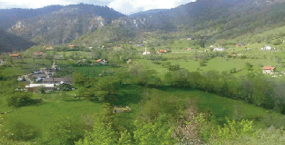
Drelaj
Photos of the village of Drelaj and topographic map of the microtoponym (location number).
Register of macrotoponyms of the village of Drelaj, starting from Qafa e Bukur, on the border with Koshuta, to Llazi i Qelës, on the border with Pepiç:
- Llazi i Ujkut
- Maja e N. Dedës
- Gurra e Stanke
- Maja e Hysene
- Shkalla e Pepiqit
- Kërrshi i Kalit
- Sheu i Shpelle
- Shpella e Pëllumave
- Bria e Xhekut
- Rrasat e Isufit
- Gurra e Lucës
- Shpella e Hysen Alisë
- Shpella e H. Sylës
- Gurra e Cufës
- Zabeli
- Gurra e Krenëve
- Llazi i Qelës
- Podi i Çardakut
- Çardaku i Bajrit
- Kodra e Ahmet Lekës
- Lugu i Shabe
- Gomila e Lakut
- Bërraka e Gjonit
- Kërrshi i Gjatë
- Lugu i Qarre
- Kodrat e Bubit
- Laknat e Kole
- Kodra e B. Hålës
- Orrnica e Marashit
- Vorri i Mencalisë
- (mungon në listë)
- Gurrat e Bardha
- Lugu i Syle
- Llazi i Gabele
- Bërrakat e Regje
- Bërraka e B. Jakupit
- Bregu i Xhamisë
- Tyrbja e M. Dajkut
- Fusha e Bajrame
- ShZeu i Dardhave
- Thana e Imërselime
- Barçja e B. Halilit
- Kodra e Vorrëve
- Kodra e Imërselime
- Bregu i Smajle
- Kërrshi i Smajle
- Gurra e Xhekut
- Barçja e C. Selimit
- Kodra e Sh. Hulit
- Vorri i Elezit
- Gërla
- Lama e Beqirit
- Qafa e Katundit
- Pas Qafja
- Qurrshia e Hajdine
- Dardha e Sykës
- Dardha e Telit
- Vorri i Jasharit
- Shentë e Pepiqit
- Ura e Mullinit
- Sheu i Madh
- (mungon në listë)
- Llazi i Mullinit
- Shpella e Martinit
- Qetat e Hasansmajle
- Shpella e Qingjave
- Shpellat e Osës
- Picetaj
- Kodra e Hambarit
- Gjenishta
- Qafa e Bukur
- Lugu i Xhekut
- Qafa e K. Çetave
- Maja e Dugajvës
- Shpella e Djathit
- Llaqigjet
- Kërshi i Bletës
- Rrasa e Xhumasë
- Zallina
- Fabrika e Djathit
- Fabrika e Ujit
- Gropa e Dukës
- Kërrshi i Dokut
- Bregu i Gjolit
- Shkolla
- Kërrshi i Çubuxhive
- Posta
- Zyra e vendit
- Kooperativa
- Ambulanta
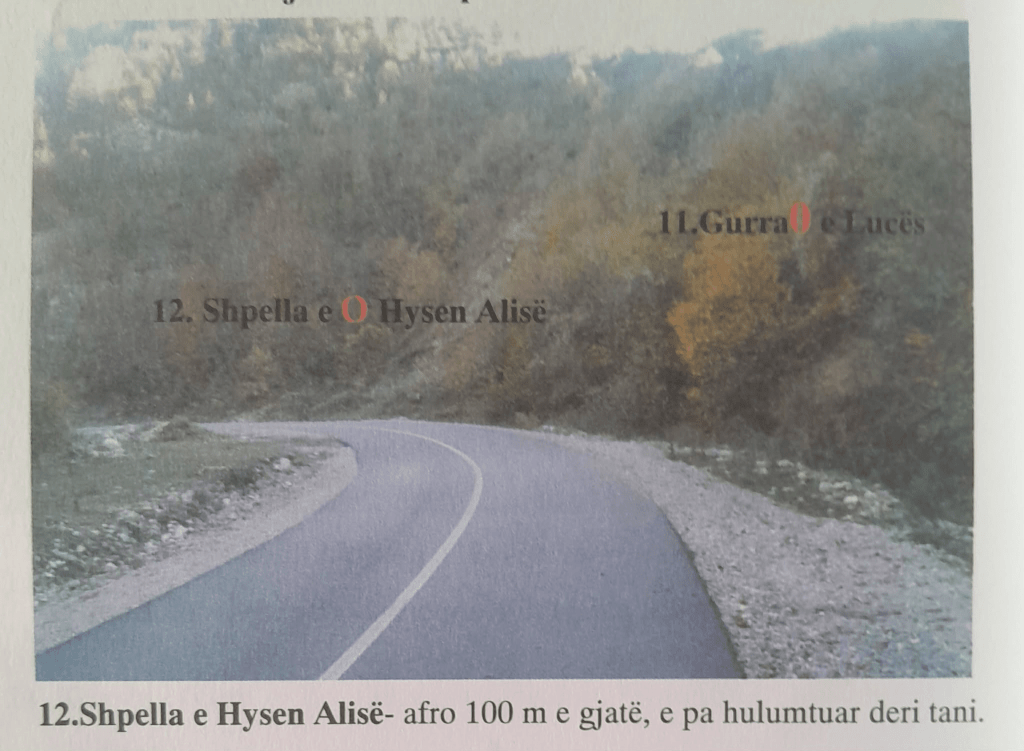
Hysen Ali’s Cave (no. 12) is approximately 100 meters long, unexplored so far.
The toponyms of the village of Drelaj prove that there were inhabitants here even before Ndreu (Drela), Ndre Nikë Deda. According to some data, it is said that the villages of Rugova: Drelajt, Pepiç, Stankajt and Nilajt in Shtupeç të Vogël, were named since 1702, and at the same time the village of Nokshiç in Pasbjeshkë from their fifth brother, Noka (Drela, Pepa, Staka, Nila and Noka).
In the village of Drelaj, counting the generations up to Drelë Nika, the time is approximate, but when I compare these data with the twelve (12) toponyms of this village, they show me that they are much earlier, even before Nde Nikë Deda, because they did not mention at all in the genealogical stem from Nikë Deda and beyond.
To prove this, I will first use the 12 oldest toponyms which took their names from those which show that they lived here before. Here are these toponyms: Kodrat e Bubit (Bubi), Laknat e Kole (Kolës), Orrnicat e Marashi (Mara shi), Brërka e Xhonit (Xhoni), Gurra e Lucës (Luca), Gurra e Xhekut (Xheka), Gropa e Dukës (Duka), Kërrshi i Dokut (Doku), Shpella e Martinit (Ndre Martini), Kërr shi i Gjopapës (Gjon Papa), Gurra e Bici (Bici) etc.
In my village, Drelaj, I have registered over 170 macro- and micro-toponyms: 90 within the village and 80 in the Neqinat mountains. Of all these toponyms, their etymology is purely Albanian.
Pepiç
The village, Pepiç is a pure Albanian name, used by generations since the time when Pepa settled in this area. This name is a precious treasure for the identity, culture and local history of this village. The village is distinguished by national, Rugova traditions. With the change of name, the past is forgotten by the generation that tries to use it with another name. So a painful separation from the old that can leave its past and traditions in oblivion. It is very possible when the village is emptying every day and the inhabitants are scattered throughout Peja and the surrounding area.
The name of the village, Pepiç, is an anthroponym. It is related to the name of the person, Pepa, the place where he settled with his family after the separation of the five brothers in the village of Drelaj. Just as the other brothers settled in some other places in Rugova and Pasbjeshke: Pepa in Pepiç, Staka in Stankaj, Nila in Shtupeç të Vogël, Noka in Nokshiç, and Drela (Ndreu) in the place of their ancestors with their father, Nikë Deda, in Drelaj. According to these names, for the five brothers, the places where they settled took the names ofthese villages belong to them.
Therefore, the name of the village, Pepiç, is a pure Albanian name, used for generations in Rugova and beyond.

The famous Zenelsylaj family house in the village: Pepiç – Formerly Lakaj Neighborhood.
Pepaj, in the sense that, according to them, it supposedly sounds Slavic and that the suffix “-ič” is therefore a Slavic suffix, which is not true at all. Changing the suffix “-ič” is unnecessary. Pepaj sounds more like a surname that identifies the lineage of some families within a closer brotherhood, whereas the name Pepiç/i defines the place where Pepa settled, and from that day the brothers and other inhabitants of Rugovë have called it Pepiç. Brotherhoods take their surname from a closer kinship circle, just as we have some lineages and brotherhoods in Drelaj: ahmetaj, dervishaj, haçkaj… from the lineage of Drel Nika (Pepa’s brother), as well as on my Shala side (Drelaj): imërselimaj, bajrqelaj, and demëmetaj.
Therefore, changing this name is not appropriate, even though the suffix “-ič” may have sounded Slavic to these new namers. No! In Slavic speech, some Serbian foresters pronounced it as Pepiq-e, not Pepiç, and that is all—nothing more. Here we are dealing with the naming of a village after a person, Pepa—thus, the toponym Pepiç.
Toponyms with the suffix “-iq” in place names, both in Kosovo and Albania, have different origins and are not necessarily Slavic suffixes; rather, they are suffixes of the Albanian language from ancient times in dialectal speech. It is a matter of the internal name of this locality, “Pepiç,” and it is better preserved as such. In this way, the identity of its inhabitants is maintained.
There are many toponyms with the suffix “-ič” (“-iq”), as there are many other villages across Albanian lands, but I will mention only a few in the Rrafshi i Dukagjinit: Raushiq, Lubeniq, Kotradiq, Isniq… These are preserved names and should remain so! They all carry the suffixes “-ič” and “-iq,” as pronounced by the locals, showing a shared historical and cultural connection. Rugova and Rrafshi i Dukagjinit possess a rich macrotoponymic heritage.
If the toponym Pepiç had a Slavic suffix, it would have taken the Slavic ending “-vić” and would be called Pepoviq or Pepiqeviq.
Under no form or circumstance has the Slavic language been able to influence the original Rugova speech, not even in naming (toponyms), except for the village of Stankaj, which the Slavs called Jashanica, and it still appears as such in state administrative documents. Why and how, I have not investigated, but the border connection with Montenegro may have played a role, with influence from Montenegrins.
I did not find it necessary to treat this name, Jashanica, in the Slavic language, since for us in Rugova and across Albanian lands it is known and pronounced in Albanian as Stankaj (from Stakë Nika). This toponym, since the time Staka settled in that place, has been called Stankaj (with the suffix “-aj”), preserved as such, and it should not lose its historical identity, as that would be a grave mistake.
Both the village name Pepiç and Stankaj are toponyms (names) with ancient local Albanian roots. As such, they have been used by the local population and are recorded in old documents, including during the time of Albania and even earlier.
Leka e Allagës
Being interested in the etymology of the name, Reka e Allagës, etymologically the truth is that we are dealing with a name of pure Albanian origin, Reka, which comes to us as a composite of three Albanian words, Reka + all + agës. From the name of the person + the color of the qelesha + the title (aga, Turkish). According to my research on the naming of the village, Reka e All-agës, is a pure name of the Albanian language and has nothing to do with Slavic as it has been claimed to change its name on the occasion of the change of names in recent times, after the war, trying to say ‘reka’ for the river in Slavic, and there is no river there, but for rocka yes.
This name has to do with the names of the people from whom it took its name: Reka and All-aga. The name Reka dominates even today in Rugova, and since ancient times among us Albanians, such as: Rekë Alia, also from this village, my peer, Rekë Smajli, in the village of Pepiç, Galo Reku, a well-known man from Nokshiç, Arif Reka of Rekë Smajli in the village of Dugaivë, etc. We have many names of villages and regions with the name Reka, such as Reka e Keqe, etc.
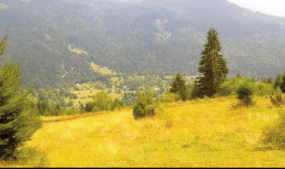
Village of Reka e Allaga
Now the question arises: where does the surname “All-aga” come from? – For this I have oral information from the elders of this village about how it got this name: “During the time of the Turks, when an Aga was persecuted for execution, this regime had sheltered, secretly kept him in his house, a person named Rek/ë-a, in this place of residence. After his government pardoned him, he again took on the duties of aga and said to Rekë: “What do you want as a reward for saving my life? Do you want Katundi e Ri (at that time an uninhabited place, my vr.), or Hajlat in Rugova”?
– Reka: aww, Aga, what are you telling me?! But calm down (this) what I see with my own eyes, because I don’t need it anymore! That’s why Aga forgave all that land that now belongs to this village, that is, Reka e Allaga.
Aga kept the qeleş of allit (red agallarësh plis with a tuft) and every time he came to Reka, they would say: here comes, All Aga (Aga with red qeleş). That’s how the village got its name, Reka e Allagës. – A story from the elders of this village, as well as the family of Bekë Sahiti with their descendants, Nikçi.
This data is more convincing for the etymology of the village, Reka e Allaga.
Rugova has always been a safe place for those persecuted by the powers of various regimes, through generations of faith, manhood and bravery. He has come to the aid of people endangered by the power of the time, as well as in the last war (1998/1999).
A similar case of sheltering those fleeing the government, as in Reka of Allaga, also occurred in the village of Pepiç. I remember as a ten-year-old child the sound of gunfire when Sani Beg was shot in Qafëskallë of Pepiç, by the communist government.
The family of Ujkan Hysen (Cenujkanaj) sheltered him for five years and when they dictated it, in the early fifties, the government took over and shot Sani Beg, while four men from this family served a heavy prison sentence of one and a half to seven years (Cenë Ujkani 7 years; Hamza 5; Shabani 2 and Rama one and a half years). To be more precise, the names and years of imprisonment were told to me in detail by the descendant of this family, Isuf R. Ujkani, Lajçi, Pepiç, on September 10, 2022.
BISTRICA

The name of the river, Bistrica, is a pure Albanian name.
The Rugova River, Bistrica, which unites all the pure springs of our mountains: from Bjelluha, Haxhaj, Stankaj and Bogët that join in Kuqishtë, and from Shkreli, Dugaiva and Koshutani, the streams join Gërlë and finally with Bistrica at the 17th kilometer, continuing to Gryka, the sources of the Allaga River also join. They formed the river called in the past,Twice thriceThis river, with all its harshness, has a pleasant melody that gives life and vitality to Peja and Dukagjini.
Bistrica of Rugova
This river, with all its harshness, has a pleasant melody that gives life and vibrancy to Peja and Dukagjini.

Bistrica e Rugova through the city of Peja
All rivers named Bistrica are pure Pelasgian-Illyrian names and are located in different territories with the same name, but the surname is taken from the place where it is located, for example: Bistrica of Rugova, Bistrica of Deçan, Bistrica of Prizren, Bistrica of Delvina, Bistrica in the Third Municipality of Tirana, etc.
All the names of the BISTRICA rivers in the Balkans belong to the ancient Albanian language. They do not have Slavic origins. When our ancestors inhabited these lands in the Balkans, there were no Slavs here! They also found the Illyrian Bistrica here with this name and it is not for nothing that they call it today: “Ilirian Bistrica” in the Slavic language, (Albanian, Bistrica Ilire). So the name, Bistrica, derives from the ancient Albanian language, never changed until today and is used in the speech of the Gheg dialect. So why change its name today?
The name Bistrica comes from the ancient Albanian word,“biscuit”=sharp, grapevine, “bistër” = clear, clear water, agile, fresh, fast, etc. How knowingly, not knowing the etymology of the name, bistrica, they made a mistake when they changed the name to “Lumbardh”, prejudging it as a Slavic name. Therefore, I request that the Municipal Assemblies in Kosovo officially return the name of their origin to all the original names of the Albanian language.
So, the names of the rivers, Bistrica, are pure names of the Albanian language wherever they occurred. The Albanian language was considered to be one of the Indo-European languages, but has recently been proven to be the oldest language among the 161 Indo-European languages (2023).
An ancient language of the Pelasgian-Mediterranean tribes that has preserved words in its vocabulary with a strong “divine” connection in the construction of words that are still used today in dialectal speech and are in the dictionaries of the Albanian language. The name Bistrica, as I mentioned above, comes from the ancient word of the Albanian language: “Bisk” (“Bistër”) = clear, clear water, sharp, sharp, fresh, clean, etc.
All the names of the rivers in the Balkans with the name Bistrica, and there are not a few, belong to the ancient Albanian language. They do not have Slavic origin, but Pelasgian-Illyrian. When our ancestors inhabited these lands, there were no Slavs at all in the Balkans. The Illyrian Bistrica (Ilirska Bistrica), was found here with this name and many others, such as: Bistrica of Ru govës, Bistrica of Deçan, Bistrica of Prizeren, Bistrica in the southwest of Albania, between Delvina and the third Municipality of Tirana, Maja of Bistres in the Prizren region, the village of Bistra-zhin-i, in the Gjakova region and others.
All the names of rivers in the Balkans, but also of some villages, such as the village, Bistra-zhin, in the municipality of Gjakova: bisk + zhin, zhan (like Zhanicë) are names that belong to the ancient Albanian language. They did not originate from the Slavic language, but from the Pelasgian-Illyrian.
So the name, Bistrica, derives from the ancient Albanian language, never changed until today, but even after today. So why did you change its name today?! It is not even white in appearance, but from this purity and purity it has the appearance of blue like the sky that reflects this clarity! Surprisingly, not knowing the etymology of the name of our river, Bistrica of Rugova, they made a big mistake when they changed its name to “Lumbardh”.
Such wrong actions are grist for the mill of our nation’s centuries-old enemy, Serbia, just as the Serbian ASHA has designed it.
Qubrilloviq Vessel(Serbian Academician) writes:
“We Serbs have no greater enemies than the Albanians, if we must raise our heads, we must lower their heads, if we must feel vast in our territories, we must narrow their spaces, if we must love the world, we must make the world hate them. For the Albanians to abandon their country, we must at all costs and in every way, blacken their lives! To get to this point, we must first deny their Illyrian, Epirote, Dardanian origin and kill their Illyrian pride, destroy their homes and confuse their names, tarnish their emblems and erase their ancient Illyrian symbols, we must necessarily make them lose their language and customs, at the same time take away everything they have that is ancient ILLY and appropriate it for ourselves”.
Then I ask: How can the enemy be better served by these demands than by making inappropriate changes, exactly as Qubrillavic would do.
Etymologists: Agron Dalipaj from Pogradec and Aleksandr Hasanas from Korça are my friends, researchers in the science of etymology. According to etymological studies, Agron proves over 93% of the words he has treated, E. Qabej, as words derived from foreign languages (Slavic, Turkish, Greek and Italian), all of which are source words of the Albanian language. Therefore, Agron, there are problems with some fanatical linguists of the time, both in ASHAK and in Albania. but no one can stop the scientific truth!
They do not want to oppose the author, because they do not have the courage or knowledge in this field and “stand their ground like … on ice” – a popular saying. Therefore, I say to you: make way and do not hinder young researchers in the progress of the science of linguistics! They have no right to reject the latest scientific research on Albanian language writings, which show us that they are even earlier than the “Formula of Baptism” of 1462 and the writings of Teodor Shkodrani.
VARDAR
According to etymology, the Vardar river belongs to the Albanian language and comes from the word: Bardhar = White. Bardhar = Vardar, replacing the letter; b = v.
During a trip to Korça, I deliberately stopped in Gostivar, in the village of Vërtok, to see the place where the Vardar originates. A rare beauty in this Albanian land! This river should have been called: Lumi i Bardhë (Lumbardh), from where its genesis is known, the old root of the Albanian word.
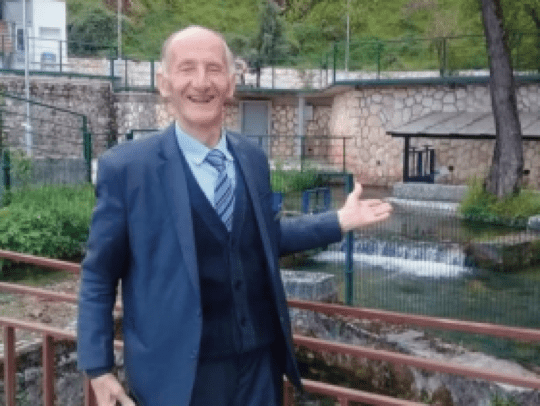
The author of the source of the Bardhari (Vardar)
(February 15, 2021)
The rivers named Bistrica have their own roots“Bisco”(“Bistër”), so you can’t change it to Lumbardh as in the case of our Bistrica. They are losing the genesis of the oldest word in the Albanian language out of ignorance. With a decision of the Provisional Government of Kosovo, after the war for the correction of names, many mistakes were made as a result of not knowing the etymology of names, specifically, Bistrica of Rugova, they made a mistake when they gave it the name “Lumbardh”, prejudging it as a Slavic name.
There is no Lumbardh river written in the Balkans, which should be the Vardar River. “Lumbardhi i Pejës” is a pure Albanian name and sounds beautiful, but why should we remove its old name, Bistrica?
Since I took the Vardar River as an example, I want to shed light on its etymology.
Vardar = Bardar, Bardhar, and should have been called Bardhari, White River = Lumbardhi. Considering that the Slavic and Greek languages read the ancient Albanian letter ‘B’ as ‘V’, it is very clear that the name of the river, VARDAR, has its origin in Albanian.
For the etymological authenticity of some of the names I have mentioned in my work: “I killed my fear in time” (Monograph) (2021) page 197. The toponyms in this work have also been evaluated by the renowned etymologist from Korçë, Alek sandër Hasanas (Mili Butka), saying: “all these toponyms are precisely explained correctly by the author Shala.
In this work, the author also brings the etymology of some of the words of the names of the area around Rugova” – citing and explaining the five names: Bjeshkët e Namuna, Rugova, Neqinati, Bistica and Vardarin. He even goes further by correctly indicating the etymology of the village of Drelaj and my mother Zoje:
“The name Zojë: – His mother Zojë, a typical Albanian tribal name from the Albanian word in the masculine gender Zot = God (god) and in the feminine Zoja baraz = Goddess; Lady.” – M. Butka.
ZHANICA
The history of the Pasbjeshka Highlands is rich and beautiful with many events and wars.tdayfor freedom. The Albanian lands under the administration of Montenegro have a difficult history, but with much courage and perseverance.
Zhanica is a village with a beautiful-sounding name, with an attractive appearance with traditional towers and cultural heritage.

Village of Zhanicë (Rrzhanicë)
The etymology of the name, Zhanicë, is related to the Albanian word, ‘Zhan’. The word “Zhan” is a variant of the word ‘Xhan’ or “zhani” which means “soul” or “life”. With ‘ZH’ in many variants are names with ancient Pelasgian-Illyrian roots.
The name of the village,Zhanice, we also find it written in the variant,Rrzanica, ‘Rr‘Zhanicë, a toponym related to the word‘ray’=‘roots’(place, bottom, slope, bottom) as well as the suffix – ‘Gračanica‘ which dominates here and in the toponyms of the Balkans.
By the name of the village,Zhanicë Street (Zhanicë),is a pure Albanian name, its toponyms show it with a large number of them and not a single one is in the Slavic language. Like the other toponyms, the toponym, Rrzhanic/ë-a, is and indicates an important place with an Albanian history and cultural heritage. Illyrian graves show a clear continuity of habitation in these parts since the Pelasgian-Illyrian period.
Noticing that some “Albanian writers” – I will call them that, on purpose or out of ignorance, they are misleading us, that they supposedly know something, and are misrepresenting the original names of the Albanian language, namely the name of this village, presumably, by indicating the opposite in various forms (Arzha nicë, Arrzhanicë, Rzhanicë, Theknajë…) with the conviction that it is Slavic‘Zhanice’and all this in recent times, avoiding the true historical name of the Albanian language due to lack of knowledge of the etymology. Therefore, I willingly took the trouble to show the readers the etymology of the village, Rr-Zhanicë.
Regarding the toponym, Zhanicë, an Albanian village near Nokshiqi, near the Lim River, where the Nokshiqi War (December 1879 – January 1880) is historically known, the highlanders of the Bjeshkët të Namuna Mountains, in the vernacular we have always called it: ZHANICË and we continue to call it that.
In recent times, especially after the 1999 war, some have begun to change this name, giving it a‘with’ahead,With-žanica, with the belief that it has a Slavic origin, which is not true! Then why are you still using the same name, (‘Ar’) –Zhaniceand I ask what you changed from this meaning?
A little clarification for lovers of the Albanian language: In Lahuta e Malëcia, in 1904, the great Gjergj Fishta uses this name with ‘Rr’=Rrzanica,in the poem: “The Bridge of Rrzhanicë”, already in the title of these verses:
“The Rrzhanica Bridge”
Albanian!
I wrote this song myself;
Tell me, what have I won?
We are all angry and upset.
Me t’ba me dalun feje!”
The original name of this village is,Rrzanica, but in time‘rr’ has incorporated the vernacular into it, making it easier to pronounce,Zhanica.So we are dealing with the name of the village, Rrzhanicë, a settlement in Rrezë Mali, thin, steep, steep, Rrëpirë, so a place of mountain slopes. With‘Rezë – side’, we have many village names in Albanian lands.
According to this study, I am completely certain that the name of the village, ZHANICË, is a purely Albanian name and has nothing to do with Slavic or ‘With-ën’… as some “literary people” are writing to me and saying.
Therefore, we beg you, my friends, not to harm the sweet language of our Albanian mother.
A precise research article about Zhanica is given by Hasan Gjonbalaj, in his work: “Zhanica, Pepaj and Nok shiqi” that no one has done such a study about these three villages of Pasbjeshka, based on historical data, archival and statistical documents from early periods: – “Zhanica has an older source than Pepaj, which, under the name, Rzhanicë, we find in the Sandzhak of Shkodra, since 1485, when there were 92 houses,…” -See page 9 of this book!
After publishing this article about Zhanica on Facebook, Montenegrin professor Marko Jokic from the village of Velika, Montenegro, commented.
Marko Jokiq
Dear Osman,
This name – toponym is the subject of my interest. Namely, in this village there were once a long time ago (13th century), Romanized Illyrian-Vlachs. The oldest family in the village is Tahiraj (fig. Tahirović), who, according to some data, have been there for 6 centuries. According to the census in the Parish of Klimenti (1703) in Ržanica /Aržanica/ etc., Catholics live there and there are no schismatics. Until the battles on Novšić, Albanians lived there (there are still some today: Tahiraj, Novaj, Ujakaj…).
There are many toponyms of Albanian origin. On the border between Rržanica and Velika there is an old “Illyrian cemetery”, and in the center of Velika there is the “(h) Otsko” cemetery, which is mentioned in monastery documents of the Serbian Church. In monastery documents from 1330 it is mentioned as Ržano.
I wanted to share this information with you. Best regards, Marko Jokić from Podgorica
February 1, 2026
Albanian translation: Dear Osman!
This name – toponym, is the object of my interest. That is, in this village there were once listed – registered (13th century), Romanized Illyrian – Vlachs. The oldest family in the village is Tahiraj (Slavicized Tahirovic), who according to some data have been there for 6 centuries. According to the registration in the Parish of Kliment (1703) in Rrzhanicë (“Ar -zhanicë etc.), Catholics lived there and there are no schismatics(sg: im, religious division within the church).Until the Nokshiq War, Albanians lived there (there are still today: Tahiraj, Novaj, Ujakaj).
Full of toponyms of Albanian origin. On the border between Rrzhanica and Velika there are the “old Illyrian graves” and in the center of Velika there is the cemetery “(h) Otsko”(sq.: mass grave)) which is mentioned in the monastery documents of the Serbian church. In the monastery documents of the year 1330, Rzhano is mentioned(clarification: name of the village).
I wanted to share this information with you.
Warm regards, Marko Jokic from Podgorica.
Zoje Shabaj Berisha– Thank you very much for this beautiful text that you have provided with some explanations of the Albanian language. Well done, mountaineer!
I am also proud, as the daughter of Zhanice that I am, that you have written the truth of the Highlanders.
May God give you health!
Albina Hoti –Proud of my grandfather who protects and explains so beautifully the Albanian language and its ancestral names. These writings are a treasure for us, the younger generations, and for those who will come after us, because our history, language, and identity are being preserved. When knowledge, history, and love for Albanian come together, valuable writings like this one emerge.
VRAÇEVA
The name of the mountain, Vraçeva, is a pure Albanian name. It is related to the word‘murder’or‘wreck’, ‘ask’, which is related to a place of battles where destruction was done, such as the Battle of Nokshiqit, whose mountain it is. It has the meaning of a beautiful mountain full of history. It is a beautiful mountain and it sounds beautiful in Albanian,Vracheva.But it can also be related to words,‘cargo’or‘murderer’which has the meaning of a dry and bare place. The suffix‘eva’ (as Rug/ova)-‘this’)is a common toponymic form of the Albanian language.
The name of the mountain, Vraçeva, is a pure toponym of the Albanian language, with 480 hectares of surface area, with full toponyms within it, all of which are pure names (toponyms) of the Albanian language, counting from the right, at the entrance to the Vraqeva Pass (above the Çakorri Pass):
From the right:The Dębanat, Thisbeautiful andThislower (‘the inhabitants’, ‘the inhabitants’(t),Peak on the mountain, Spindles (from the word,‘(vertit/a-ur’- around).
From the left:Vraçeva Peak, Gëlliat, Hartinat (pine trees), Pllaninica Mountain(from the word, ‘plain/’,-a(t)’, Somishti(‘soma’ i.e., dry, parched, sunburnt place)) Kershi i kujit, The hill of the kuji, The hill of the har tinitandLake stones.
I collected these toponyms of the Vraçevo Mountain on purpose, both for toponymic etymology and for historical reasons.
to preserve these names for generations because the mountain was left without owners as it once was and is now almost completely abandoned. The names of these places were given to me by Prof. Hysen Mehaj of Nokshiqi, (on March 9, 2026), in Peja, telling me: “As a child I went to our mountain, Vraçevo, and I remember well all its beauty with springs and mountains all around. We mowed meadows, put hay and planted potatoes. A mountain full of vitality with added life”. Today, in all weathers, this mountain is guarded by the Tomb of Brah Zhuji who left a message: “When I die, I want you to bury me in my mountain, Vraçevo, where I spent the most beautiful days of my life. After me, no one else will go to this mountain and it will be known that the mountain is ours, the tomb of Brah Zhuji is proof”. The order was delivered to him by his family.
AN EVALUATION BY THE LITERARY CREATOR, ETYMOLOGIST, ALEKSANDER HASANAS – (MILI BUTKA) from KORÇA
(published on Gazetadiplomacia.al)
“Osman Shala “I KILLED THE FEAR OF THE GOAT WITH THE HOLY” – Gazeta diplomacia.al by Editor 1 February 20, 2022 in Current Affairs, Kosovo, News.
Life is sweet, says the author, even when it is difficult, full of ups and downs and sacrifices, but in the end it is the “building of hope” in the divine soul of man and forget about fear, it does not exist if you have the desire to fight and leave behind enlightenment; the success of your battles…
Among his 6 works, I (Aleksander Hasanas), today chose to leave my impressions on the book, “I Killed Fear in Time” – And this book begins with its first chapter:“Life in the Lost Mountains”.And precisely the author begins his book with the words: “Mountains with Nam, they told you in vain”. I really liked it, it is precisely this pure Albanian word “Nam” with nam, the source of the name of the Albanian word: ‘Mountains of Namura = Named, known and named; this word which shows the belonging that these blessed Mountains belong to the one who inhabits them, the Gegian highlander, the inheritance of their ancestors… Albanian-ro/Dardan.
In his book“I had killed my fear in time”The author also brings the etymology of some words and names of the surrounding area (Rugovës). Like the Bjeshkët e “Namuna” which we mentioned above with the meaning “with name; of name; with name”. Then he discusses the name,Rugova,This name is more accurately compared to the Albanian words: Rru gë+o’va; vahe, vau; lugina të lugta; të ulta, even where it enabled the easiest passage of pedestrians and caravans towards those areas, the surrounding villages and even the only Road connecting Peja with Shkodra.
Neqinati– The author connects this name to the movement of livestock that took place there only for the three summer months since it is very cold there, and it was called the place of 100 nights; {In the hundred nights} Neqinat.
BISTRICA– The author rightly writes that this name of my river is dedicated to the Albanian language as an ancient IE language as a stem of its word; Bisk = sharp (bisturi) cold, razor, clean, sharp, fast; bistr full of “dre dha”, Bistrica.
VARDAR– Again we are dealing with a river name where the author, Osman Shala, like many other researchers, taking into account that the Slavic and Greek languages read the ancient Pelasgian-Albanian letter ‘β’ as ‘ν’, and after this we have a very clear origin and meaning of this river from the Albanian BARDHARI – Pure white water, Bardhar.
The author, born on June 28, 1944, talks about his childhood full of difficulties in boundless poverty, about his father and mother, Zoje, a typically Albanian noble name from the Albanian word in the masculine gender Zot = God (god) and in the feminine Zoja equals: Goddess; Lady.
Well done my friend! You have done a correct etymology, as in the Albanian language we also have many settlements called villages; ARZË with the clear meaning of settlements located: A’ at the foot of the mountain.
Respect!
Article writer: Etymologist, Aleksandër Hasanas, Korça, 20/2/2022.
ALBANIAN LANGUAGE
Ancient language, nightingale among the ages, Roots that in Pelasgian times, you were the queen of this land, everywhere in the Illyrian lands!
Our language has golden words.
The first language since ancient times, Mother of all other languages, Well preserved in these lands.
A language that was born with us, It tells us that I am Albanian, And the ancient Homeric word belongs to the Albanian language.
Mother tongue with many values, even kings and kingdoms, In inscriptions and coins, They guard you with pride!
You are valuable and will remain, From ancient times, divine equal! Language of light, language of the vulture, For us you remain a dear possession!
Let us have respect for our mother tongue,
Let us speak correctly, let us write beautifully,
The Albanian language, the language of eagles,
We must protect it like the eyes of our forehead!
Let’s talk nicely as befits us,
Let’s not spoil it with foreign words,
We are neither Greek nor Slav,
by no means Turkish or Arab!
(From the poem: “Hope Walled Me”).
In my poetic work: “Hope Walled Me” (2020), in the poem,Albanian language(page 19), three years later it was scientifically proven (in 2023) by 33 researchers of 161 Indo-European languages and was published in the American journal “Science”, listing the Albanian language as one of the three oldest languages (Albanian, Armenian and Greek).
I have expressed the antiquity of the Albanian language in simple verses and with clear thoughts about the Albanian language. Each verse in my poems has a clear message.
REFERENCES
– Work: “The Albanian language in practice – for everyone”. Ardian Doka, prof. at the Department of Cosenza in Italy. – Work of etymology. Agron Dalipaj, Pogradec:
“Pseudo-orientalisms in the Albanian language (“Turkisms”), 2020.
– Etymological work by Aleksander G. Hasanas, Korça: “The last Pelasgians – their language (etymology)), 2020. “The Lute of Malëcia” – Gjergj Fishta.
– Work 1 of Ibrahim Çavolli: I am a Kosovar …! 2007. – Work of Dr. Jusuf Osmani:
“Settlement Sites of Kosovo – Peja and Deçan, 2004 – Idriz Ajeti’s work: “Etymological Studies in the Field of Albanian”, 1982.
– The work of Osman R. Shala:
“Genealogy of the Drelaj and Dreljani people – Ancient Rugova”, 2017.
Conversations with the elderly about the topics I address in this work.
– Hasan Gjonbalaj’s work: “Zhanica, Pepaj and Nok shiqi” – 2007.
– Vepra and Johan Von Han – austiak:
“Albanian Studies” (1854).
CONTENT (PËRMBAJTJA)
Cataloguing in Publication – (CIP)
National Library of Kosovo “Pjetër Bogdani”
81’373
Shala, Osman R.
Call me by my name: (etymology) / Osman R. Shala. – Peja: Libri im, 2026. – 84 p. ; 21 cm.
ISBN 978-9951-989-63-3
376-056.262(496.51)
Shala, Osman
The best reader – evaluator – Osman R. Shala. – Peja: My Book – Peja, 2025. – 144 p. : 21 cm.
ISBN 978-9951-678-8-7
BIOGRAPHY
Osman R. Shala, born on June 28, 1944 in the village of Drelaj, Rugova. He is the first generation of the “Përparimi” Eight-Year School in Drelaj. He completed his secondary school (five years) in Peja, at the “Ali Kelmendi” Normal School (1968). He completed the Higher Pedagogical School of Albanian Language and Literature in Gjakova at the “Bajram Curri” School (1970) and continued, in the same direction, at the University of Prishtina.
He worked for 12 years as an Albanian language teacher at the “Përparimi” school in Drelaj and for 12 years as the director of the “Rugova” agricultural cooperative in Rugova, based in Drelaj. He has a wide life activity, seasoned in many areas of life. Member of the KLA War (1989/1999) with a rifle and a pen in his hand.
So far, he has published 11 literary works of national historical value:
“Either today or never” – War Diary, (2014). – Albanian – English.
“Genealogy of the Drela and Dreljans – Old Rugova”, (2015- re.2017).
“Broken Hearts” – experiences and memories, (2018). “Love on Swan Wings” – novel, (2020). “Hope Walled Me” – poetry, (2020).
“I killed fear with time” – monograph, (2021).
“Mountain aroma” – bibliography, (2022).
“Rugovë echoes manhood”, (2024). – Albanian – English.
“The Best Reader Appraiser”, (2025). “Beyond Love” – novella, (2025) and “Call Me by My Name” – etymology, (2026).
The author lives and works in his native village of Drelaj, Rugova, which he never turned his back on.
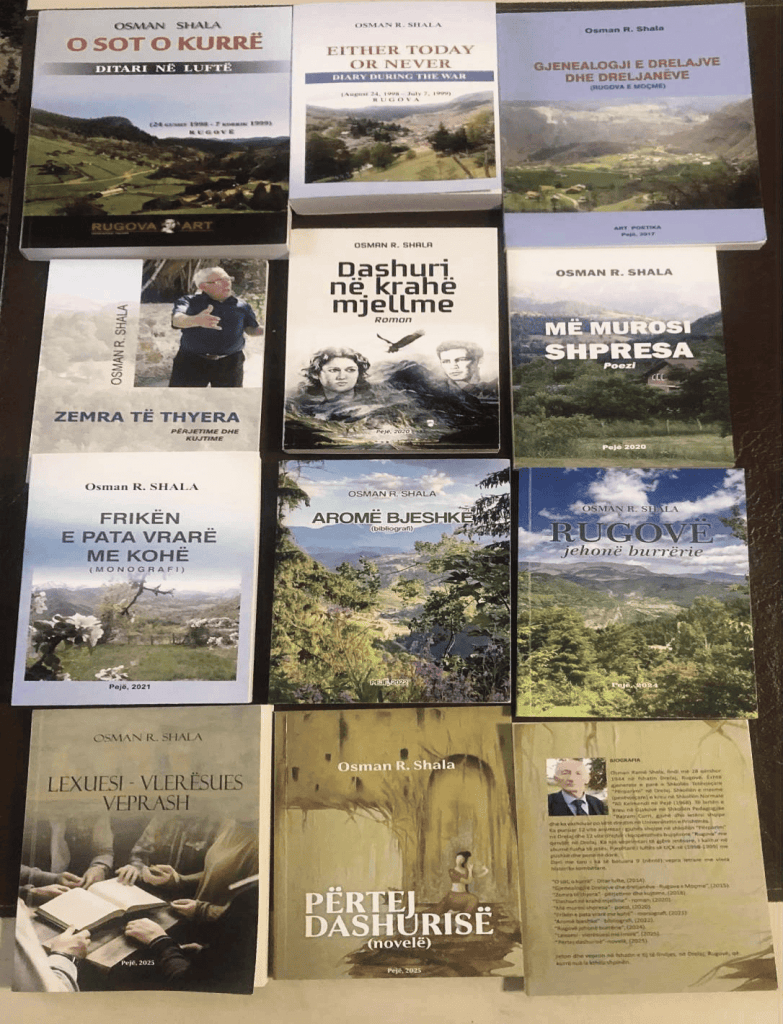
To read the rest, please buy the book from Osman Shala. He can be contacted here on Facebook.
Contact info: osmanshala1@hotmail.com

