
by Yaroslav Falko.
Nowadays, not every native Odessan will answer why two streets in the center of old Odessa are called Velikaya and Mala Arnautskaya. They were founded by Albanian emigrants. The fact is that the Turks called Orthodox Albanians who lived in the southern part of Albania and in Greece Arnauts. This is where the name of the famous streets comes from.
Descendants of the haiduks
In the village of Zhovtneve, whose authentic name is Karakurt, in the Bolgrad district of the Odessa region, festive events were held dedicated to the 200th anniversary of this settlement – the largest village in our country, where Albanians, descendants of the Balkan haiduks, who moved to the harsh Budzha steppes at the end of the 18th century, live compactly.
People still call their village the way it was called before the Bolsheviks, Karakurt. It was first mentioned in written documents two hundred years ago. Judging by the name, the settlement was founded much earlier and was inhabited by Budzhak Tatars. Translated from Turkic, Karakurt means “black wolf.”

But today it is a multinational village, inhabited by representatives of five nationalities – Albanians, Bulgarians, Gagauz, Ukrainians and Russians. The majority are Albanians.
They appeared in the Northern Black Sea region at the end of the 18th century. They were families of Albanian volunteers who, during the Russo-Turkish War of 1787–1791, served in the Russian flotilla that controlled the Danube Delta, and after its end, settled in Odessa and its surroundings. Apparently, there was a second wave of Albanian immigrants, after 1812.
In Odessa, as in many other cities around the world where Albanian emigrants lived, the cultural and educational society “Relindia” (“Renaissance”) was established. After the Albanian Revolution of 1912, during which Albania gained independence, the famous Fan Noli, one of the most famous public figures, politicians and poets of that time, visited Odessa. And in 1948, the leader of “socialist” Albania, Enver Hoxha, “the last dictator of Europe,” as Western political scientists called him, also visited the city.
Nowadays, many people probably still remember the famous variety of Ukrainian wheat, which was grown at the beginning of the last century, – Arnautka. From the name it is clear that this variety was originally cultivated by Ukrainian Albanians, whom, apparently, their Ukrainian neighbors continued to call Arnautka.
Familiar agronomists are inclined to believe that it was a durum spring wheat, without which it is impossible to produce high-quality pasta. It was these wheats that then formed the main part of the export of high-quality grain to European countries, bringing glory to Ukraine as the recognized “breadbasket of Europe”.
It was not by chance that this variety was bred by Ukrainian Arnautkas – Albanian peasants have always focused on exporting agricultural grain to Italy, the homeland of spaghetti.
But in reality, the ties between Ukraine and Albania are much older and deeper.
Modern Albanians are descendants of the Illyrians, whose tribes inhabited the Balkan coast of the Adriatic Sea in ancient times . “There are many Illyrianisms left in the toponymy of our country,” says linguist Konstantin Tyshchenko, a polyglot and a well-known specialist in the field of general, Romance and Oriental linguistics. “For example, the name Carpathians comes from the Illyrian karpё, which translates as “rock”. And 25 mountain peaks in the Carpathians have the root “kicher”, which in Illyrian means “beech mountain”…
The ties between Albanians and Ukrainians were intense even in the early Middle Ages. As Mr. Kostyantyn proves, the toponymy of our country has recorded many Albanianisms. For example, if the capital of Albania is Tirana, then in Ukraine there is a village called Tyranivka in the Khmelnytskyi region. Both names mean the same thing – “dry, arid area, unirrigated lands.”
Multilingualism at the family level
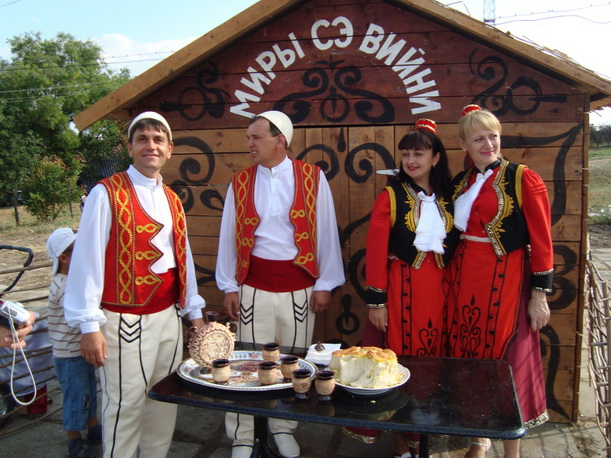
Numerous guests and compatriots who had gathered from all over the country were met in national costumes by representatives of the main nationalities living in the village. They were greeted in Albanian, Bulgarian, Gagauz and Ukrainian.
A concert was held in the Palace of Culture, the program of which consisted of songs and dances of different peoples. The Albanian and Gagauz heritage was represented by amateur artists from Zhovtneve, and Bulgarian, Moldovan, Ukrainian, Russian and even Georgian vocal and dance numbers were performed by creative groups from four villages of the Izmail district.
A real sensation was caused by the fashion show of the famous Kyiv couturier Mirabella Supyr, whose parents are originally from Zhovtneve. She recently returned from the Albanian Fashion Week, which took place in Tirana, where the Kyiv native was invited for the second time. In Tirana, the girl was congratulated on her creative success by the popular American actor James Belushi, who was in the capital of Albania. It turns out that his parents are natives of this country, and he performed in Tirana with the concert program “I am Albanian.”

“Completely different languages, different cultures and ways of life did not hinder good neighborliness, future kinship of families,” says the head of the village council, Olena Zhecheva. “We have never had any misunderstandings on national grounds. All residents speak three to five languages. It is even common for one family to use two or even three languages at the same time in everyday life.”
As is known, in Albania the majority of the population is Muslim, 20% are Orthodox and 10% are Catholics, who live in the north of the country. But here neither during the struggle for independence, nor during the Italian and German occupation of the country in World War II, nor after the overthrow of the communist regime, there were no conflicts on interfaith grounds. As one of the leaders of the Albanian national revival proudly stated at the beginning of the last century, “the only religion of the Albanians remains Skoptarism”!
“Shkeptari” is the self-name of Albanians. The word comes from the verb “shkip” – “to speak”, in the meaning – to speak a common language understandable to each other. It occurred to me: how we lack “Ukrainism”! A conscious desire to have one, understandable language, and not to vote “for our own” in every election, only to then complain about fate and curse the woeful politicians who always speak different languages in our country.
The Law “On Languages” is not in force
Ukrainian Albanians have preserved their language only because they live compactly in Zhovtneve and three villages of the Priazovsky district of Zaporizhia region. They still solve language and cultural problems, as our officials say, “at the expense of internal reserves.” The authorities do not help them at all. Although the Law “On Languages” is more than 20 years old, the children of Ukrainian Albanians still do not attend lessons in their native language and literature, do not study the basics of Albanian culture and history.
“The language was preserved only because Albanian was spoken in families,” says Rodion Pandar, head of the “Vidrodzhennia” cultural and educational society in the village of Zhovtneve. “It was passed down from generation to generation. But recently the situation has been worsening. The ethnic composition of the village is changing, and the Albanian language is gradually being replaced by Russian.”
Unfortunately, we Albanians are left with our problems face to face and are solving them largely solely thanks to ties with Albania: we have gradually restored cultural ties with it, lost after the loud and scandalous rupture of diplomatic relations between Moscow and Tirana during the Khrushchev era. We have organized an Albanian song choir in the village, which already has the status of a folk choir, and a national Albanian dance group.
Thanks to the efforts of the Honorary Ambassador of Albania to Ukraine, Xhevad Reri, we can watch programs of the Albanian TV channel, which broadcasts news, folklore and educational programs. But, to our great regret, we have still not managed to organize the teaching of the Albanian language and literature at the Zhovtneve school. The universities of the cities of Tetovo and Chair from Macedonia agreed to send teachers to us and teach our students Albanian for free.
However, here too, for two years, all we have been doing is overcoming various bureaucratic obstacles. “It’s surprising, but the Bolgrad District State Administration still can’t find 5,000 (!) UAH to organize a reception for the delegation from Macedonia or for our trip to Chair, with which a twinning agreement has been concluded.”
Reference
https://tyzhden.ua/nasha-arnautiia/. Author: Yaroslav Falko

