
Summary
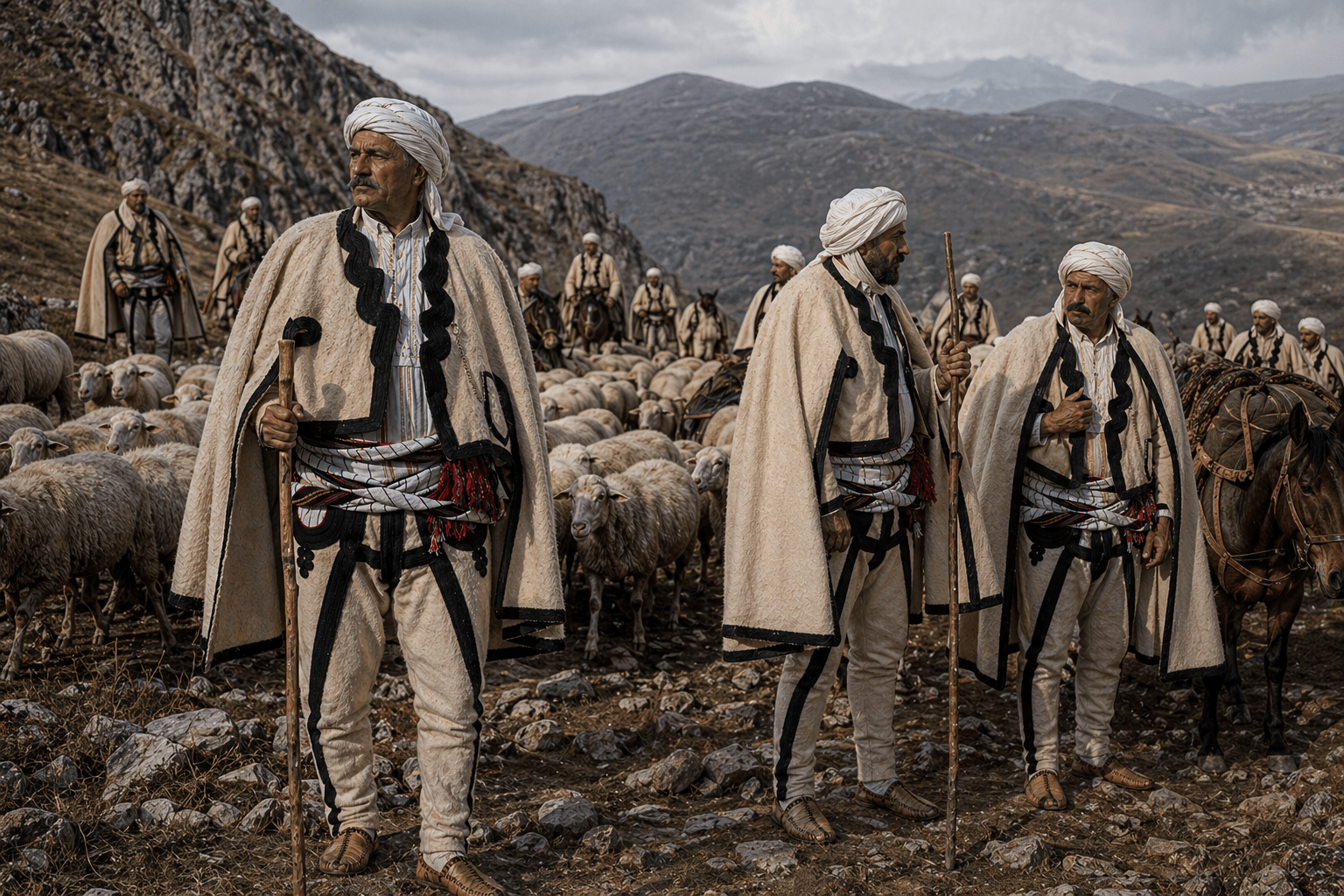
The Albanians of Rozhajë and Rugova traditionally wintered their herds around Bijeljina and Brčko in Bosnia, while some Berane herders stayed closer during milder winters. Wealthier shepherds occasionally remained in Bosnian mountains through summer. The last major transhumance occurred around 1870, with large flocks (e.g., 1,200 sheep by Rajkovići) driven northward. The 1875–1878 wars and new borders ended this practice, forcing herders to redirect livestock toward the Adriatic, Aegean, and nearby valleys. Rugovans drove thousands of sheep as far as Thessaloniki and Shkodra, enduring month-long journeys filled with difficult crossings, while others headed to Kosovo, Peshter, or coastal lowlands.
Cited:
“The Rožajci (Albanians of Rozhaje) and Rugovci (Albanians of Rugova) say that they wintered around Bijeljina and Brčko. However, some herders from the Berane area say that they sometimes stayed closer. This happened in those years when the winter was milder and the summer was somewhat more fertile, so not many cattle came to Bosnia for the winter.
At that time, it happened that some wealthier herders would stay with their cattle in the Bosnian mountains over the summer. Bole Šoškić from the Polim village of Ulotine did not return from Bosnia for three years, because his mountain was pressed by the Klimenti (Kelmendi). The last descent into Bosnia was around 1870. That year, the Rajkovići from Brezovica near Plav drove 1,200 sheep into Bosnia, and Žujo Cimbaljević 300 from Dapsić.
The wars of 1875-1878 put an end to this movement. The new border completely prevented any crossing into Bosnia, as it had been to Pomoravlje before. This at first greatly confused the herders. Having recovered a little, they, in distress, turned to the Adriatic and Aegean coasts, and many went down to the neighboring valleys and Peshter for the winter.
From Rugova, cattle were driven to Thessaloniki and Shkodra; from the Plav-Gucia valley to Shkodra and Lezhë, from Rozhajë to Kosovo. Tahir Ibra Shkreli from Rugova drove 4000 sheep to the Thessaloniki Field in 1905, and Aci Usein, a Rugova resident from Alagina Rijeka, “followed his 1200 sheep to Thessaloniki.
The cattle-breeding journey to the Thessaloniki coast was fraught with great difficulties. A whole month was spent on the road. The crossings were particularly difficult, where herd after herd had to be caught up. The Rugova residents took several horses with them, on which they carried necessary things, exhausted lambs, and exhausted sheep.”
Source
Posebna Izdanja. Editions Speciales. Edition 12–14. Geografsko Društvo, Belgrad. 1932. p. 32

