
Summary
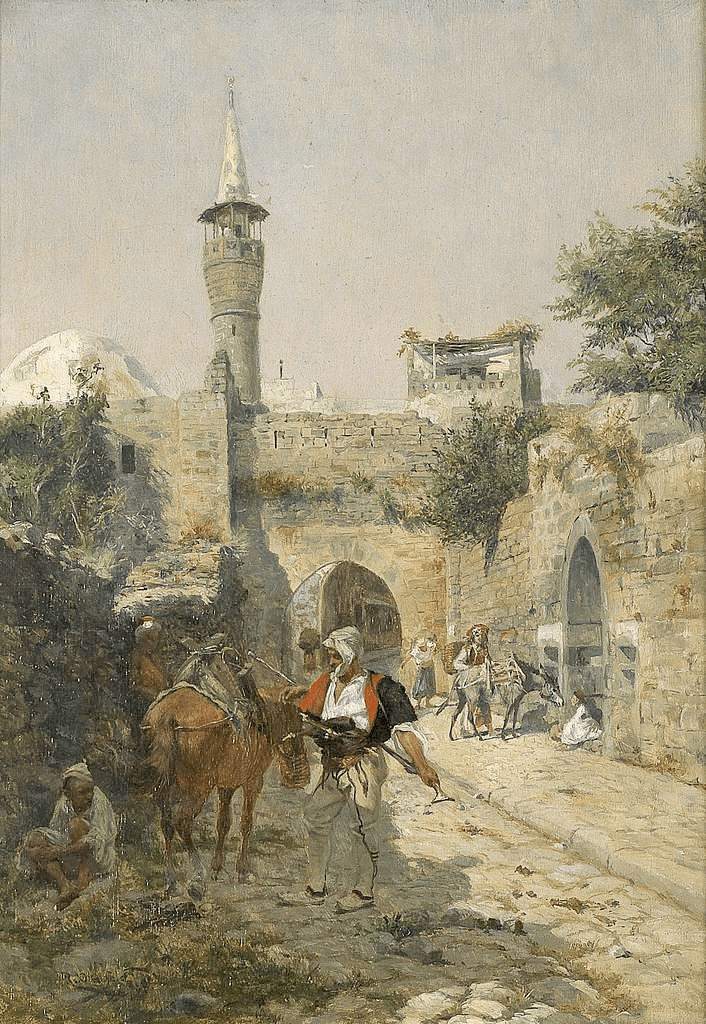
The Albanian presence in Jerusalem represents a remarkable but little-known chapter of history. Between 1831 and 1840, Albanian troops under Mehmet Ali Pasha and his son Ibrahim Pasha controlled Jerusalem and much of Syria-Palestine. As modernizing rulers, they introduced significant reforms, granting greater religious freedoms to Jews and Christians, promoting equality before the law, and allowing European consulates and church bells in the Holy City. This decade of Albanian rule ended in 1840 due to European intervention. Though largely erased from mainstream narratives and often misattributed to Egyptians, this episode highlights Albanians as active protagonists in one of the world’s most contested cities.
At first glance, Jerusalem and the Albanians seem to have no connection whatsoever. Geographically, they are 1,736 miles apart. If you take the time to explore the thousands of years of history of the City of David and Solomon, of Jesus Christ and the Prophet Muhammad, you will discover a surprising fact: for nearly a decade, from 1831 to 1840, the Holy City of Jerusalem was under Albanian rule.
Sultan Mahmud II of the vast Ottoman Empire, which stretched across three continents, believed that by massacring the Janissaries on 10 June 1826 he had broken their power forever. Albanians had held dominant positions within the Janissary corps. What the Sultan could not foresee was that, just eight years later, Albanians would once again pose the most serious threat to the Ottoman throne. Had Europe not intervened, the army of Mehmet Ali — an Albanian soldier — might well have captured Istanbul itself.
When speaking of Jerusalem and other “holy lands,” Albanians appear as unexpected but significant protagonists. While countless empires and great nations have fought for control of this sacred city — the capital of two peoples and the spiritual center of three religions — the Albanian presence there is usually reduced to a single, remarkable episode.
Anyone who has read biographies of Napoleon Bonaparte has likely encountered the dramatic event at Jaffa Castle, near Jerusalem. During his Egyptian campaign, after easily conquering Gaza, Napoleon’s 35,000-strong army encountered fierce resistance at the fortress of Jaffa.
The defenders were Albanians. After four days of bloody fighting, they surrendered on the promise that their lives would be spared. However, Napoleon, after a sleepless night, ordered their execution. According to the Russian historian Yevgeny Tarle, between 2,400 and 10,000 Albanian soldiers were massacred on 6–7 March 1799. Other sources give figures between 1,200 and 4,100.
Thirty years later, Albanians reappeared in the region — this time not as defenders, but as conquerors.
One of these “Ottoman” soldiers, Mehmet Ali of Kavala (most likely originally from the village of Zëmblak near Korça in Albania), rose to power in Egypt. In 1811, he eliminated the Mamluk leadership in a single night and established his own military regime. What followed is known in Egyptian history as the “Albanian period,” which lasted over 150 years.
Frustrated with the Ottoman Sultan, Mehmet Ali launched his own military campaigns. Although history books call it the “Turko-Egyptian War,” his army was overwhelmingly composed of Albanian troops. In 1831–1832, he conquered Palestine and Syria with relative ease. Jerusalem fell in December 1831, and the port city of Acre (Akra) surrendered on 27 May 1832.
After the victory at the Battle of Konya in December 1832, Mehmet Ali’s son, Ibrahim Pasha, destroyed the main Ottoman army. With the road to Istanbul open, Mehmet Ali openly threatened the Sultan’s throne. Only the direct intervention of the European powers prevented the collapse of the Ottoman Empire.
From 1831 to 1840, Jerusalem and much of Syria-Palestine were under Albanian control. The period is often referred to as the “Albanian Captivity” (1830–1840). The famous historian Simon Sebag Montefiore, in his book Jerusalem, describes how the Albanian army entered the city “happy and content,” accompanied by music and celebration.
For the first time in centuries, Jews and Christians enjoyed greater freedoms: they were allowed to ride horses, wear clothes previously reserved for Muslims, and were relieved of the jizya tax. Ibrahim Pasha, known as “Kuqi” (the Red) because of his reddish beard, introduced European-style reforms, including equality before the law and the opening of consulates.
The Albanians proved to be enthusiastic modernizers. They allowed the reconstruction of churches and synagogues and even permitted church bells to ring again for the first time since the Crusades.
In 1839–1840, the European powers — particularly Britain — intervened decisively to preserve the Ottoman Empire. After military pressure and the London Convention of 1840, Mehmet Ali was forced to withdraw from Syria, Palestine, and Jerusalem. On 27 November 1840, the Albanian forces left the Holy City.
The decade-long Albanian rule over Jerusalem left surprisingly few traces in local history books. When mentioned at all, it is usually attributed simply to “the Egyptians.” Even the name “Zamalek” — one of Cairo’s most prominent neighborhoods — is believed to derive from the Albanian village of Zëmblak, the ancestral home of Mehmet Ali.
The last notable echo of this Albanian-Egyptian dynasty was Princess Fawzia Fuad Ali, daughter of King Fuad and sister of King Farouk. She became Queen of Iran as the first wife of Shah Mohammad Reza Pahlavi and was once celebrated by Hollywood as “the most beautiful woman in the world.”
This fascinating chapter of Albanian history in Jerusalem and Egypt remains largely unknown — a story that still carries the purity of myth. Throughout their rule, these Albanians never claimed to be Ottomans. They never forgot — and never stopped declaring — that they were Albanians.
References
Akropolites, George. The History. Translated and edited by Ruth Macrides. Oxford: Oxford University Press, 2007.
Günther, Hans F. K. The Racial Elements of European History. Translated by G. C. Wheeler. London: Methuen, 1927.
Montefiore, Simon Sebag. Jerusalem: The Biography. New York: Alfred A. Knopf, 2011.
Rexha, Riza. Ulqini në vitet e Lidhjes Shqiptare të Prizrenit 1878–1881. Ulqin: Art Club “Rifat Kukaj”, 1998.
St. Jerome. Commentariorum in Isaiam (Commentary on Isaiah). In Patrologia Latina, vol. 24, edited by Jacques-Paul Migne. Paris, 1845–1855.

