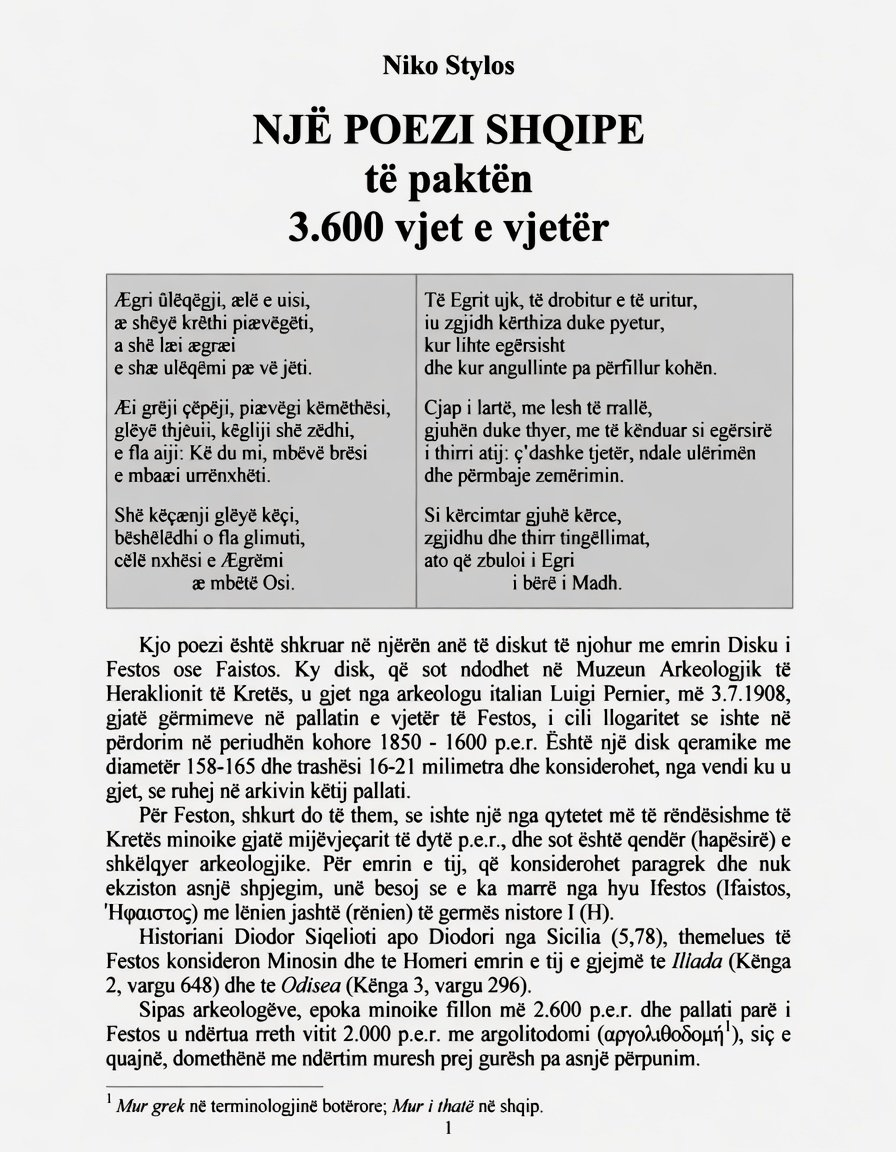

by Niko Stylos
Summary
Niko Stylos presents an ancient Albanian poem, stated to be at least 3,600 years old, inspired by the famous Phaistos Disc discovered in Crete in 1908. The two-column poem vividly describes majestic mountains, soaring eagles, and powerful natural forces, using rich, archaic Albanian imagery. The accompanying text links the poem to the Minoan Phaistos Disc (c. 1850–1600 BC), suggesting linguistic and cultural connections between ancient Minoan Crete and Albanian (Illyrian/Pelasgian) roots. It references archaeological findings, classical historians like Diodorus Siculus and Homer, and argues that the disc’s script and themes reflect early Indo-European poetic traditions preserved in modern Albanian.
Transcribed:
“Egri uleqëgi, ale e uisi,
a shehye krëthi piavëgëti,
a shë laei egraei
e shae uleqëmi pae ve jeti.Aei greji çepëji, piavëgi këmëthësi,
glëvë thjëuii, këglliji shë zëdhi,
e fla aiji: Kë du mi, mbëvë brësi
e mbaaei urrënxhëti.Shë këçanji glëvë këçi,
bëshëlëdhi o fla glimuti,
cëlë nxhësi e Ægrëmi
ae mbëtë Osi.
Të Egrit ujk, të drobitur e të uritur,
iu zgjidh kërthiza duke pyetur,
kur lihte egërsisht
dhe kur angullinte pa përfillur kohën.Cjap i lartë, me lesh të rrallë,
gjuhën duke thyer, me të kënduar si egërsirë
i thirri atij: ç’dashke tjetër, ndale ulërimën
dhe përmbaje zemërimin.Si kërcimtar gjuhë kërcë,
zgjidhur dhe thirr tingëllimat,
ato që zbuloi i Egri
i bërë i Madh.”
English:
“Where the sun rises, there is light,
and the high mountains are illuminated,
where the eagle builds its nest
and the stars set on the peaks.
The great peaks, illuminated by dawn,
the high peaks, the high mountains,
and the eagle: It is there, in the middle of the rocks
and in the high rocks.
The high peaks shine,
the shining light of the mountains,
all the high peaks of the Eagle
and the great Osi.
The Eagle rises, it thunders and roars,
it flies high in the wide sky,
when it sees the eagle
and when it calls on the high peaks.
The eagle and the lion, with a loud roar,
fly high in the sky, when they see the eagle
and the three eagles: from the high peaks,
they descend to the earth.
The high peaks of the eagle,
the high and three peaks,
where the Eagle
and the great Madh dwell.”
Context
This poem is still recited today and is discussed together with the Disk of Phaistos or the Disk of Festos. This disk, which was found at the archaeological site of Heraklion in Crete, by the Italian archaeologist Luigi Pernier, on July 3, 1908, is considered one of the oldest writings and the oldest poem of Festos, and it is believed to date from the period of the Middle Minoan era 1850–1600 BC. It is also a ceramic disk with a diameter of 158–165 mm and a thickness of 16–21 millimeters and is considered, according to the experts, to be written in the ancient Palladian script.
For Festos, it is said that it was one of the most powerful cities of Minoan Crete, and it is believed that the king (prince) and ruler of archaeology was there. For the name and the time, it is considered a parallel and an exact match with the name of the king of I Festos (Iphaistos, Ἥφαιστος) with the linear script (ruler) of the first dynasty I (H).
The historian Diodorus Siculus or Diodorus of Sicily (5,78), mentions that Festos is considered Minoan and that Homer mentions the time and the great Illiada (Book 2, verse 648) and that of Odisea (Book 3, verse 296).
According to archaeologists, the Minoan era is filled with 2,600 BC and the palaces in Festos were built around 2,000 BC. with argilotodomi (ἀργυλοδομή), such and such, built with strong walls before the great catastrophe.
Reference
¹ Mur grek in Greek terminology; Mur i thatë in Albanian.

