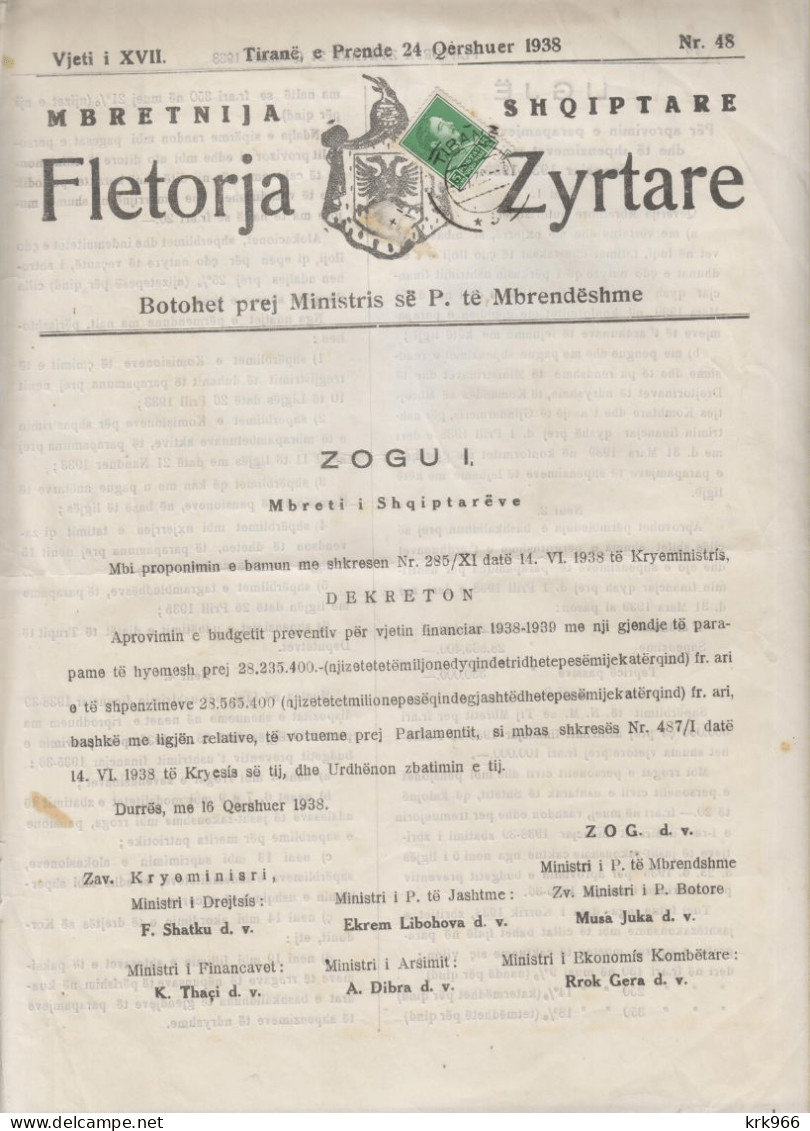

The Fletorja Zyrtare (Official Gazette) of the Kingdom of Albania under King Zog I offers an invaluable window into the everyday functioning of a young Balkan state striving for modernization in the turbulent interwar period. The excerpts presented here—spanning court rulings, financial decrees, citizenship grants, debt auctions, municipal tenders, and international agreements—paint a vivid picture of Albania in 1937–1938, on the eve of the Italian invasion of 1939.
Justice, Feuds, and Social Order
Criminal cases in the Gazette reveal the persistent tension between traditional customs and the modern state. In one notable ruling, Ymer Vokri was sentenced to death for premeditated murder under Article 405 of the Criminal Code. The court established that the victim, Nikoll Tomas, had years earlier killed a friend of the accused after catching him stealing sheep in the mountains — a classic blood feud (gjakmarrja) motive rooted in highland society.
Other announcements deal with expulsions, illegal cohabitation, and fugitives. The state used the Gazette to publicize arrest warrants and decisions, relying on gendarmes and police to enforce central authority in remote areas like Mat, Kruja, and Kolonja.
Economy, Debt, and Emigration
Economic life appears precarious. Multiple auction announcements detail the forced sale of properties belonging to debtors who had emigrated. For example, Zef Nika and Gjok Nika from Katundi i Kallmet failed to appear and faced seizure of their assets. Other debtors included Vasil Mihal Qipo (now in Russia) and members of the Kreshova family (residing in the United States).
These cases highlight a recurring pattern: significant Albanian emigration for economic or political reasons, with families maintaining land ties back home. Municipalities such as Fier and Zogaj (Saranda) issued tenders for tax collection rights, while the state managed budgets carefully, as seen in the approval of revenue and expenditure projections for the 1938–1939 financial year.
Infrastructure, Finance, and Foreign Influence
The documents reflect Albania’s dependence on foreign capital and expertise. Decrees approved loans contracted with Italy’s Banco di Napoli in 1936 and referenced conventions for the Port of Durrës (Durazzo). Agreements with the Italian company AGIP (on petroleum products, gasoline, and profit tax forfaiting for 1939–1949) underscore growing Italian economic penetration.
Public works and concessions — from road maintenance tools to thermal waters — formed another key theme, as the government sought to develop infrastructure while balancing the budget.
Nation-Building and Citizenship
A recurring priority was defining and expanding the Albanian citizenry. The Gazette regularly granted citizenship to individuals of “Albanian race and language” returning from Yugoslavia (e.g., Gusinje, Dibër in Macedonia) or elsewhere. One such case involved Hilmi Aliko, born in Dibër. These policies supported repatriation and reinforced ethnic-linguistic criteria for national belonging.
Business registrations, such as the “Vllazën Hoxha” collective society in Durrës or the partnership of Vasil Bakalli & Athanas Papingji, further illustrate the growth of a small commercial class.
Academic and Historical Value
These fragments from the Official Gazette hold significant academic value as primary sources. They allow historians to study:
State formation and the centralization of power in a tribal-influenced society.
Legal modernization versus customary law.
Economic conditions and emigration patterns.
Foreign economic relations, especially with Italy, in the lead-up to 1939.
Social micro-history through names, villages, and individual cases (including families like the Nika from northern Albania, potentially linked to broader Malësia heritage).
While bureaucratic in tone, such records are essential for understanding how ordinary Albanians experienced the Zogist state — through courts, taxes, property disputes, and citizenship processes. They complement oral histories and diplomatic sources, offering concrete data for genealogists, legal historians, and scholars of Balkan nation-building.
In an era of rapid change and external pressure, these dry announcements reveal a state actively legislating, judging, taxing, borrowing, and defining itself — one proclamation at a time. The Fletorja Zyrtare remains a rich, underutilized resource for anyone seeking to understand Albania on the cusp of World War II.
Sources
Excerpts from the Official Gazette of the Kingdom of Albania, 1937–1938.

