

by Aleksander Hasanas
Summary
Epirus was a mountainous region in northwestern Greece, home to the Molossians and other tribes. The Epirots claimed heroic ancestry through Achilles. Known for its harsh terrain, fierce Molossian hounds, and the ancient oracle of Zeus at Dodona, Epirus was often politically divided, uniting only loosely under tribal leaders. Its history was closely tied to Macedon and Illyria, with shifting alliances and conflicts. The kingdom reached its peak under King Pyrrhus, a skilled conqueror who expanded Epirote power and challenged Rome. After his death, Epirus weakened, and by 232 BC its monarchy collapsed into a tribal confederacy.
Epirus
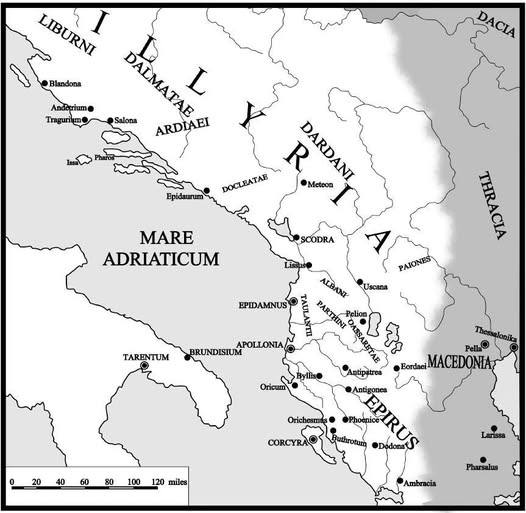
Closely linked to the Illyrians were the Molossians, the leading tribe of the rough country south of Illyria and west of Thessaly known to the Greeks as Epirus. Reluctantly admitted to be Greeks by their fellow nationals, the Epirots claimed descent from a son of Achilles who had settled there after the Trojan War.
Thirteen other tribes were also part of Epirus, a region which is particularly afflicted by the Greek landscape, and especially by the Pindus mountain chain, which makes Epirus a land of narrow valleys and tiny plateaux cut across by massive mountain ranges. The humid summers and freezing winters made Macedonian soldiers nostalgic for the mountains of upper Macedonia which the Epirot landscape and climate closely resembled.
Among the Greeks, Epirus was famed principally for its huge and ferocious Molossian hounds, which were the ancient world’s premier hunting and guard dogs (and which are possible ancestors of both the St Bernard and Rottweiller breeds). Epirus was also known for the oracle and sanctuary of Zeus at Dodona.
The oracle was of great antiquity and even predated that of Apollo at Delphi. Like Illyria, Epirus was more or less a kingdom on those occasions when its various tribes agreed to be so, though the rulers (generally from the Molossian tribe) styled themselves ‘protectors’ rather than kings. Macedon tended to dominate Epirus, but both states were united in their distaste for the Illyrians, who, whenever given the chance had a tendency to plunder either nation indiscriminately.
A marriage alliance between Macedon and Epirus produced the most famous of Epirot exports – the warlike King Pyrrhus. Though he began his rule as a minor and with a co-ruler, Pyrrhus rapidly established himself as the sole power in Epirus and quickly went on to make Epirus the principal power in Greece.
Like Alexander, Pyrrhus had a taste for conquest, which he first took out on the Illyrians by annexing their southern territory, probably as far north as the Greek city of Epidamnus. He then secured that flank by allying with King Bardylis of Dardanos, and decisively broke Macedon’s power over his kingdom. Pyrrhus was undone by over-reaching his strength in an attempt to conquer southern Italy from the Romans.
He attempted to restore his fortunes by attacking Macedon, and even managed to seize the kingship there in 274 BC. Eventually ejected from Macedonia, Pyrrhus turned on the Peloponnese and eventually died whilst attacking Argos.
The career of Pyrrhus represented the high tide of Epirot fortunes. Though he established Ambracia as the Epirot capital and embellished the shrine at Dodona, the most enduring legacy of Pyrrhus was the entrenched enmity of Illyria, Macedon and Greece towards his kingdom.
By 232 BC the embattled state was crumbling under constant attacks from its neighbours. The monarchy was dissolved, allowing the tribes greater independence in a loose confederacy.
Reference
Matyszak, Philip. Roman Conquests: Macedonia and Greece. Barnsley: Pen & Sword Military, 2009.

