
by Gurakuç Kuçi
Summary
Security analyst Gurakuç Kuçi warns that Serbia is executing a multifaceted hybrid strategy against Kosovo, blending propaganda, disinformation, military buildup, and Russian-backed influence operations. He highlights Serbia’s protection of figures linked to the Banjska attack and its “neutral” facade masking deeper ties with Russia. Kuçi stresses hybrid threats—propagandistic, psychological, and social—exploit Kosovo’s internal divisions. He urges stronger Kosovo-Albania coordination on strategic reserves, information security, and resilience. With KFOR issuing warnings, Kuçi calls for unity: division in dangerous times becomes a national weakness, as the region faces heightened insecurity.
There are moments when politics is no longer measured by daily debates, but by the ability to defend the country in difficult times.
In this discussion, we spoke about a reality that is often underestimated: Serbia is not acting only through statements against Kosovo. It is building a broader strategy, where propaganda, hybrid warfare, armament, ties with Russia, and efforts to weaken Kosovo from within come together.
The main points we addressed:
- Serbia is presenting itself as “neutral”, which in practice allows it to pursue its goals more easily together with Russia.
- Russian media have now taken the lead in defending Serbia, and they are not merely following the rhythm after the sentencing of Serbian terrorists in – Kosovo, which exposes Serbia as a state that supports terrorism.
Radoicic and his group are not simply isolated individuals. The Banjska case showed that the problem is much deeper and is linked to structures that have political, financial, and security support. - Serbia is arming itself from several directions and preparing for every scenario, while we often deal with internal divisions.
- The European Union sees the danger, but it is still not acting with the force the situation requires.
- The risk for Kosovo is not only military. It is also propagandistic, diplomatic, psychological, and social.
- KFOR has warning steps in this direction.
- During elections and political crises, Serbian propaganda tries to deepen the division among citizens, the media, and political parties in Kosovo.
- Kosovo and Albania must cooperate strategically and deepen the organization of the creation of strategic reserves. Therefore, my message was simple: Kosovo and Albania must behave more seriously as two states that share the same strategic interest.
We need more coordination, more care with information, more social resilience, and less fighting over positions. Because at a time when Serbia works with a plan, Russia works with propaganda, and the region is entering a new phase of insecurity, we cannot behave as if everything is normal.
Division in peacetime is a political problem. Division in times of danger becomes a national weakness.
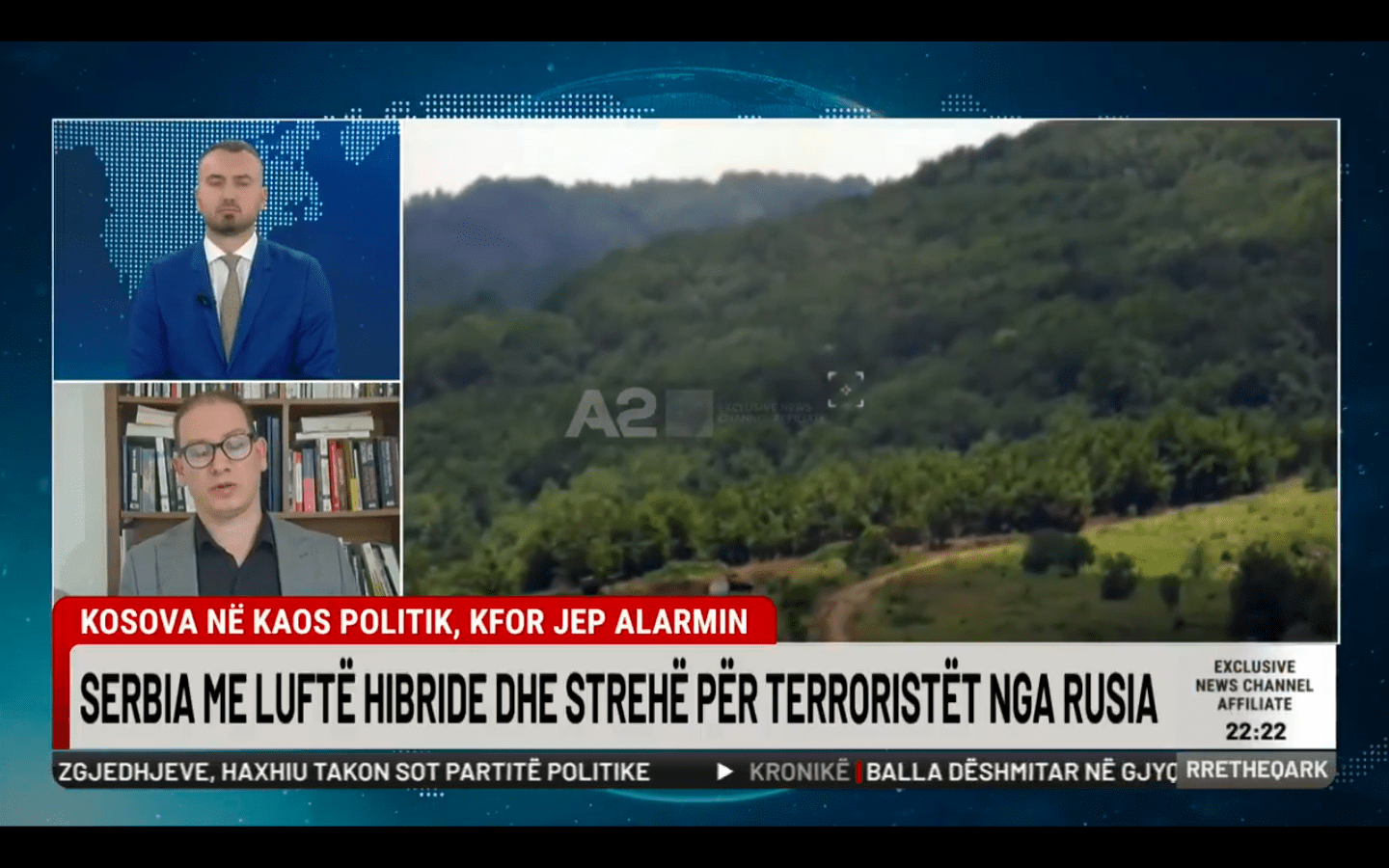
Here in the video is only one part of the interview, while in the first comment, the first link contains the full interview, and the other links are separate parts from the interview.
Source

