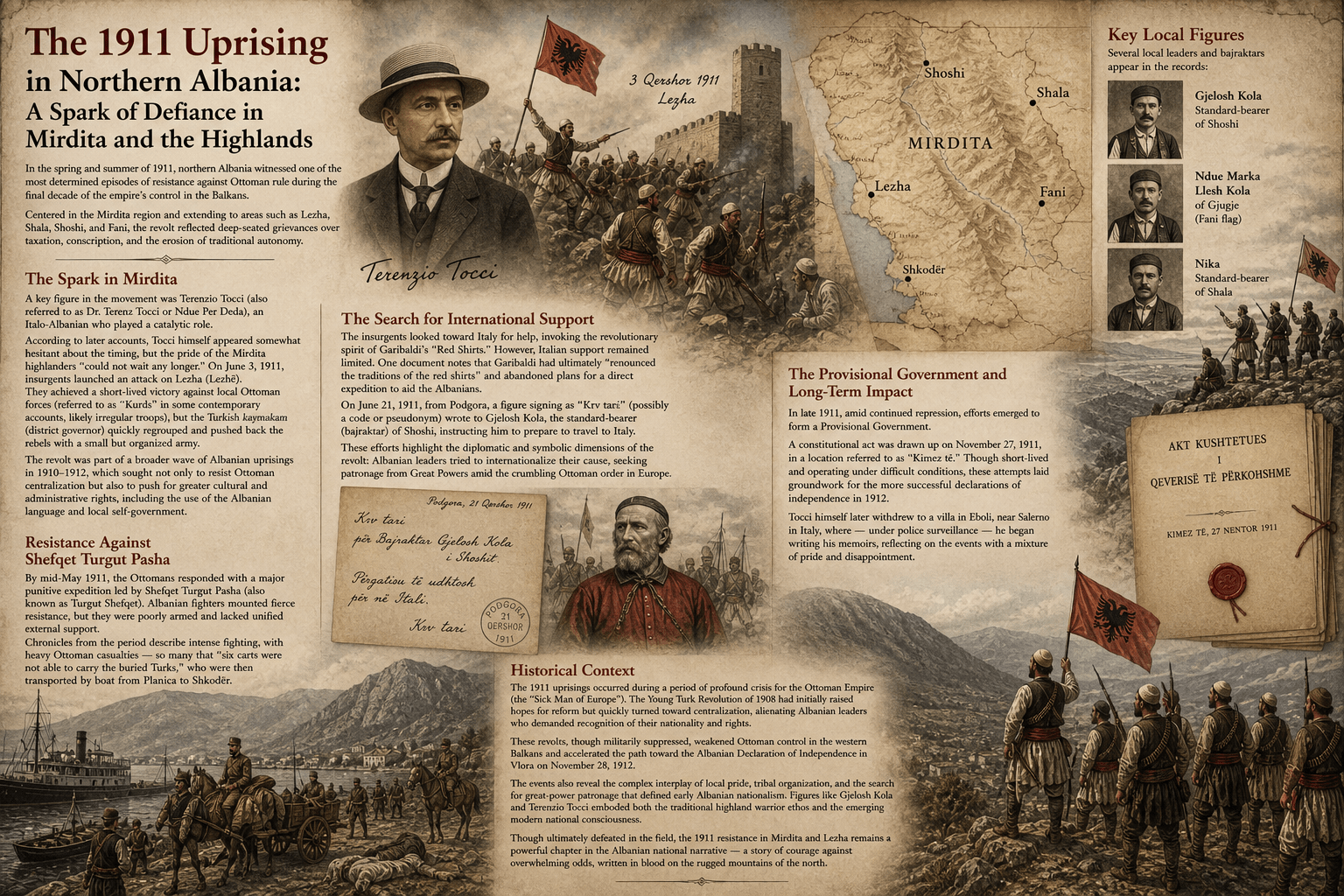

In the spring and summer of 1911, northern Albania witnessed one of the most determined episodes of resistance against Ottoman rule during the final decade of the empire’s control in the Balkans. Centered in the Mirdita region and extending to areas such as Lezha, Shala, Shoshi, and Fani, the revolt reflected deep-seated grievances over taxation, conscription, and the erosion of traditional autonomy.
The Spark in Mirdita
A key figure in the movement was Terenzio Tocci (also referred to as Dr. Terenz Tocci or Ndue Per Deda), an Italo-Albanian who played a catalytic role. According to later accounts, Tocci himself appeared somewhat hesitant about the timing, but the pride of the Mirdita highlanders “could not wait any longer.”
On June 3, 1911, insurgents launched an attack on Lezha (Lezhë). They achieved a short-lived victory against local Ottoman forces (referred to as “Kurds” in some contemporary accounts, likely irregular troops), but the Turkish kaymakam (district governor) quickly regrouped and pushed back the rebels with a small but organized army.
The revolt was part of a broader wave of Albanian uprisings in 1910–1912, which sought not only to resist Ottoman centralization but also to push for greater cultural and administrative rights, including the use of the Albanian language and local self-government.
Resistance Against Shefqet Turgut Pasha
By mid-May 1911, the Ottomans responded with a major punitive expedition led by Shefqet Turgut Pasha (also known as Turgut Shefqet). Albanian fighters mounted fierce resistance, but they were poorly armed and lacked unified external support. Chronicles from the period describe intense fighting, with heavy Ottoman casualties — so many that “six carts were not able to carry the buried Turks,” who were then transported by boat from Planica to Shkodër.
The Search for International Support
The insurgents looked toward Italy for help, invoking the revolutionary spirit of Garibaldi’s “Red Shirts.” However, Italian support remained limited. One document notes that Garibaldi had ultimately “renounced the traditions of the red shirts” and abandoned plans for a direct expedition to aid the Albanians. On June 21, 1911, from Podgora, a figure signing as “Krv tarı” (possibly a code or pseudonym) wrote to Gjelosh Kola, the standard-bearer (bajraktar) of Shoshi, instructing him to prepare to travel to Italy.
These efforts highlight the diplomatic and symbolic dimensions of the revolt: Albanian leaders tried to internationalize their cause, seeking patronage from Great Powers amid the crumbling Ottoman order in Europe.
Key Local Figures
Several local leaders and bajraktars appear in the records:
Gjelosh Kola — Standard-bearer of Shoshi
Ndue Marka Llesh Kola of Gjugje (Fani flag)
Nika — Standard-bearer of Shala
Their involvement underscores the traditional clan and bajrak (banner) structure that organized highland resistance.
The Provisional Government and Long-Term Impact
In late 1911, amid continued repression, efforts emerged to form a Provisional Government. A constitutional act was drawn up on November 27, 1911, in a location referred to as “Kimez té.” Though short-lived and operating under difficult conditions, these attempts laid groundwork for the more successful declarations of independence in 1912.
Tocci himself later withdrew to a villa in Eboli, near Salerno in Italy, where — under police surveillance — he began writing his memoirs, reflecting on the events with a mixture of pride and disappointment.
Historical Context
The 1911 uprisings occurred during a period of profound crisis for the Ottoman Empire (the “Sick Man of Europe”). The Young Turk Revolution of 1908 had initially raised hopes for reform but quickly turned toward centralization, alienating Albanian leaders who demanded recognition of their nationality and rights. These revolts, though militarily suppressed, weakened Ottoman control in the western Balkans and accelerated the path toward the Albanian Declaration of Independence in Vlora on November 28, 1912.
The events also reveal the complex interplay of local pride, tribal organization, and the search for great-power patronage that defined early Albanian nationalism. Figures like Gjelosh Kola and Terenzio Tocci embodied both the traditional highland warrior ethos and the emerging modern national consciousness.
Though ultimately defeated in the field, the 1911 resistance in Mirdita and Lezha remains a powerful chapter in the Albanian national narrative — a story of courage against overwhelming odds, written in blood on the rugged mountains of the north.
Source
Clan Editions 98–105. 1999

