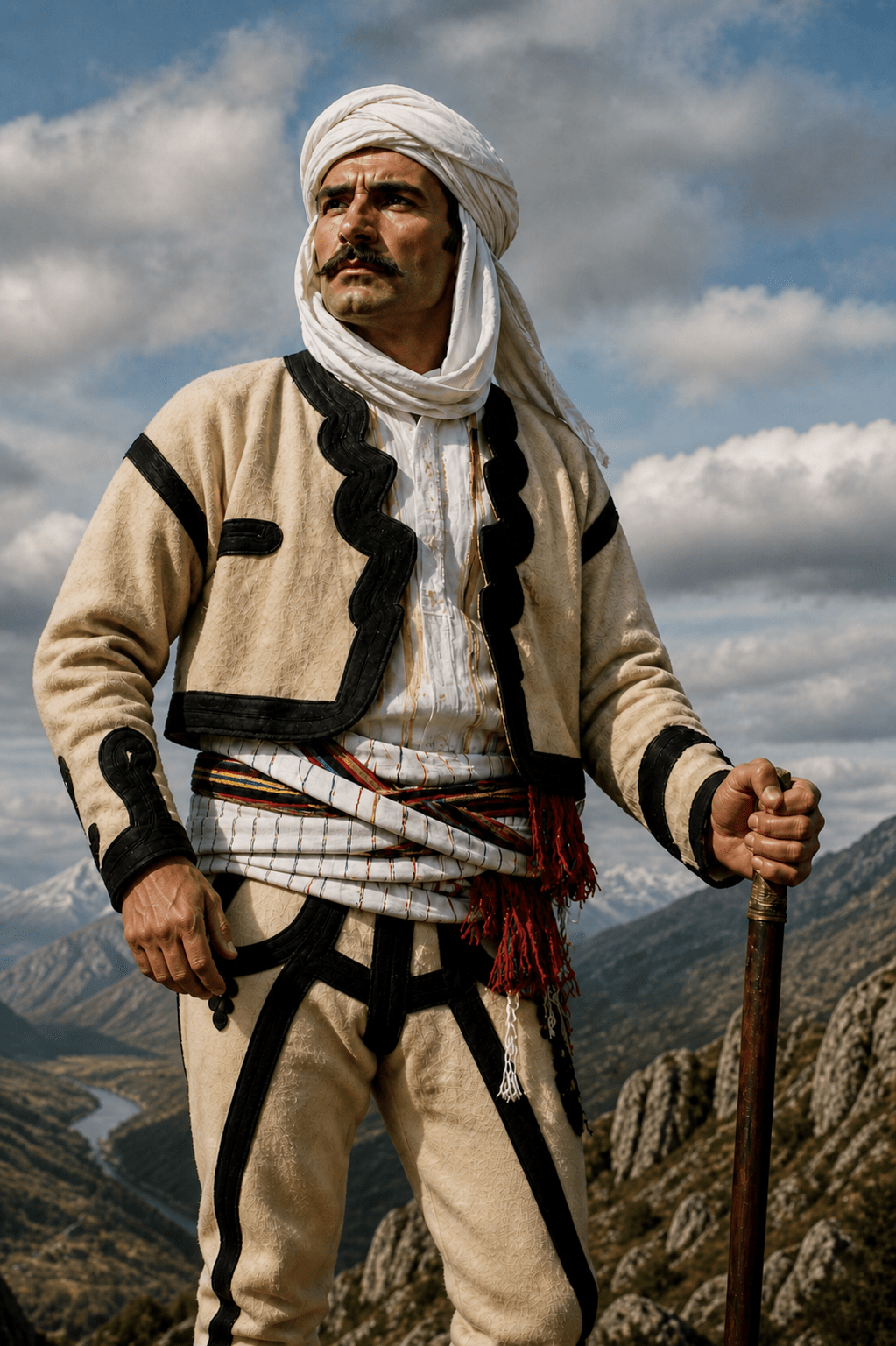

In the literary world of the Balkans, few figures embody the collision of personal honor, tribal identity, and epic morality as powerfully as Sadri Binak. Emerging from the mountainous frontier of Rugova, Sadri Binak stands as one of the most compelling warrior-figures in the story Unusual Duel (Neobičan dvoboj), a Serbian literary version shaped by centuries of blood-feuds, contested borders, and heroic traditions.
At the center of the story is not simply a conflict between two men, but between two worlds: Rugova and the Vasojević (an Albanian tribe), represented by Sadri Binak and Panta Cemov. Their rivalry symbolizes what one critic described as “two old, bloody, feuding kingdoms” whose borders were historically drawn and redrawn by violence, swords, and severed heads. This historical memory forms the background against which Sadri Binak’s character is built.
The Warrior of Rugova
Sadri Binak is introduced as a legendary Rugovan standard-bearer and warrior, celebrated among his people for his skill in battle. His exploits in gunfights against the Vasojevićs are immortalized in song, accompanied by the lahuta, the traditional instrument of Albanian epic poetry. In this sense, Sadri exists not merely as an individual but as a living epic hero—a man whose reputation is carried in oral tradition.
Yet his heroic identity is disturbed by one recurring story: that Panta Cemov cannot be killed by rifle or bullet. For a warrior like Sadri, this is intolerable. Heroism in epic culture depends on hierarchy—someone must be the strongest, the bravest, the most feared. The existence of a rival whose invincibility is sung by others threatens Sadri’s standing. The insult is not only personal; it is symbolic. If Panta cannot be killed, then Sadri’s own legend remains incomplete.
The Duel in Berane
According to Grigorije Božović’s story “Neobičan dvoboj”, Sadri intercepts Panta Cemov in the center of Berane and challenges him to a duel. This scene is one of the story’s most powerful moments because it strips heroism down to its essentials: two men, face to face, carrying the weight of collective history on their shoulders.
One of the most striking aspects of Sadri Binak’s character is his relationship to epic morality. In heroic tradition, there are rules even in violence: fairness, courage, honesty, and respect for one’s opponent. Panta Cemov’s challenge—urging Sadri to strike first—reflects this code. There is no deception, no ambush, only direct confrontation.
Symbol of a divided world
Through Sadri Binak, Unusual Duel creates a symbolic image of the Balkan frontier: dynamic, violent, proud, and deeply divided. Rugova and Vasojević are not different. They are both Albanian, but some of the Vasojevic assimilated into the Slavic Orthodox identity. It is a rival systems of honor and memory. Sadri’s duel with Panta is a miniature version of centuries of tribal struggle. His character embodies the psychological cost of that history. He is brave, honorable and legendary – but he is also vulnerable.
Conclusion
Sadri Binak remains one of the most memorable warrior-figures in Balkan prose because he stands at the crossroads between epic tradition and literary realism. He is neither villain nor pure hero. Instead, he is something more enduring: a tragic hero shaped by song, rivalry, and the impossible demands of honor. His story reminds us that in cultures built on heroic memory, the greatest battles are often not fought against enemies, but within the self.

