
by Aleksander Hasanas
Summary
Hasanas argues that the Albanian language preserves ancient linguistic roots connected to Pelasgian and pre-Greek forms. It highlights the word δίζω found in Homer, comparing it to the Albanian dyshoj (“to doubt”), both sharing the root dy (“two”). According to Hasanas, this similarity reflects a common ancient Balkan linguistic layer and supports the antiquity of Albanian. While modern Greek uses different terms for doubt, Albanian is presented as having retained the original structure more clearly. This suggests continuity between Albanian and older Balkan languages such as Illyrian or the Pelasgian language.
Aleksander Hasanas writes:
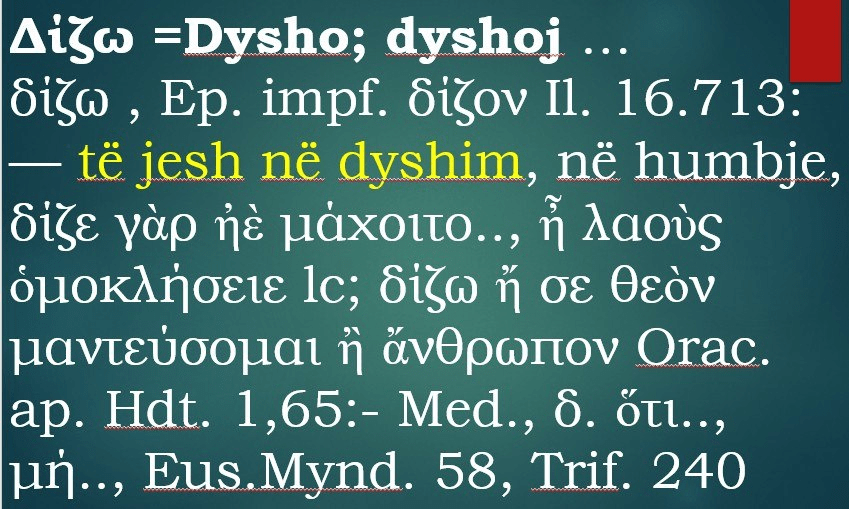
“δίζω = dyzim, dyshim — to doubt; to be in hesitation (between two voices) … between two points of view — it speaks Albanian.
The word dy-zim or dy-shoj, with the root “dy” (“two”), is entirely visible and alive in our language even today.
The fact that this word appears in Homer (in the form δίζον) with the same meaning as the Albanian dyshoj (“I doubt”) is presented as important evidence used by linguists to argue for the antiquity of Albanian and its closeness to the oldest layers of the Balkan languages (such as Pelasgian or Illyrian).
Thus, while modern Greek language has lost this form (using other words such as amfivallo), Albanian has preserved the original structure in a pure form: dy → dyshoj / dyzim.”
Reference
Perseus Digital Library, “δίζω,” Greek Vocabulary Tool, accessed May 3, 2026, Perseus entry.

