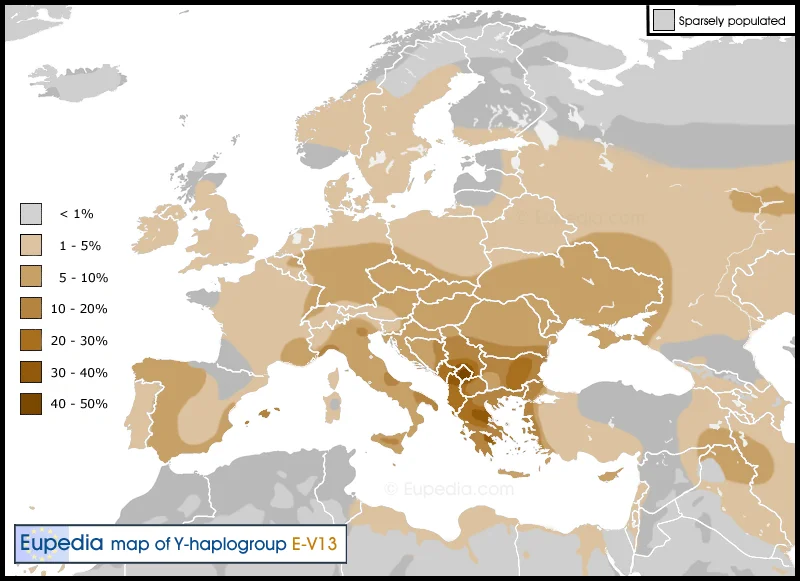

The Balkans have long been a crossroads of peoples, migrations, and cultural shifts. Modern genetic research, particularly Y-DNA haplogroup analysis, provides compelling evidence that challenges traditional narratives and reveals deep ancestral layers. One of the clearest markers is Haplogroup E-V13, which reaches its highest concentrations in Albanian habitats and shows a striking prevalence among southern Serbs and many Montenegrins. This distribution strongly supports the view that many southern Serb and Montenegrin populations carry significant Albanian (pre-Slavic Paleo-Balkan) origins, with the Slavic genetic and cultural element growing stronger as one moves northward.
E-V13: The Hallmark of Albanian and Paleo-Balkan Ancestry
E-V13 is one of the dominant paternal lineages in the Balkans, but its peak frequencies are unmistakably tied to Albanian territories. Among Albanians, E-V13 often comprises 28–50% of male lineages, reaching extraordinary levels in Kosovo (around 45–47%), northern Albania, and among Arvanites in southern Greece. This haplogroup is considered a signature of ancient Illyrian, Dardanian, and other indigenous Balkan populations that form the core of Albanian ethnogenesis.
In contrast to its rarity outside the Balkans, E-V13 forms a clear hotspot in traditional Albanian settlement areas. This is not coincidental. Genetic studies consistently show that Albanian populations preserve a high degree of continuity with ancient Balkan inhabitants, with E-V13 undergoing significant expansion during late antiquity and the early Middle Ages in these regions.
High E-V13 in Southern Serbs and Montenegrins: Evidence of Albanian Roots
When examining Serb and Montenegrin populations, a clear regional pattern emerges. Overall frequencies of E-V13 among Serbs hover around 15–20%, but they rise markedly in the south:
In Kosovo (Dardania and southern Serbia), E-V13 is significantly more prominent, often second only to other lineages and far higher than in northern Serbia.
In Montenegro, E-V13 reaches approximately 27%, with certain clans in the Brda (eastern hills) region showing over 50% in specific lineages (e.g., among Vasojevići (Vasa), Kuči (Kuqi), and Bjelopavlići (Palabardhë) tribes). These areas historically overlap with Albanian-inhabited or adjacent zones.
This elevated presence of E-V13 in southern populations mirrors the distribution in Albanian habitats. Many historians and geneticists interpret this as evidence that a substantial portion of southern Serbs and Montenegrins descend from Albanian-speaking or pre-Slavic Paleo-Balkan groups that were gradually Slavicized through language shift, religion (Orthodox Christianity), and cultural assimilation, especially during the medieval period and under Ottoman rule. Tribes in Montenegro, in particular, show historical records of Albanian origins or bilingualism before full integration into Slavic identity.
The mechanism is straightforward: Slavic migrations brought new elements into the Balkans, but in the southern and mountainous regions, incoming Slavs intermixed with and assimilated larger local populations carrying E-V13. The result is populations that today identify as Serb or Montenegrin but retain a strong paternal genetic signal from Albanian-like ancestral stock.
The North-South Gradient: Increasing Slavic Element
One of the most revealing aspects of Balkan genetics is the cline from south to north:
Southern regions (southern Serbia, Kosovo, Montenegro): High E-V13 (Albanian/Paleo-Balkan marker), lower overall Slavic haplogroups. This reflects stronger continuity with pre-Slavic inhabitants.
Central and Northern Serbia: Declining E-V13, rising I2a (particularly I2a-Din, associated with South Slavic expansions) and other Slavic-linked lineages like R1a. Northern areas show greater genetic affinity to broader Slavic migrations from the north and east.
This gradient demonstrates that the “more Slavic” the genetic profile becomes, the further north one travels. Southern populations preserve more of the ancient Balkan substrate—shared with Albanians—while northern ones reflect heavier Slavic settlement and less admixture with indigenous groups. Studies of Serbian regional samples confirm greater haplogroup differentiation, with southern/Kosovo groups standing apart due to elevated E lineages.
Historical Corroboration
This genetic picture aligns with historical accounts of Albanian presence in what is now southern Serbia and Montenegro, medieval migrations, and the Slavicization of local populations. Many Montenegrin clans trace origins to areas with documented Albanian or Vlach (often Albanian-related) roots. The high E-V13 acts as a genetic “fingerprint” confirming that Slavic identity in these southern zones was often layered over earlier Albanian or Albanoid substrates.
Implications for Understanding Balkan Identities
The elevated E-V13 in southern Serbs and Montenegrins provides strong support for the thesis that many in these regions indeed have substantial Albanian origin. It highlights how language and identity can shift over centuries while paternal lineages preserve the deeper story. Albanians, by maintaining both linguistic and genetic continuity, represent a direct link to the ancient Balkans, while neighboring groups in the south show the results of assimilation.
As more high-resolution genetic data emerges, the pattern becomes clearer: the Balkans’ population history is one of indigenous Paleo-Balkan foundations (strongest in the south and west, embodied by E-V13), overlaid by Slavic migrations whose influence intensifies northward. This does not diminish modern identities but enriches our understanding of shared heritage and the complex processes that shaped the region.
The evidence from E-V13 underscores a fundamental truth: in the southern heartlands, Albanian genetic roots run deep among those who today identify as Serbs and Montenegrins.
References
Eupedia. “European Y-DNA Haplogroups Frequencies by Country.” Accessed May 3, 2026. https://www.eupedia.com/europe/european_y-dna_haplogroups.shtml.
Mihajlović, M., et al. “Distribution of Y-Chromosome Haplogroups in Serbian Population Groups Originating from Historically and Geographically Significant Distinct Parts of the Balkan Peninsula.” Forensic Science International: Genetics 61 (2022). https://doi.org/10.1016/j.fsigen.2022.102789.
Semino, Ornella, et al. “Origin, Diffusion, and Differentiation of Y-Chromosome Haplogroups E and J: Inferences on the Neolithization of Europe and Later Migratory Events in the Mediterranean Area.” American Journal of Human Genetics 74, no. 5 (2004): 1023–1034.
Cruciani, Fulvio, et al. “Phylogeographic Analysis of Haplogroup E3b (E-M215) Y Chromosomes Reveals Multiple Migratory Events Within and Out Of Africa.” American Journal of Human Genetics 74, no. 5 (2004): 1014–1022.
Wikipedia contributors. “Genetic Studies on Serbs.” Wikipedia, The Free Encyclopedia. Last modified 2025. https://en.wikipedia.org/wiki/Genetic_studies_on_Serbs.
Balkan Academia. “The E-V13 Haplogroup of Albanians.” December 28, 2025. https://balkanacademia.com/2025/12/28/the-e-v13-hablogroup-of-albanians/.
Olalde, Iñigo, et al. “A Genetic History of the Balkans from Roman Frontier to Slavic Migrations.” Cell (2023). https://doi.org/10.1016/j.cell.2023.11.024.
The Poreklo Project / Srpska Times. “Y-DNA Haplogroups of Ethnic Serbs.” June 12–13, 2019. https://www.poreklo.rs/2019/06/12/y-dna-haplogroups-of-ethnic-serbs/ and https://thesrpskatimes.com/y-dna-haplogroups-of-ethnic-serbs/.
Additional supporting data drawn from regional Y-DNA surveys compiled on platforms such as Eupedia and peer-reviewed Balkan population genetics papers (2017–2025).

