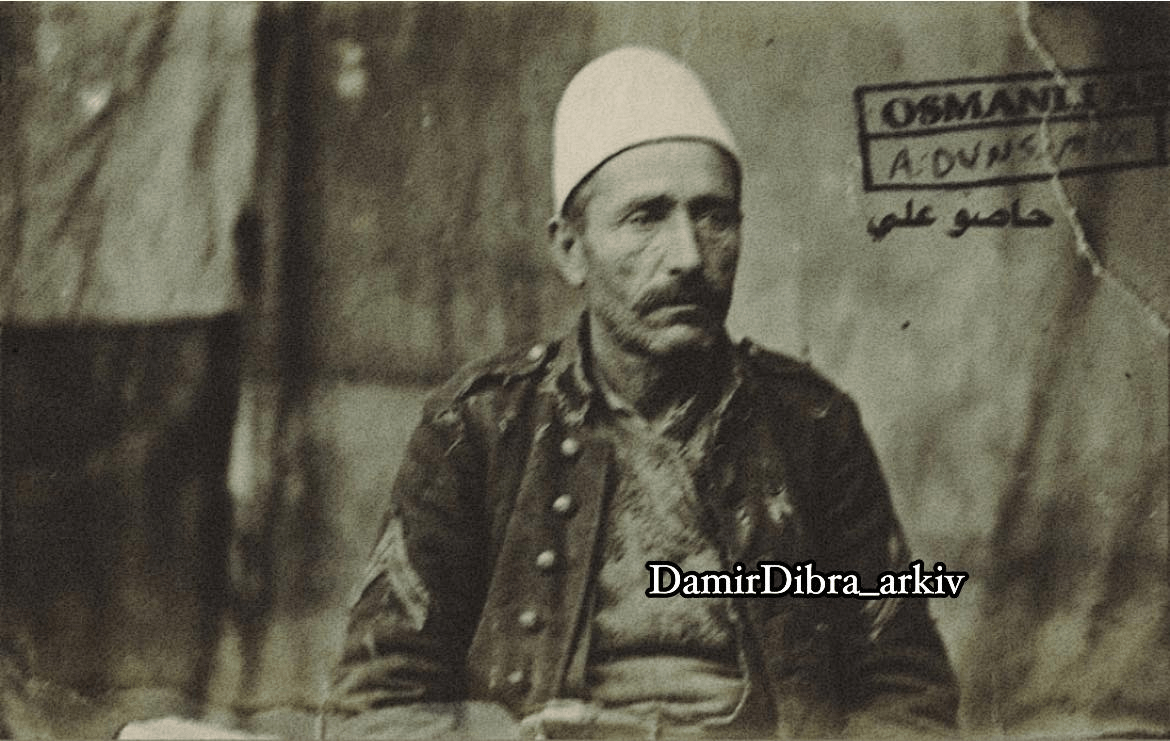

by Damir Dibra
Summary
Has Alia Qetkaj was a renowned Albanian warrior from Ledina, Dinosha, originating from the Qetkaj tribe of Kuçi. Born into a wealthy and respected family, he became a prominent cavalryman known for his bravery. He played a key role in several historic events: the 1874 blood feud in Podgorica, the Battle of Fundina (1876) where he killed a Montenegrin officer, and the decisive Battle of Nokshiq (1879), where his timely warning helped secure a major Albanian victory. He also fought in the Battle of Zharnica (1880), where he was seriously wounded. Despite his military exploits, his later life was marred by heavy drinking and gambling, leading to the loss of his fortune.
Has Alia Qetkaj was born in Ledina, into a family with a strong tradition of bravery and resistance.
The Qetkaj tribe originates from Kuçi, specifically from the village of Krzhanj. In earlier times, this family moved and settled in Dinosha, precisely in a place called Lulan, and later moved to Ledina, where they have lived for approximately 360 years.
Has Alia grew up in a family of prestige and authority. His father held the rank of binbashi (major) during the Ottoman Empire and was among the wealthiest in the region. In this spirit, Has also became a suhari — a cavalryman known for his courage, bravery, and dedication in battle.
The important events in his life begin on July 7, 1874, in Podgorica, when Jusuf Muça Krniq was killed by a relative of Marko Milani. This act ignited a blood feud. In revenge, several bands from Dinosha, including Has Alia, headed to Podgorica and killed several relatives of Marko Milani. This event was seen as a direct attack and led to a complete deterioration of relations between the Principality of Montenegro and the Ottoman Empire.
In 1876, Has Alia took part in the Battle of Fundina, one of the largest clashes of the time. There he proved himself a remarkable warrior: in direct combat, he cut off the head of a Montenegrin officer named Drago Mashov Vukmirović with his yataghan. Has himself was wounded in this battle but remained steadfast. For his bravery, he received a special horse as a gift from Istanbul — a token of recognition for his service.
In December 1879, a decisive moment occurred. Om Haku Kajoshaj learned that some Montenegrin garrisons were preparing in Kuç to attack Plavë and Gucia. He told his brother, Murat Haku: “Go to Has Alia, take the best horse, and ride to Gucia. Find Ali Pasha Gucia and tell him that Om Haku sent you, and that Marko Milani is preparing to attack with his army.”
Murat Haku carried out this mission and delivered the message in time. Thanks to this warning that came from Dinosha, the Albanian forces managed to organize and decisively defeated the Montenegrin army in the Battle of Nokshiq — one of the greatest Albanian victories of that period.
In April 1880, Has also participated in the defense of Tuzi, in the Battle of Zharnica, under the command of Baca Kurti Gjokaj and Çun Mula. In this battle he was seriously wounded, and this injury caused his health to deteriorate day by day.
Despite his great wealth, Has Alia’s life was not orderly. He was a man of pleasure, heavily given to alcohol and gambling. These vices gradually led him to lose his fortune and weakened his family life.
His brother, Mehmet Alia, was a very intelligent and brave man, but withdrawn due to deep sorrow. His two sons had died tragically — one was killed and the other drowned in the Cem River — which left him spiritually broken.
Has Alia had two sons: Ali (Lushi) and Rami, and two daughters: Hana and Caka. Because of his reckless lifestyle and the vices that gripped him, he failed to secure a good future for his children, leaving them in difficult circumstances.
He was also a relative of Shaban Muja Qetkaj, who sacrificed himself along with his comrades in his own house to prevent the Montenegrin army from entering and burning Dinosha.

