
Article | Published: 04 May 2026
Authors: Leonidas-Romanos Davranoglou, Alban Lauka, Aris Aristodemou, Zoltán Maróti, Gjergj Bojaxhi, Ardian Muhaj, Ilia Mikerezi, David Wesolowski, Brian D. Joseph & Alexandros Heraclides
Nature Human Behaviour (2026)
Abstract
The history of the Albanian people has long been debated, as they first appear in historical records in the eleventh century CE and their language is not closely related to any surviving Indo-European branches. Here, to reconstruct their history, we analysed over 6,000 ancient West Eurasian genomes and 74 newly sequenced present-day ethnic Albanians.
Using a range of population genetics methods, including an enhanced protocol to detect identity-by-descent segments between ancient and present-day individuals, we detect continuity of West Balkan Late Bronze and Iron Age ancestry in Early Medieval Albania, to a greater degree than in neighbouring Balkan regions.
We find that present-day Albanians predominantly descend from this remnant palaeo-Balkan group, which by at least 800–900 CE already exhibited a genetic profile suggesting that they are ancestral to many modern Albanians. In addition, we observe geographically structured admixture with Medieval East European-related groups, averaging 10–20% across present-day Albanians. Our findings provide insight into the demographic processes shaping Albanian ancestry and help locate the origin area of the Albanian language.
Figures
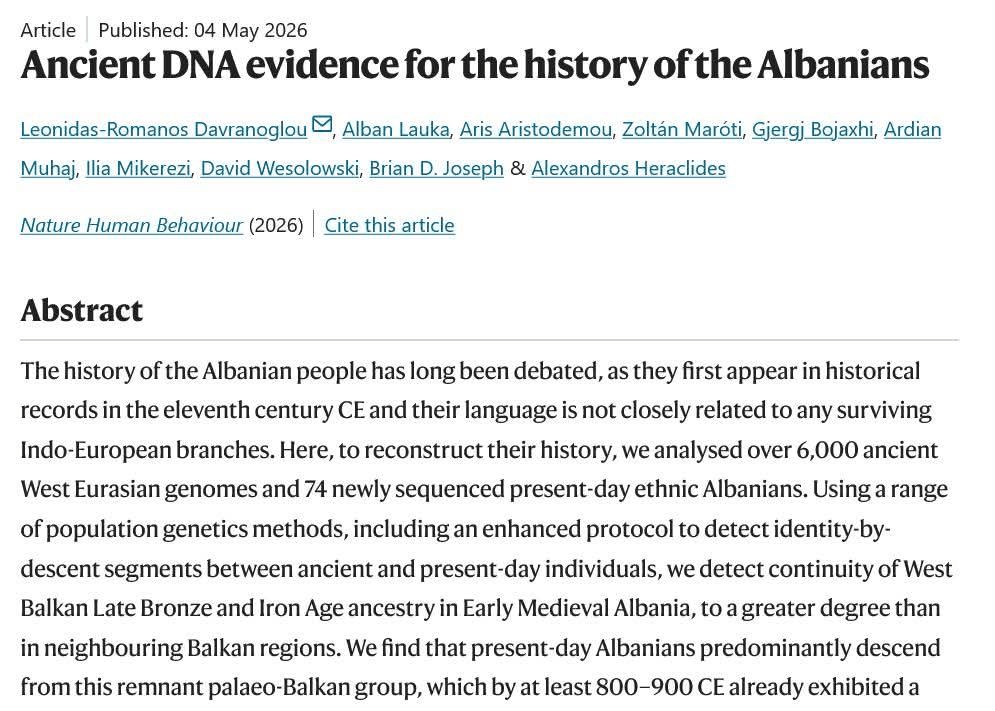
- Fig. 1: Geographical distribution and dating of the ancient and present-day Balkan populations examined.
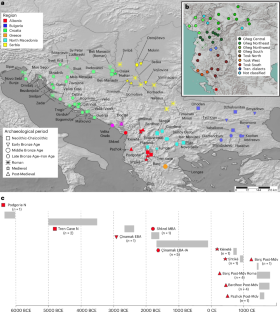
- Fig. 2: PCA of present-day West Eurasian samples (grey points) with projection of ancient Neolithic-EBA individuals from the Balkans.
- Fig. 3: PCA of present-day West Eurasian samples (grey circles) with projection of ancient BA and IA individuals from the Balkans.
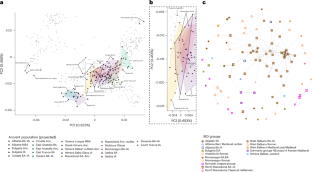
- Fig. 4: PCA of present-day West Eurasian samples (grey circles) with projection of ancient Roman, Medieval and Post-Medieval individuals from the Balkans
- Fig. 5: Ancestry proportions of present-day Albanians, shown using two proxies for East European-related ancestry.
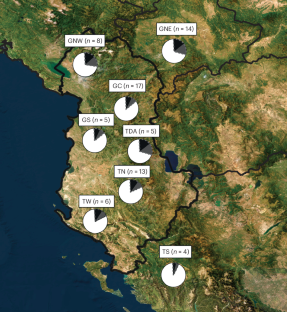
- Fig. 6: PCA and IBD sharing patterns of present-day Albanians by dialect.
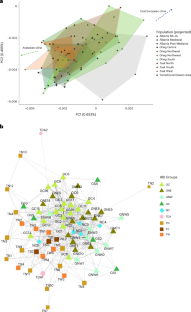
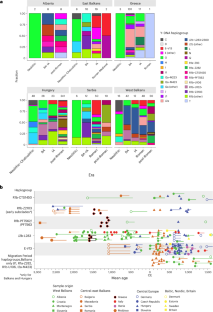
- Fig. 7: Haplogroup transformations of the Balkans and Hungary from the Neolithic to the Early Modern Period.
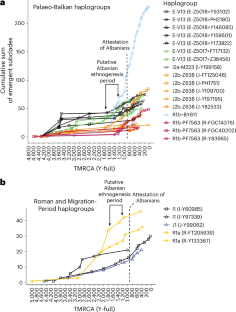
- Fig. 8: Graphical representation of clade formation (cumulative sum of new subclades) of the principal palaeo-Balkan and Migration Period-related haplogroups of present-day Albanians, using TMRCA estimates from Y-full.
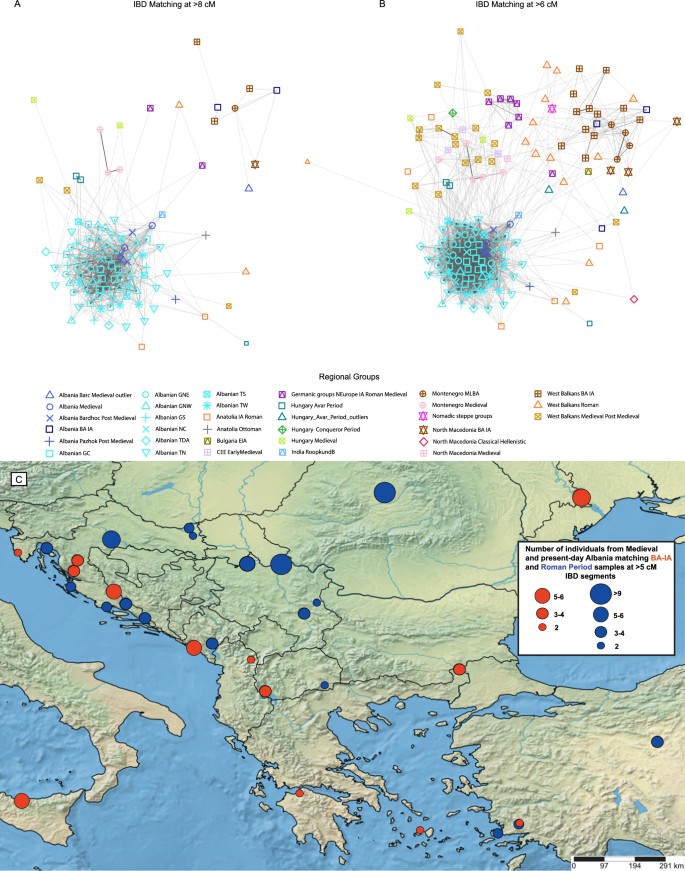
- Extended Data Fig. 1 Identity-by-Descent (IBD) sharing among present-day Albanians and selected ancient genomes from West Eurasia.
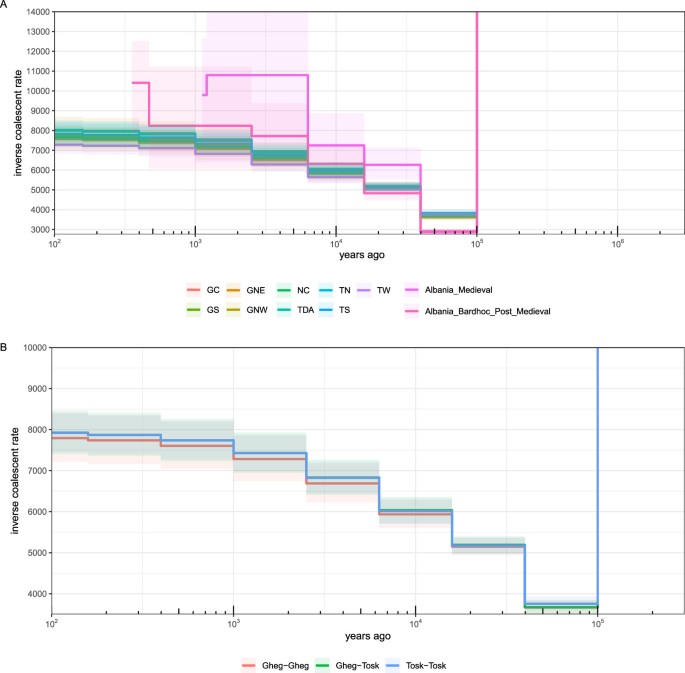
- Extended Data Fig. 2 Effective population size estimation of present-day Albanians and ancient samples from the territory of present-day Albania using Colate.
- Extended Data Fig. 3 Runs of homozygosity (ROH) in populations from Albania over a 6,000-year transect, using hapROH.
References
- Papazoglu, F. The Central-Balkan Tribes in Pre-Roman Times. Triballi, Autariatae, Dardanians, Scordisci, and Moesians (Hakkert, 1978).
- Georgiev, V. The genesis of the Balkan peoples. Slav. East Eur. Rev. 44, 285–297 (1966).Google Scholar
- Olalde, I. et al. A genetic history of the Balkans from Roman frontier to Slavic migrations. Cell 186, 5472–5485 (2023).Article CAS PubMed PubMed Central Google Scholar
- Lazaridis, I. et al. Genetic origins of the Minoans and Mycenaeans. Nature 548, 214–218 (2017).Article CAS PubMed PubMed Central Google Scholar
- Patterson, N. et al. Large-scale migration into Britain during the Middle to late Bronze Age. Nature 601, 588–594 (2022).Article CAS PubMed Google Scholar
- Lazaridis, I. et al. The genetic history of the Southern Arc: a bridge between West Asia and Europe. Science 377, eabm4247 (2022).Article CAS PubMed PubMed Central Google Scholar
- Lippert, A. & Matzinger, J. Die Illyrer: Geschichte, Archaologie Und Sprache (Reiche Der Alten Welt – Ethnien, Lander, Dynastien) (Kohlhammer, 2021).
- Wilkes, J. The Illyrians. The Peoples of Europe (Wiley Blackwell, 1996).
- Mócsy, A. Pannonia and Upper Moesia. A History of the Middle Danube Provinces of the Roman Empire (Routledge, 2015).
- Krzewińska, M. et al. Ancient genomes suggest the eastern Pontic–Caspian steppe as the source of western Iron Age nomads. Sci. Adv. 4, eaat4457 (2018).Article PubMed PubMed Central Google Scholar
- Clemente, F. et al. The genomic history of the Aegean palatial civilizations. Cell 184, 2565–2586 (2021).Article CAS PubMed PubMed Central Google Scholar
- Aneli, S. et al. The genetic origin of Daunians and the Pan-Mediterranean Southern Italian Iron Age context. Mol. Biol. Evol. 39, msac014 (2022).Article CAS PubMed PubMed Central Google Scholar
- Lazaridis, I. et al. A genetic probe into the ancient and medieval history of Southern Europe and West Asia. Science 377, 940–951 (2022).Article CAS PubMed PubMed Central Google Scholar
- Koder, J. in Migration Histories of the Medieval Afroeurasian Transition Zone: Aspects of Mobility Between Africa, Asia and Europe, 300–1500 C.E. (eds Preiser-Kapeller, J. et al.) 81–100 (Brill, 2020).
- Hyllested, A. & Joseph, B. D. in The Indo-European Language Family. A Phylogenetic Perspective (ed. Olander, T.) 223–245 (Cambridge Univ. Press, 2022).
- Hamp, E. P. in Studies Presented to Joshua Whatmough 73–89 (Mouton & Co., 1957).
- Porphyrogenitus, C. Constantine Porphyrogenitus. De Administrando Imperio (Dumbarton Oaks, 1967).
- Stallman-Pacitti, C. The Life of Saint Pankratios of Taormina. Edited by John B. Burke. Byzantina Australiensia, 22 (Brill, 2018).
- Vranoussi, E. L. Les termes Ἀλβανοί et Ἀρβανῖται et la première mention des Albanais dans les sources du XIe siècle. Symmeikta 2, 207–254 (1970).Google Scholar
- Popović, V. Byzantins, Slaves et autochtones dans les provinces de Prévalitane et Nouvelle Épire. Publ. l’École Française Rome 77, 181–243 (1984).
- Ylli, X. Das slavische Lehngut im Albanischen. Das slavische Lehngut im Albanischen. Teil 2. Ortsnamen (Verlag Otto Sagner, 2018); https://doi.org/10.3726/b12638
- Bowden, W. in Fortified Settlements in Early Medieval Europe. Defended Communities of the 8th–10th Centuries (eds Christie, N. & Herold, H.) 235–247 (Oxbow, 2016).
- & Bowden, W. The construction of identities in post-Roman Albania. Late Antiq. Archaeol. 1, 57–78 (2003).Article Google Scholar
- Lafe, E. Toponymes Latino-Romans sur le territoire de l’Albanais. Iliria 5, 113–117 (1976).Article Google Scholar
- Muljačić, Ž. Das Dalmatische: Studien zu einer Untergegangenen Sprache (Bohlau, 2000).
- Elsie, R. Early Albania: A Reader of Historical Texts 11th–17th Centuries (Otto Harrassowitz Verlag, 2003).
- Elsie, R. The earliest references to the existence of the Albanian language. Zeitschrift für Balk 27, 101–105 (1991).Google Scholar
- Matzinger, J. Die Albanische Autochthoniehypothese aus der Sicht der Sprachwissenschaft *. Überarbeitete Fassung eines Thesenpapiers vom Runden Tisch in Regensburg (Südosteuropa-Institut) am 24.04.2009 (2016).
- Hamp, E. P. in Ancient Indo-European Dialects (eds Birnbaum, H. & Puhvel, J.) 97–121 (Univ. California Press, 1966).
- Demiraj, S. The origin of the Albanians (linguistically investigated) (Academy of Sciences of Albania, 2006).
- Ackermann, K., Gavranovic, M. & Matzinger, J. The Indo-Europeanization of the Balkans: Some new insights at the interface of Archaeology, archaeogenetics and historical linguistics. In The Secondary Homelands of the Indo-European Languages (IG-AT2022) (Leiden, 2022).
- Matzinger, J. Messapico e illirico. L’Idomeneo 9, 57–66 (2015).Google Scholar
- Hamp, E. P. in Linguistics in Western Europe. Part 2. The Study of Languages (ed. Haugen, E.) 1626–1692 (De Gruyter Mouton, 1972).
- Orel, V. E. Albanian etymological dictionary (Brill, 1998).
- Polomé, E. C. in The Cambridge Ancient History. Part III. The Prehistory of the Balkans, the Middle East and the Aegean World. Tenth to Eighth Centuries B.C. (eds Boardman, J. et al.) 866–888 (Cambridge University Press, 2021).
- Maran, J. in Material, Method, and Meaning Papers in Eastern Mediterranean Archaeologyin Honor of Ilan Sharon. Ägypten und Altes Testament Studien zu Geschichte, Kultur und Religion Ägyptens und des Alten Testaments Band 110 (eds Davidovich, U. et al.) 7–25 (Zaphon, 2022).
- Chang, W. et al. Ancestry-constrained phylogenetic analysis supports the Indo-European steppe hypothesis. Language 91, 194–244 (2015).Article Google Scholar
- Thorsø, R. in Dispersals and Diversification. Linguistic and Archaeological Perspectives on the Early Stages of Indo-European (eds Serangeli, M. & Olander, T.) 251–262 (Brill, 2019).
- Antonio, M. L. et al. Stable population structure in Europe since the Iron Age, despite high mobility. eLife 13, e79714 (2024).Article CAS PubMed PubMed Central Google Scholar
- Antonio, M. L. et al. Ancient Rome: a genetic crossroads of Europe and the Mediterranean. Science 366, 708–714 (2019).Article CAS PubMed PubMed Central Google Scholar
- Ralph, P. & Coop, G. The geography of recent genetic ancestry across Europe. PLoS Biol. 11, e1001555 (2013).Article CAS PubMed PubMed Central Google Scholar
- Harney, É, Patterson, N., Reich, D. & Wakeley, J. Assessing the performance of qpAdm: a statistical tool for studying population admixture. Genetics 217, iya045 (2021).Article Google Scholar
- Patterson, N. et al. Ancient admixture in human history. Genetics 192, 1065–1093 (2012).Article PubMed PubMed Central Google Scholar
- Chintalapati, M., Patterson, N. & Moorjani, P. The spatiotemporal patterns of major human admixture events during the European Holocene. eLife 11, e77625 (2022).Article PubMed PubMed Central Google Scholar
- Schmid, C. & Schiffels, S. Estimating human mobility in Holocene Western Eurasia with large-scale ancient genomic data. Proc. Natl Acad. Sci. USA 120, e2218375120 (2023).Article CAS PubMed PubMed Central Google Scholar
- Schütz, O. et al. Unveiling the origins and genetic makeup of the ‘forgotten people’: a study of the Sarmatian-Period population in the Carpathian Basin. Cell 188, 4074–4090 (2025).Article PubMed Google Scholar
- Ringbauer, H. et al. Accurate detection of identity-by-descent segments in human ancient DNA. Nat. Genet. 56, 143–151 (2024).Article CAS PubMed Google Scholar
- Olalde, I. et al. The genomic history of the Iberian Peninsula over the past 8,000 years. Science 363, 1230–1234 (2019).Article CAS PubMed PubMed Central Google Scholar
- Olsen, B. A. Tracing the Indo-Europeans: New Evidence from Archaeology and Historical Linguistics (Oxbow Books, 2019).
- Haak, W. et al. Massive migration from the steppe was a source for Indo-European languages in Europe. Nature 522, 207–211 (2015).Article CAS PubMed PubMed Central Google Scholar
- Allentoft, M. E. et al. Population genomics of Bronze Age Eurasia. Nature 522, 167–172 (2015).Article CAS PubMed Google Scholar
- Lazaridis, I. et al. Ancient human genomes suggest three ancestral populations for present-day Europeans. Nature 513, 409–413 (2014).Article CAS PubMed PubMed Central Google Scholar
- Korkuti, M. Archaeological Studies on the Prehistory of Albania (Academy of Sciences of Albania, 2013).
- Kushniarevich, A. et al. Genetic heritage of the Balto–Slavic speaking populations: a synthesis of autosomal, mitochondrial and Y-chromosomal data. PLoS ONE 10, 1–19 (2015).Article Google Scholar
- Pulaha, S. Popullsia Shqiptare e Kosovës Gjatë Shek: Studime dhe Dokumente (8 Nëntori, 1984).
- Rexha, I. Registration of Settlements and Albanian Population of Kosovo (According to the Ottoman Defters (Records) of XV Century) (Institute of History Ali Hadri Prishtina, 2016).
- Weigand, G. Albanische einwanderung in Siebenbürgen. Balkan-Archiv 3, 208–226 (1927).Google Scholar
- Rusakov, A. in The Indo-European Languages (ed. Mate Kapović) 552–608 (Routledge, 2016).
- Martínez-Cruz, B. et al. Origins, admixture and founder lineages in European Roma. Eur. J. Hum. Genet. 24, 937–943 (2016).Article PubMed Google Scholar
- Ena, G. F., Aizpurua-Iraola, J., Font-Porterias, N., Calafell, F. & Comas, D. Population genetics of the European Roma—a review. Genes 13, 2068 (2022).Article CAS PubMed PubMed Central Google Scholar
- Urasin, V. YFull. Y-Chr sequence interpretation service. yfull.com https://www.yfull.com/ (2023).
- Çabej, E. Hyrje në Historinë e Gjuhës Shqipe (BUShT, 1958).
- Curtis, M. C. Slavic–Albanian Language Contact, Convergence, and Coexistence. PhD dissertation, Ohio State Univ. (2012).
- Morozova, M. S., Ovsjannikova, M. A. & Rusakov, A. Y. Albanian dialects in the light of language contact: a quantitative study of loanwords. Acta Linguist. Petropolitana 16, 275–305 (2020).Article Google Scholar
- Ylli, X. Das Slavische Lehngut im Albanischen. Teil 2. Ortsnamen (Verlag Otto Sagner, 2000).
- Pericić, M. et al. High-resolution phylogenetic analysis of southeastern Europe traces major episodes of paternal gene flow among Slavic populations. Mol. Biol. Evol. 22, 1964–1975 (2005).Article PubMed Google Scholar
- Battaglia, V. et al. Y-chromosomal evidence of the cultural diffusion of agriculture in Southeast Europe. Eur. J. Hum. Genet. 17, 820–830 (2009).Article CAS PubMed Google Scholar
- Sarno, S. et al. Shared language, diverging genetic histories: high-resolution analysis of Y-chromosome variability in Calabrian and Sicilian Arbereshe. Eur. J. Hum. Genet. 24, 600–606 (2016).Article PubMed Google Scholar
- Kovacevic, L. et al. Standing at the gateway to Europe – the genetic structure of Western Balkan populations based on autosomal and haploid markers. PLoS ONE 9, e105090 (2014).Article PubMed PubMed Central Google Scholar
- Lauka, A. & Bojaxhi, G. RRËNJËT. Projekti Shqiptar i ADN-së. Rrënjët https://rrenjet.com/ (2023).
- Jankova, R., Jovcevska, I., Kouter, K., Filipova, S. & Videtič Paska, A. Genotype characteristics of Y-chromosome in the Balkan population: review of haplogroup frequencies. Aust. J. Forensic Sci. https://doi.org/10.1080/00450618.2024.2359424 (2024).Article Google Scholar
- Primorac, D. et al. Croatian genetic heritage: an updated Y-chromosome story. Croat. Med. J. 63, 273–286 (2022).Article PubMed PubMed Central Google Scholar
- Doğan, S., Ašić, A., Doğan, G., Besic, L. & Marjanovic, D. Y-chromosome haplogroups in the Bosnian–Herzegovinian population based on 23 Y-STR loci. Hum. Biol. 88, 201–209 (2016).Article PubMed Google Scholar
- King, T. E. & Jobling, M. A. Founders, drift, and infidelity: the relationship between Y chromosome diversity and patrilineal surnames. Mol. Biol. Evol. 26, 1093–1102 (2009).Article CAS PubMed PubMed Central Google Scholar
- Chiaroni, J., Underhill, P. A. & Cavalli-Sforza, L. L. Y chromosome diversity, human expansion, drift, and cultural evolution. Proc. Natl Acad. Sci. USA 106, 20174–20179 (2009).Article CAS PubMed PubMed Central Google Scholar
- Jankova-Ajanovska, R. et al. Mitochondrial DNA control region analysis of three ethnic groups in the Republic of Macedonia. Forensic Sci. Int. Genet. 13, 1–2 (2014).Article CAS PubMed PubMed Central Google Scholar
- Rohrlach, A. B. et al. Using Y-chromosome capture enrichment to resolve haplogroup H2 shows new evidence for a two-path Neolithic expansion to Western Europe. Sci. Rep. 11, 15005 (2021).Article CAS PubMed PubMed Central Google Scholar
- Harney, É et al. Ancient DNA from the skeletons of Roopkund Lake reveals Mediterranean migrants in India. Nat. Commun. 10, 3670 (2019).Article PubMed PubMed Central Google Scholar
- Gilbert, E., Shanmugam, A. & Cavalleri, G. L. Revealing the recent demographic history of Europe via haplotype sharing in the UK Biobank. Proc. Natl Acad. Sci. USA 119, e2119281119 (2022).Article CAS PubMed PubMed Central Google Scholar
- Speidel, L. et al. Inferring population histories for ancient genomes using genome-wide genealogies. Mol. Biol. Evol. 38, 3497–3511 (2021).Article CAS PubMed PubMed Central Google Scholar
- Leitwein, M., Duranton, M., Rougemont, Q., Gagnaire, P.-A. & Bernatchez, L. Using haplotype information for conservation genomics. Trends Ecol. Evol. 35, 245–258 (2020).Article PubMed Google Scholar
- Ringbauer, H., Novembre, J. & Steinrücken, M. Parental relatedness through time revealed by runs of homozygosity in ancient DNA. Nat. Commun. 12, 5425 (2021).Article CAS PubMed PubMed Central Google Scholar
- Elsie, R. The Tribes of Albania: History, Society and Culture (IB Tauris, 2015).
- Bianco, E. et al. Recent common origin, reduced population size, and marked admixture have shaped European Roma genomes. Mol. Biol. Evol. 37, 3175–3187 (2020).Article CAS PubMed Google Scholar
- Muhaj, A. Le origini economiche e demografiche dell’insediamento degli arbëreshë in Italia. Dal medioevo alla prima età moderna. Basiliskos 3, 21–34 (2016).Google Scholar
- Muhaj, A. Five centuries of plague presence in Albania (fourteenth to nineteenth century). Hiperboreea 11, 151–170 (2024).Article Google Scholar
- Scorrano, G., Yediay, F. E., Pinotti, T., Feizabadifarahani, M. & Kristiansen, K. The genetic and cultural impact of the Steppe migration into Europe. Ann. Hum. Biol. 48, 223–233 (2021).Article PubMed Google Scholar
- FamilyTreeDNA Discover BetaTM. Gene by Gene Ltd https://discover.familytreedna.com/ (2023).
- Ghalichi, A. et al. The rise and transformation of Bronze Age pastoralists in the Caucasus. Nature 635, 917–925 (2024).Article CAS PubMed PubMed Central Google Scholar
- Lazaridis, I. et al. The genetic origin of the Indo-Europeans. Nature 639, 132–142 (2025).Article CAS PubMed PubMed Central Google Scholar
- Žegarac, A. et al. Ancient genomes provide insights into family structure and the heredity of social status in the early Bronze Age of southeastern Europe. Sci. Rep. 11, 10072 (2021).Article PubMed PubMed Central Google Scholar
- Fulvio, C. et al. Tracing past human male movements in Northern/Eastern Africa and Western Eurasia: new clues from Y-chromosomal haplogroups E-M78 and J-M12. Mol. Biol. Evol. 24, 1300–1311 (2007).Article Google Scholar
- Mihajlovic, M., Tanasic, V., Markovic, M. K., Kecmanovic, M. & Keckarevic, D. Distribution of Y-chromosome haplogroups in Serbian population groups originating from historically and geographically significant distinct parts of the Balkan Peninsula. Forensic Sci. Int. Genet. 61, 102767 (2022).Article CAS PubMed Google Scholar
- Tofanelli, S. et al. The Greeks in the West: genetic signatures of the Hellenic colonisation in southern Italy and Sicily. Eur. J. Hum. Genet. 24, 429–436 (2016).Article PubMed Google Scholar
- DuNay, A. The Origins of the Rumanians: The Early History of the Rumanian Language (Matthias Corvinus Publishing, 1996).
- Charanis, P. in Studies on the Demography of the Byzantine Empire 230–247 (Variorum Reprints, 1972).
- Matzinger, J. in Balkan Area. Altaic Studies. General Linguistics. In Memoriam Albina H. Girfanova (1957–2018) (eds Andronov, A. V. et al.) 278–287 (Nestor-Istoria, 2019).
- Breu, W. in Oxford Research Encyclopedia of Linguistics (ed. Aronoff, M.) (Oxford Univ. Press, 2022); https://doi.org/10.1093/acrefore/9780199384655.013.421
- Muljačić, Ž. in Das Dalmatische: Studien zu einer Untergegangenen Sprache (ed Muljačić, Ž.) 325–345 (Böhlau Köln, 2000).
- Mallick, S. et al. The Allen Ancient DNA Resource (AADR) a curated compendium of ancient human genomes. Sci. Data 11, 182 (2024).Article PubMed PubMed Central Google Scholar
- Reitsema, L. J. et al. The diverse genetic origins of a Classical period Greek army. Proc. Natl Acad. Sci. USA 119, e2205272119 (2022).Article CAS PubMed PubMed Central Google Scholar
- Patterson, N., Price, A. L. & Reich, D. Population structure and Eigenanalysis. PLOS Genet. 2, e190 (2006).Article PubMed PubMed Central Google Scholar
- Begg, T. J. A. et al. Genomic analyses of hair from Ludwig van Beethoven. Curr. Biol. https://doi.org/10.1016/j.cub.2023.02.041 (2023).Article PubMed Google Scholar
- Balanovsky, O. et al. Phylogeography of human Y-chromosome haplogroup Q3-L275 from an academic/citizen science collaboration. BMC Evol. Biol. 17, 18 (2017).Article PubMed PubMed Central Google Scholar
- Robinson, J. T., Thorvaldsdottir, H., Turner, D. & Mesirov, J. P. igv.js: an embeddable JavaScript implementation of the Integrative Genomics Viewer (IGV). Bioinformatics 39, btac830 (2022).Article Google Scholar
- Li, H. et al. The Sequence Alignment/Map format and SAMtools. Bioinformatics 25, 2078–2079 (2009).Article PubMed PubMed Central Google Scholar
- Davis, C. et al. Big Y-700 white paper: powering discovery in the field of paternal ancestry (FamilyTreeDNA, 2019).
- RStudio: Integrated Development for R (RStudio Team, 2020).
- Danecek, P. et al. Twelve years of SAMtools and BCFtools. Gigascience 10, giab008 (2021).Article PubMed PubMed Central Google Scholar
- Nyerki, E. et al. correctKin: an optimized method to infer relatedness up to the 4th degree from low-coverage ancient human genomes. GenomeBiol. 24, 38 (2023).CAS Google Scholar
- Hofmeister, R. J., Ribeiro, D. M., Rubinacci, S. & Delaneau, O. Accurate rare variant phasing of whole-genome and whole-exome sequencing data in the UK Biobank. Nat. Genet. 55, 1243–1249 (2023).Article CAS PubMed PubMed Central Google Scholar
- Rubinacci, S., Ribeiro, D. M., Hofmeister, R. J. & Delaneau, O. Efficient phasing and imputation of low-coverage sequencing data using large reference panels. Nat. Genet. 53, 120–126 (2021).Article CAS PubMed Google Scholar
- Fruchterman, T. M. J. & Reingold, E. M. Graph drawing by force-directed placement. Softw. Pract. Exper. 21, 1129–1164 (1991).
Source
https://www.nature.com/articles/s41562-026-02462-z

