
Summary
Ancient sources portray Epirus and its tribes (Chaonians, Thesprotians, Molossians) as largely non-Hellenic in the Classical period. Thucydides classifies most Epirote tribes north of Amphilochia as barbaroi, whose native language was not Greek, though they gradually adopted it under Hellenic influence by the 4th century BC. Many were bilingual or spoke Illyrian-related languages. Epirus suffered massive destruction by Romans in 167 BC, remaining largely desolate. Its population, considered of Pelasgian origin, showed strong Illyrian characteristics in language, dress, and customs, similar to the Macedonians, who were likely of Illyrian stock. Ethnic mixing between Illyrian and Greek elements was common.
Epirus and the Illyrian Tribes: Language, Identity, and Barbarian Status in Ancient Sources
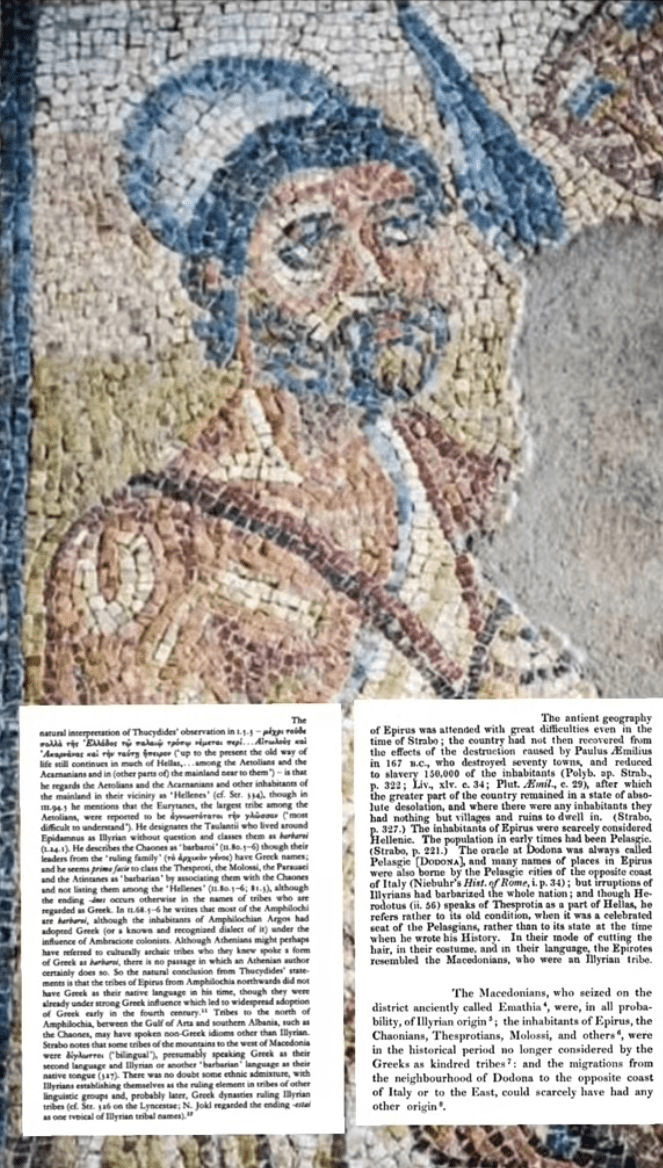
“The natural interpretation of Thucydides’ observation in 1.5.3 — μέχρι τοῦδε πολλὰ τῆς Ἑλλάδος τῷ παλαιῷ τρόπῳ νέμεται περί… Αἰτωλοὺς καὶ Ἀκαρνᾶνας καὶ τὴν ταύτῃ ἤπειρον (‘even today the old way of life continues in most of Hellas… among the Aetolians and Acarnanians and on the mainland near them’) — is that he considers the Aetolians, Acarnanians, and the other inhabitants of the adjacent mainland as ‘Hellenes’ (cf. Str. 334), even though in III.94.5 he notes that the Euritae, the largest tribe among the Aetolians, were said to be ἀγνωστότατοι τὴν γλῶσσαν (‘very difficult to understand in their speech’).
He unambiguously classifies the Taulantii living around Epidamnus as Illyrians and labels them as barbaroi (1.24.1). He describes the Chaonians as ‘barbaroi’ (II.80.5-6), although their leaders from the ruling family (τὸ ἀρχικὸν γένος) bear Greek names; and at first glance he appears to classify the Thesprotians, Molossians, Parauaioi, and Atintanes as ‘barbarians’ by grouping them with the Chaonians and not listing them among the ‘Hellenes’ (II.80.5-6; 81.3), despite the fact that the ending -ates frequently appears in the names of tribes considered Greek.
In II.68.5-6 he writes that most of the Amphilochians are barbaroi, although the inhabitants of Argos Amphilochikon had adopted Greek (or a recognizable dialect of it) under the influence of Ambrakiote colonists. Although the Athenians may have referred to culturally backward tribes who spoke a form of Greek as barbaroi, there is no clear passage in which an Athenian author does so with certainty.
Therefore, the natural conclusion from Thucydides’ statements is that the tribes of Epirus north of Amphilochia did not have Greek as their native language in his time, although they were already under strong Greek influence, which led to the widespread adoption of Greek in the early fourth century.
The tribes north of Amphilochia, between the Gulf of Arta and southern Albania, such as the Chaonians, may have spoken other non-Greek languages besides Illyrian. Strabo notes that some tribes in the mountains west of Macedonia were δίγλωσσοι (‘bilingual’), apparently speaking Greek as their second language and Illyrian or another ‘barbarian’ language as their mother tongue (347).
There was undoubtedly a kind of ethnic mixture, with Illyrians settling as the dominant element among tribes of other linguistic groups and, perhaps later, Greek dynasties ruling over Illyrian tribes (cf. Str. 326 on the Lynkestai; N. Jokl considered the ending -estai a characteristic feature of Illyrian tribal names).”
“The ancient geography of Epirus was attended by great difficulties even in Strabo’s time; the country had not yet recovered from the consequences of the destruction wrought by Paulus Aemilius in 167 BC, who destroyed seventy cities and enslaved 150,000 inhabitants (Polyb. ap. Strab., p. 322; Liv., xlv. c. 34; Plut. Aemil., c. 29).
After this, most of the country remained in a state of complete desolation, and where there were inhabitants, they had nothing but villages and ruins to live in (Strabo, p. 327). The inhabitants of Epirus were scarcely considered Hellenes. The population in early times had been Pelasgian (Strabo, p. 221).
The oracle at Dodona was always called Pelasgian [DODONA], and many place names in Epirus were also borne by Pelasgian cities on the opposite coast of Italy (Niebuhr’s Hist. of Rome, i. p. 34). However, the Illyrian invasions had barbarized the entire nation; and although Herodotus (ii. 56) speaks of Thesprotia as part of Hellas, he refers more to its ancient condition, when it was a famous seat of the Pelasgians, than to its state at the time he wrote his History. In their manner of cutting the hair, in their dress, and in their language, the Epirotes resembled the Macedonians, who were an Illyrian tribe.
“The Macedonians, who conquered the region long called Emathia, were in all probability of Illyrian origin; the inhabitants of Epirus — the Chaonians, Thesprotians, Molossians, and others — in the historical period were no longer regarded by the Greeks as kindred tribes; and migrations from the neighbourhood of Dodona to the opposite coast of Italy or to the East can hardly have had any other origin.”
Source
N. G. L. Hammond, Epirus: The Geography, the Ancient Remains, the History and the Topography of Epirus and Adjacent Areas (Oxford: Clarendon Press, 1967), 419–20.

