
Summary
This excerpt from Antonio Bellusci’s book recounts his discovery of Kostandin Farmaqis, an extraordinary 80-year-old illiterate Arvanite rhapsode (oral poet) from a small village near Thebes, Greece. During an impromptu visit facilitated by local Arvanites, Farmaqis delivers a remarkable three-hour improvised performance of heroic and everyday songs in the Albanian (Arvanitika) language. Bellusci portrays him as a living Homer and highlights the power of oral tradition in preserving Albanian cultural identity among the Arvanites of Greece. The text emphasizes the value of oral literature, the altruism of the community, and the urgency of documenting and saving this endangered linguistic and cultural heritage before the last native speakers pass away. It celebrates “Lidhja” magazine’s role in giving voice to these overlooked traditions.
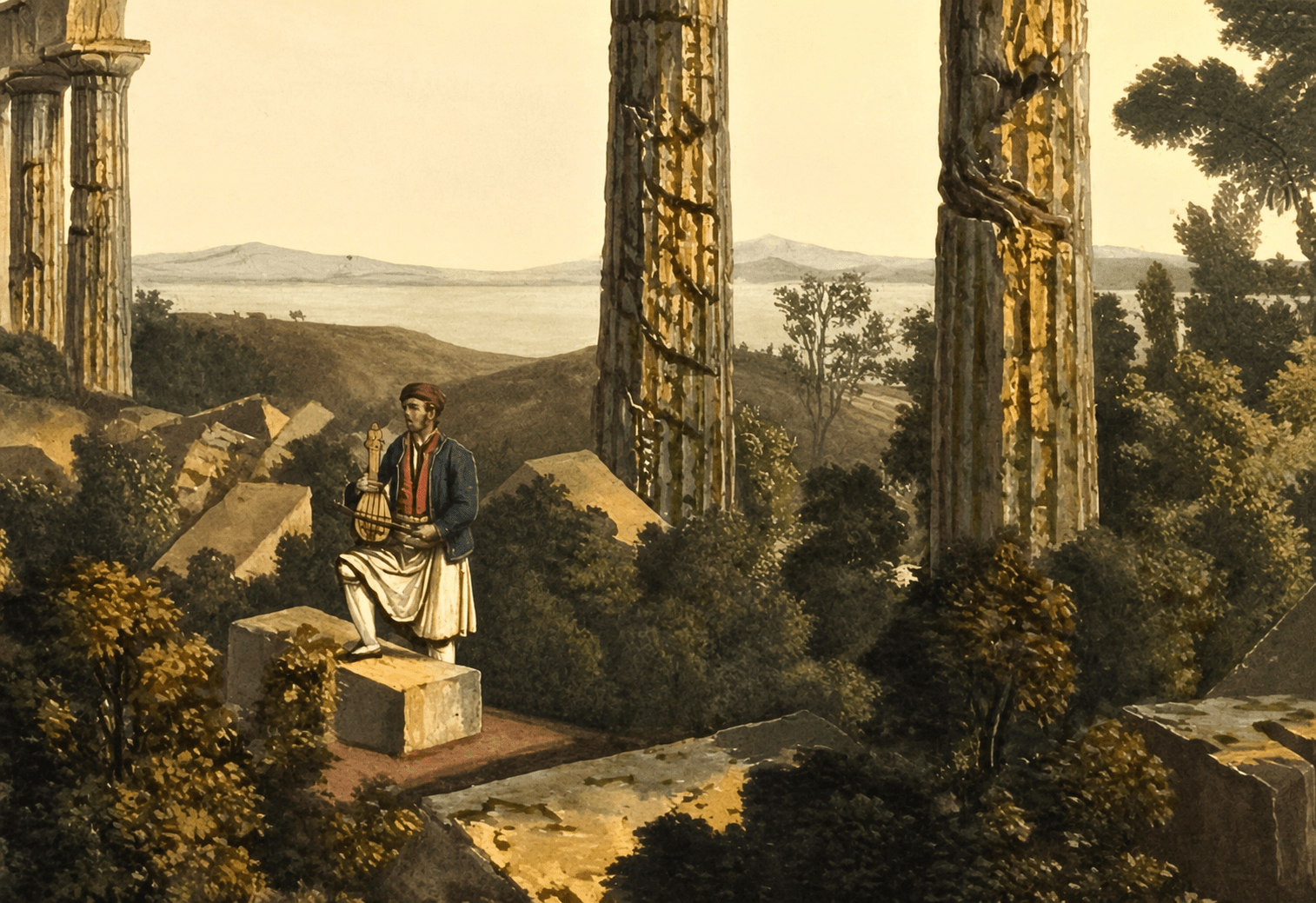
Arvanite Rhapsodes – A Centuries-Old Albanian Tradition Preserved. With Kostandin Farmaqis, an Albanian “O-Mir,” 80 Years Old, from Thebes.
Bellusci wrote that “in 40 years of research, he had never seen anyone like him.” He sang for 3 uninterrupted hours about the Arvanite heroes of independence.
With the Arvanites of Greece
(Bellusci, p. 14)
Oral Poetry
In my research, I have given importance to oral literature, which is a universal value. We have songs, love poems, and interviews with these people, popular creators. Oral literature comes from a people without culture, according to today’s thinking, but from an anthropological point of view, culture has many branches; it contains the human being who works and progresses, overcoming every difficulty.
Oral literature flows from an invisible people who are not on the surface, are not known, and have no rights, but whose stories are passed mouth to mouth, heart to heart. Scientific research on this invisible people, through the codification of these stories collected mouth to mouth and put on paper, has turned them into written literature.
One day I had set out very early from Euboea and around 3:00 p.m. I arrived in Daramari (Thebes), Greece, now called Dafni. Daramari is a very small village with about 300 inhabitants. I was determined to interview someone in an area I had never visited before.
I had asked for help from the priest Meletios, himself an Arvanite, but he did not help me. He was afraid. Priests like that, who are afraid and lack courage, have never pleased me and, in my opinion, are not true Arvanites.
I was driving around but could not find a soul. At one point I stopped at a crossroads near a workshop. Its owner was named Jorgo Kozmas. We greeted each other and spoke a little Arvanitika.
It wasn’t long before a truck appeared on the road.
— Jorgo, who is that stranger with you? — the driver asked.
— He’s not a stranger, he’s an Arbëresh, he came from Italy, — Jorgo replied.
The truck driver, eager to speak Arvanitika, joined us. We were three brothers meeting after many centuries. Song, in joy and sorrow, is in the heart of the Arbër, so the three of us began to sing.
I also told them about the magazine “Lidhja,” where I published everything I recorded, and I showed them the photos I had taken during my research. The truck driver, Thanas Sandillas, when he saw with his own eyes the work I had done, told me:
— My papu (grandfather) is a rhapsode.
Right then and there I asked:
— How can I find your grandfather’s house?
— I’ll close the workshop and we’ll go, — said Kozmas.
Thanas left his truck loaded with onions that he was supposed to deliver to the market in Athens, and the three of us set off to record his grandfather. Those two Arvanites left the work that fed them just to help me. Albanianism is altruism.
We arrived at Sandillas’s grandfather’s house. In front of the house stretched a large meadow where about 20 sheep were grazing. As soon as he entered, Sandillas started calling:
— Papù, papù, an Arbëresh priest has come, come so he can record you while you sing.
The grandfather was about eighty, small in stature.
— They call me Kostandin Farmaqis, — he told me, looking me straight in the eye.
Then he went into his room, took the holy icon and placed it on a chair. He ordered that I be brought a coffee and began to sing. For three hours straight he improvised about heroes and about everyday Arvanite life. It was getting dark and the sheep had still not been put in the fold. The lady of the house, irritated, complained that no one was taking care of the village work.
In forty years of research, I had never seen such a rhapsode. He seemed to me like a Homer singing the ballads of the Iliad and the Odyssey, while the audience shouted “O mirë, O mirë” — from which, it is said, his name also derives: O-mirë, O-mer, H-o-mer.
Farmaqis was illiterate; he had never written or read Albanian, but he had an Arbëresh heart. When I asked him what “arvaniti-besënlidhi” meant, Farmaqis explained it this way:
— If you want me, I will come with you.
Thanks to the magazine “Lidhja,” Farmaqis lives in the hearts of all those who read it. Because “Lidhja” also had this function: to give voice to these forgotten people who spoke the Albanian language, sang in the Albanian language, and knew only the Albanian language.
In “Lidhja” you will also find his improvisations and rhapsodies, written in the mother Arbëresh language, which I published using the Manastir alphabet and not the Greek one.
I understood these Arvanites very well. I do not deny that their language has been heavily influenced by Greek, and this is normal given the circumstances. But I want to emphasize that the Arvanite case is very interesting, because the Arvanite language, among its last speakers, is still very much alive and complete.
These elderly men are the last ones who master the Albanian language. Languages normally die when they are no longer used, but it never happens that a language dies when, in its last generation of speakers, it is preserved as well as Arvanitika. This gives me hope that we are still in time to save this Arbëresh language and this cultural identity from its deathbed — a treasure of humanity that must be passed on from generation to generation.
Reference
Rrugëtimi i një arbëreshi. jeta, vepra, kujtime. Author: Antonio Bellusci. Interviewer and reviewer: Ornela Radovicka . Editor: Elona Qose. Publisher: Tiranë, Maluka

