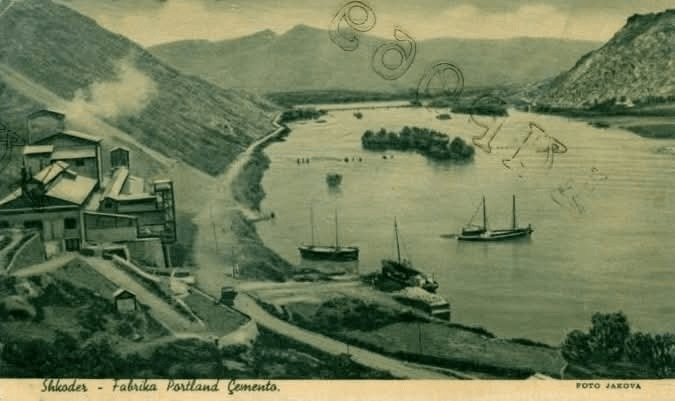

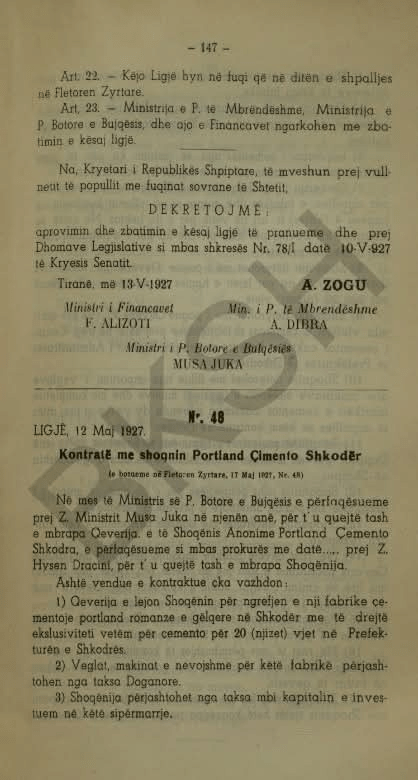
“Portland Çemento e Shkodër” was one of the earliest initiatives of industrialization in Albania. It was established as a joint-stock company by Shkodër entrepreneurs and merchants. By Decree Law No. 48 of 12 May 1927, the contract with the company “Portland Çemento Shkodër” was approved. The contract was signed by Musa Juka, Minister of Public Works and Agriculture, and on behalf of the company by its representative, Hysen Dracini. The factory was created with the aim of producing cement for the country’s construction needs and to support the economic development of the time.
Within the framework of incentive policies for industrialization, the government of the Albanian Republic and later the government of the Albanian Kingdom granted the company “Portland Çemento e Shkodër” several fiscal facilitations, such as exemptions from customs duties on machinery, taxes on invested capital, and exemptions from export taxes. In exchange, the company was obligated to supply public projects with cement at a price approximately 5% lower than the market rate, thereby providing more affordable materials for state construction projects.

This contract defined the operating conditions of the factory, the fiscal benefits, and the obligations toward the state for the regular supply of public projects.
After World War II and the establishment of the communist regime in Albania, the factory was nationalized as part of the policy of nationalizing private property.
The history of “Portland Çemento e Shkodër” reflects the beginnings of modern Albanian industry, while also demonstrating the importance that the government of the Albanian Republic and later the Albanian Kingdom attached to cooperation between the state and Albanian private capital during the period 1925–1939.

1 – Postcard of the “Portland Çemento e Shkodër” Factory
2 – Decree Law No. 48, dated 12 May 1927 (Contract with the Company “Portland Çemento Shkodër”)
Source
(by Ilir Kuka) in RealitetiPost.

