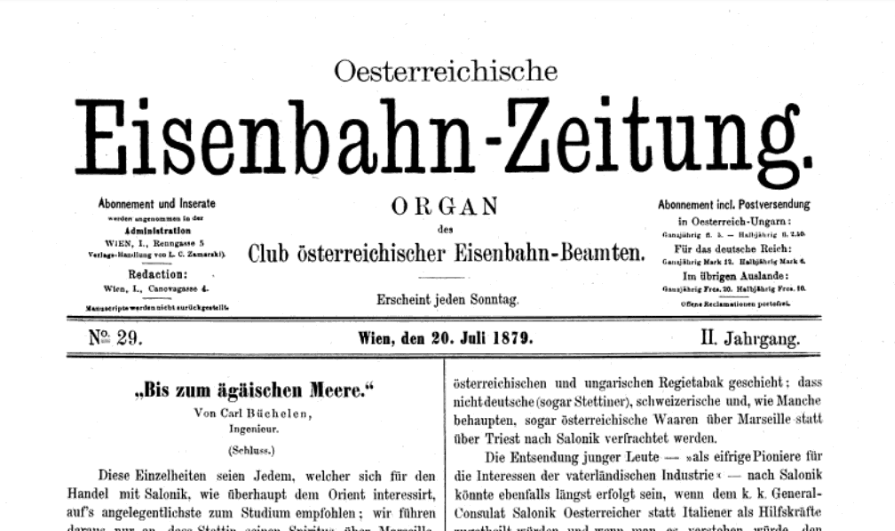

In the late 19th century, the Albanian city of Mitrovica (then Mitrowitza) emerged as one of the most strategically important commercial centers in the western Balkans, particularly for Austro-Hungarian economic interests. The completion of the Thessaloniki–Skopje–Mitrovica railway line in the early 1870s transformed the city into a vital inland port and distribution node.
A contemporary analysis published in the Oesterreichische Eisenbahn-Zeitung (1879) emphasized Mitrovica’s pivotal role. Connecting the proposed Sarajevo–Mitrovica railway to the existing Macedonian line would eliminate the lengthy and costly sea route via Trieste and Thessaloniki. This shift promised to save ten full days of travel time and significant freight costs on the outward journey alone, enabling Austria-Hungary to compete effectively in Ottoman markets.
Geographic and Economic Dominance
Mitrovica was not merely a station but a gateway to a vast hinterland. From there, traders could control commerce across Dardania (Kosovo), eastern Albania, and southwestern Serbia. The author argued that this territory remained accessible even via Serbian railways, which were otherwise detrimental to Austrian interests. However, diplomatic maneuvers — contrary to the decisions of the 1878 Congress of Berlin — threatened to divert connections toward Uesküb (Skopje) or other points, undermining Mitrovica’s centrality.
The article criticized Vienna’s neglect of Salonika trade relations, noting that foreign diplomats were better informed and more proactive in advancing their nations’ commercial goals. Despite political and military arguments for rapid railway expansion toward Salonika, the economic imperative remained central: a direct link through Mitrovica represented both prudent strategy and a major civilizational project.
Significance
By securing Mitrovica as a rail junction, Austria-Hungary aimed to strengthen its influence in the post-Berlin Balkans, counter Serbian expansion, and tap into rich regional resources and markets. The city’s importance endured well into the 20th century as a mining and transport center.
In essence, from 1879 onward, Mitrovica symbolized the intersection of infrastructure, geopolitics, and commerce — a linchpin that could have reshaped Balkan trade networks in favor of Central European powers.
Source
Oesterreichische Eisenbahn-Zeitung. Organ des Club österreichischer Eisenbahn-Beamten (Red. Karl Engelhard.) By Carl I Engelhard. 1879

