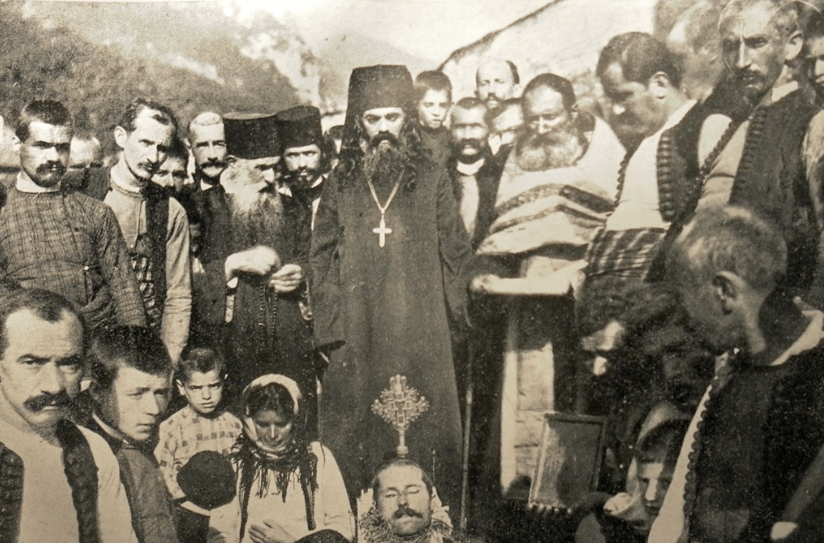

During the Balkan Wars of 1912–1913, Serbian media frequently used powerful imagery to justify military action and mobilize public support. One notable example is Photo 6, published in a Serbian weekly with the sensational caption:
“Burial of the Head of Josa Radić in Peć Who Was Killed by the Turks and Whose Disembodied Head They Kicked with the Foot for Three Days through the Streets.”
The image shows a grieving woman and several children gathered around a burial scene in Peć (Peja). It was presented as fresh evidence of Ottoman Turkish brutality against Christian civilians. In reality, the photograph was several years old and had been deliberately repurposed for wartime propaganda.
The True Story Behind the Image
The photograph was taken in September 1908 by Russian-French traveler and photographer Alexandre Baschmakoff (Alexander Bashmakov) in Peja of Dardania-Kosovo. It depicts local Serbs conducting the burial of the severed head of a Montenegrin warrior who had been killed by Albanians from the Rugova region.
The woman seated in the center is Rada Spalević, who was actively seeking justice for her family. She is not a passive mourner as the propaganda caption implied; rather, she exercised agency by submitting petitions. The three boys beside her are likely her sons, referenced in her complaint.
Serbian authorities had obtained the image years earlier — possibly in 1906 or 1908 — via the Consulate in Prishtina. A state official had already marked it as “usable for newspapers.” When the Balkan Wars began, the Serbian Ministry of Foreign Affairs supplied the photo to the press, where it was given a new, inflammatory caption linking it to “the Turks” and presenting it as a current atrocity.
Propaganda
This case illustrates sophisticated propaganda methods:
Decontextualization and Re-captioning: An old photo from 1908 was presented as a fresh event from the Balkan Wars.
Emotional Manipulation: The gruesome detail about kicking the head through the streets for three days was designed to provoke outrage.
National Mobilization: The image reinforced the narrative of Christian Serbs suffering under Ottoman (and Albanian) oppression, positioning the Serbian army as the liberator and protector of its “brethren.”
Strategic Framing: By omitting key facts (the Montenegrin victim, Albanian perpetrators from Rugova, and the 1908 date), the photo effectively supported Serbia’s territorial claims in Old Serbia (Kosovo) and justified the war.
Significance
While violence and atrocities certainly occurred in the turbulent border regions between Serbs, Albanians, and Montenegrins, this specific image shows how propaganda often relied on selective truth and manipulation. The photograph of Rada Spalević mourning the Montenegrin fighter became a tool in the broader information war that accompanied the military campaigns of 1912–1913.
This episode remains a clear example of how historical photographs can be weaponized to shape public perception and support political objectives.

