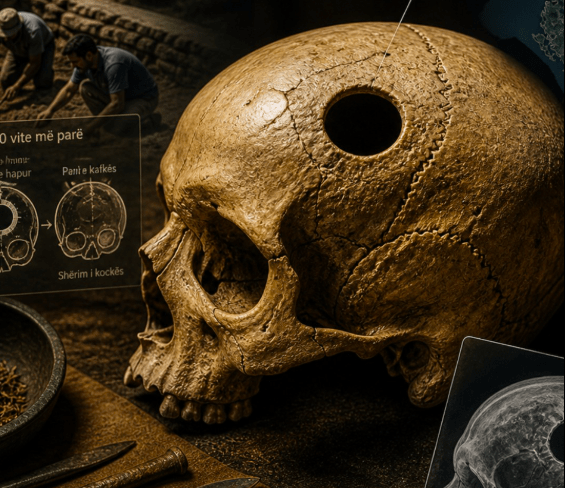

Image from N’Kohe.
Trepanation — the surgical practice of drilling or scraping a hole into the skull — is one of the oldest known medical procedures in human history. Practiced across the world for thousands of years, it was likely used to treat head trauma, relieve intracranial pressure, address infections, epilepsy, or even spiritual afflictions. While survival rates in antiquity were surprisingly high (many skulls show clear signs of bone healing), dramatic claims of highly advanced “Illyrian brain surgery” 2,500 years ago with modern-like bronze tools remain unverified in current archaeology.
The Key Albanian Discovery: Medieval Trepanation at Rozafa Castle, Shkodra
The most well-documented case of trepanation from Albania comes from the medieval necropolis at Rozafa Castle in Shkodra. A human skull found during excavations shows clear evidence of a successful trepanation performed during the Middle Ages.
Published in the scientific journal Bulletins et Mémoires de la Société d’Anthropologie de Paris by researcher Ulsi Tota, this find represents a genuine example of surgical intervention in the region. The patient survived long enough for the bone to heal, indicating skilled hands and adequate post-operative care for the era. This discovery highlights that medical knowledge and surgical practices existed in medieval Albania, within the cultural layers that include Illyrian, Roman, Byzantine, and later influences.
Broader Context in the Balkans and Illyrian Territories
While no widely confirmed Iron Age (roughly 800–200 BC) Illyrian trepanation matching viral social media descriptions has been published in peer-reviewed sources, the broader Western Balkans have yielded evidence of the practice:
Croatia and neighboring areas (within the ancient Illyrian cultural sphere) have produced several prehistoric and ancient trepanned skulls.
Studies from pre-Slavic and Dardanian regions in modern day Serbia document trepanations across different periods.
Trepanation was known in prehistoric Europe from the Neolithic onward, with techniques evolving from stone tools to metal instruments in later periods.
These findings show that communities in the region, including those with Illyrian heritage, participated in the same medical traditions seen in many ancient societies — from Peru to Europe and Asia.
What Does This Tell Us?
Ancient and medieval people in the Balkans demonstrated practical anatomical knowledge and courage in performing high-risk surgeries. Success depended on avoiding infection, controlling bleeding, and the body’s natural healing — achievements that deserve respect without exaggeration.
The viral Facebook narrative of a recent 2,500-year-old fully healed Illyrian skull with “precise bronze tools similar to modern ones” appears to blend real archaeological possibilities with dramatic embellishment for engagement. Real archaeology moves more slowly and relies on careful excavation, peer review, and publication.
Albania’s Place in Medical History
Albania and the Western Balkans have a rich archaeological heritage that continues to reveal insights into ancient life, healing practices, and resilience. Discoveries like the Shkodra trepanation contribute to our understanding of regional medical history and place the area within the wider story of human innovation in surgery.
Ongoing excavations and bioarchaeological studies will likely uncover more evidence. For now, the verified finds remind us that our ancestors were resourceful and knowledgeable — qualities worth celebrating through science rather than myth.
This article is based on published scientific sources. If new peer-reviewed discoveries emerge from Illyrian sites, they will further enrich this fascinating chapter of Balkan history.
Sources
Tota, Ulsi. 2026. “Medicine in the Middle Age: A Case of Trepanation from the Necropolis in the Castle of Shkodra (Albania).” Bulletins et Mémoires de la Société d’Anthropologie de Paris 38 (S). https://journals.openedition.org/bmsap/17641.
Petrone, Pierpaolo. 2015. “Early Medical Skull Surgery for Treatment of Post-Traumatic Epilepsy in Neolithic Italy.” PLOS ONE. https://doi.org/10.1371/journal.pone.0123378. (Context on ancient European trepanation practices.)
Premužić, Zrinka, et al. Various publications on trepanation in Croatia and the Adriatic region (Illyrian cultural sphere).
Šikanjić, Petra Rajić. Studies on ancient and medieval cranial surgery in the Western Balkans.

