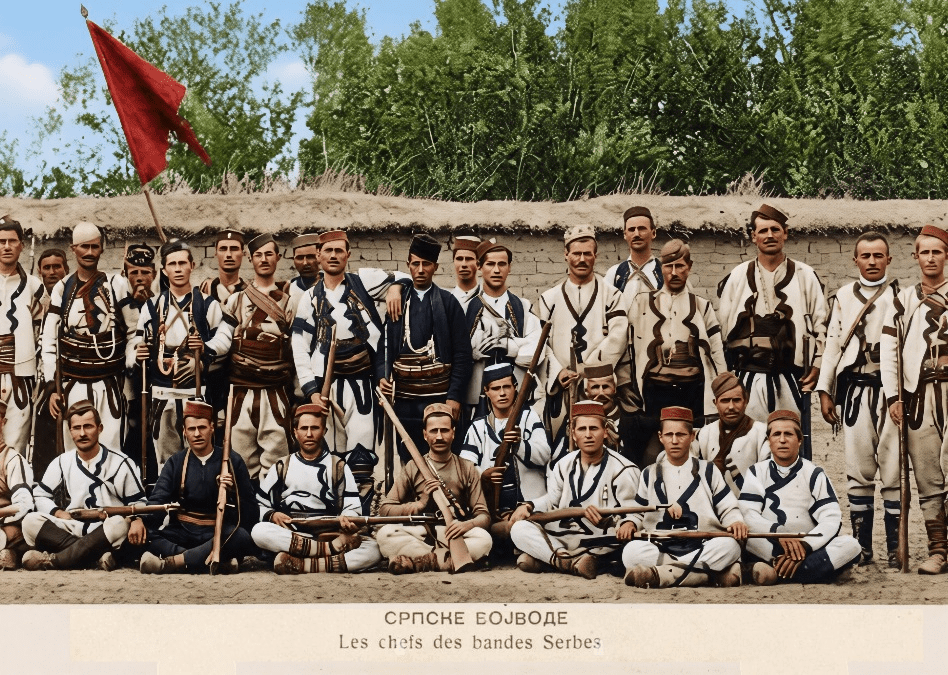

The striking early 20th-century photograph labeled “Српске војводе – Les chefs des bandes Serbes” (“Serbian Voivodes – Chiefs of the Serbian Bands”) captures a group of armed men in traditional Balkan highland dress. At first glance, it appears to be a classic image of Serbian Chetnik guerrillas fighting Ottoman rule and rival bands in Macedonia around 1907–1908. Yet a closer look reveals a deeper historical irony: many of these fighters are wearing distinctly Albanian wool costumes — the white tirqe (tight wool trousers), embroidered vests (jelek), and regional headgear typical of Albanian highlanders.
Regional reality vs. national narrative
In the late Ottoman period, ethnic and religious identities in what is today North Macedonia, Kosovo, and southern Serbia were far more fluid than modern nationalisms admit. Orthodox Christianity did not automatically equal “Slavic” or “Serbian.” There existed communities of Orthodox Albanians (sometimes called Shqiptarë ortodoksë or Arvanites in Greek contexts) who had lived alongside Slavic populations for centuries. Under the influence of Serbian schools, the Serbian Orthodox Church, and pan-Slavic propaganda — often backed by Russia — many of these Orthodox Albanians underwent a process of cultural and linguistic Slavicization (Russification/Serbianization).
They spoke Albanian at home but adopted Serbian as a public and liturgical language. They kept their ancestral clothing and customs while embracing a Serbian national identity for practical, economic, or ideological reasons. Serbian Chetnik organizations actively recruited such men because they knew the terrain, local languages, and clan networks intimately.
The costume as evidence
The tirqe and the cut of the clothing in the photo are not generic “Balkan” attire. They are characteristic of Albanian Tosk and Gheg highland dress, widely worn across Epirus, Macedonia, and Kosovo. Serbian peasants from Šumadija or Montenegro traditionally wore different styles (e.g., opanci with different trousers and embroidery). The fact that these “Serbian voivodes” are dressed head-to-toe in Albanian wool garments highlights how the Chetnik movement in Old Serbia/Macedonia operated in a culturally Albanian milieu, often relying on local Orthodox Albanians who had been rebranded as Serbs.
Artificial identity and historical irony
This phenomenon exposes the constructed nature of early 20th-century Serbian nationalism in the southern Balkans:
Religion over ethnicity: The Serbian state and Church prioritized Orthodox affiliation, using it as a vehicle for assimilation. Orthodox Albanians were welcomed as “Serbs” while Muslim Albanians were increasingly viewed as alien.
Fluid identities: Many fighters likely had mixed or ambiguous origins. A man could be Albanian by blood and language but “Serbian” by political loyalty and church membership.
Later consequences: During the Balkan Wars (1912–1913), some of these very same Slavicized Orthodox Albanians participated in operations against Muslim Albanian villages — a tragic case of fratricide enabled by imposed national identities.
The image perfectly symbolizes the absurdity and tragedy of Balkan identity politics. Men whose grandfathers likely spoke Albanian and wore tirqe as a marker of their mountain heritage now posed under a Serbian flag, fighting in the name of a Slavic nation-state that was still being invented on the ground.
Today, the descendants of such communities sometimes maintain dual or contested identities. Some fully identify as Serbian; others rediscover Albanian roots. The photograph remains a powerful reminder that clothing, blood, language, and declared nationality do not always align — and that many “Serbian” heroes of the Chetnik era were, in fact, Slavicized Orthodox Albanians wearing their ancestral costume while serving a foreign national project.
History, as usual, is more complicated — and more ironic — than the official captions suggest.

