

Abstract
The fortress of Gjirokastra, built on a prominent rocky hill (c. 310 m a.s.l.) dominating the Drino valley, represents a continuously inhabited fortified site from prehistoric times through the Middle Ages. With a perimeter of approximately 1,300 m enclosing an area of about 2.5 hectares, the defensive walls follow the natural topography and exhibit multiple construction phases.
Surface surveys and limited sondages conducted in 1983–1984 along the walls revealed archaeological material, primarily pottery, together with stratigraphic evidence and construction details. Three main building phases were identified: an early phase characterized by large, roughly worked limestone blocks typical of Illyrian fortifications (likely Iron Age to Hellenistic); a middle phase; and a later medieval phase (9th–10th centuries) with smaller, more regular masonry and mortar.
The ceramic finds include handmade coarse wares with impressed and incised decoration attributable to the prehistoric Illyrian period, as well as material from Late Antiquity (5th–6th centuries) and the medieval period. These finds, along with architectural remains, indicate that the site began as a small settlement in the Iron Age, developed into an Illyrian fortified center, and later became an important military and administrative stronghold during the Byzantine and medieval periods.
The earliest historical mention of the fortress appears as Argyrokastro in 1336 in the writings of John Kantakouzenos. The evidence suggests that Gjirokastra served as a significant ethno-cultural and military center for the surrounding Drino region, inhabited by the Epirote/Illyrian population.
Although systematic large-scale excavations have not yet been carried out, the available data provide valuable insights into the long-term occupation and defensive architecture of this important Albanian monumental site.
Keywords: Gjirokastra Fortress, Illyrian fortifications, medieval archaeology, Drino valley, Albanian antiquity, pottery typology, Argyrokastro.
ILIRIA Nr. 2 — 1988. Damian KOMATA
Kalaja e Gjirokastrës is situated on a rocky hill that dominates the Drino valley and controls one of the most important communication routes. This rocky outcrop and the Gjirokastër fortress have been continuously inhabited since antiquity. The location of Pazar i Vjetër (Old Market) and the neighborhood of Dunavat (Fig. 2) lie at the foot of the hill.
The fortress hill (known locally as “Shkodra” etc.) rises about 500 m above sea level and about 75 m above the surrounding plain. The fortress walls follow the natural contours of the terrain (Fig. 1). The rock is limestone, very hard and resistant. The perimeter of the walls is approximately 1,300 m. The thickness of the walls varies from 2.5 m to 5 m. The walls are built with large, well-fitted limestone blocks.
The outer and inner faces are made of carefully worked stone, while the core consists of smaller stones bound with lime mortar. The height of the preserved walls reaches 5–8 m in some places (Fig. 1). In several places, remains of towers or bastions can be seen.
The fortress has three entrances. The main one, on the southeast side, is still used today. The other two, smaller ones, are on the north and west sides. From the historical and archaeological point of view, the results of the investigations carried out so far are very interesting.
… and existence of this fortress.
We have not conducted systematic excavations in the fortress. From the observations and facts gathered during visits in 1983 and 1984, we present some data here regarding the construction phases and the festive and folkloric character of the material. Archaeological material and the construction phases of the fortress walls have been studied in detail.
The fortress has three main construction phases, marked as:
- Phase A — the first, oldest phase
- Phase B — the middle phase
- Phase C — the last phase (Fig. 1)
The northern part of the fortress (point A) is built with very large, roughly worked limestone blocks. The wall here is preserved to a height of about 2.5 m and has a gallery 125 m² in area. The cultural layers are 0.65–2.83 m thick and contain archaeological and ceramic material that is very interesting for study, especially pottery fragments and animal bones.
The construction technique and the stratigraphy of the wall at point D (gallery with pilasters) are noteworthy. The stratigraphy here reaches 2.83 m. The layers contain:
- 1.20 m of fill with mixed material (ceramic and animal bones)
- 2.40 m of cultural layer
… relatively and the pottery is coarse and mixed with small stones. The bottom layer contains 0.08 m of ash and traces of burning, 0.35 m of reddish earth mixed with grayish clay, and a layer of yellowish clay.
The wall at point B is built with smaller, better-worked limestone blocks. The wall thickness here is 1.10 m. The preserved height is 1.10 m in one place and 0.75 m in another. The blocks measure (0.38 × 0.32; 0.35 × 0.17 m; 0.36 × 0.12; 0.21 × 0.07 m; 0.30 × 0.08 m etc.) laid without mortar on a clay bedding.
The construction of the walls and the fortifications of this antiquity are typical of the Illyrian period (Zharrëz, Çukës së Ajtotit, Pogradec, Kaninës, etc.). This technique of large blocks and the absence of mortar is characteristic of pre-Roman Illyrian fortifications (see Table I, 12-19).
The wall at point D (the gallery with pilasters) has a preserved height of 7 m and a width of 0.30–2.15 m. The foundation is 1.82 m deep (Fig. 4).
No other traces of phase B or later phases have been found in the interior of the fortress. The walls of phase B are built with smaller, more regular limestone blocks (0.52 × 0.08 m; 0.4 × 1.2 m; 0.35 × 0.08 m; 0.20 × 0.09 m etc.). The foundation stones are laid without mortar.
Fig. 2 shows a cross-section of the wall at point D.
Fig. 1 is a plan of the fortress showing the layout of the walls, gates, and key points (A, B, C, D, etc.).
Fig. 2 is a stratigraphic profile of the wall/galley at point D, with legend for different layers (fill, cultural layers, etc.).
Footnotes
- W. Tomaschek, Pauly-Wissowa Realencyclopädie…
- Various Albanian and foreign archaeological works on Illyrian fortifications, Gjirokastër, etc.
The article is an archaeological report on the Illyrian and medieval phases of Gjirokastër Fortress (a UNESCO site today). It describes the defensive walls, construction techniques, and stratigraphic findings indicating multiple building phases from antiquity through the Middle Ages.
… appear to belong to the later period, judging by the coarse pottery with a 2–2.5 cm thick base. In the middle of the wall face, the mortar is very hard and contains small pebbles. The wall thickness here is preserved up to about 50–60 cm. The preserved height of the wall in some places reaches 0.70 m. The stones are laid without mortar on a clay bedding. On the outer face of this wall, there are traces of a possible tower with a diameter of about 9 m. From the pottery found in the cultural layer, this wall appears to belong to the medieval period (9th–10th centuries) and shows constructive similarities and the same technique as the walls of the Lezhë citadel.
Pottery
A large amount of archaeological material was found during the cleaning of the walls, especially pottery fragments from different periods. Among the surface finds, there are some fragments of coarse, reddish-brown pottery with a black core, as well as pieces of tiles, etc. Most of the pottery is handmade, roughly shaped, and belongs to the prehistoric and early historic periods. Some fragments show similarities with the pottery of the Gauls and the prehistoric Illyrian period (see Tab. I, 6–9), etc.
From point B, in the rubble layer, a fragment of a vessel with a black core and reddish surface was recovered (Tab. I, 6–9). Other fragments of coarse pottery with thick walls, some with handles, were also found (Tab. I, 10, 11, 4). All this material, along with other finds, is typical of the prehistoric Illyrian period (see IV–I millennium BC).
At point B, in the rubble layer, some fragments of tiles and bricks from the late Roman or early medieval period were found (Tab. II, 14, 15, 17). Also recovered were fragments of pottery with a black core and reddish surface, some decorated with impressed or incised motifs, as well as fragments with horizontal or vertical relief bands (Tab. I, 16, 17). The typology of this pottery finds analogies in material from Zharrëz, Oranjem, Mallakastra, Mesaplik, Kaninë, etc. (see Tab. V–VI e.s.o.).
The pottery and other finds from the gallery and the fortress (point D) are of particular interest because they provide important data about the history of this fortress and the medieval period (8th–10th centuries).
Fig. 3 and Fig. 4 show photographs of wall sections with visible stratigraphic layers and construction details (labeled A and B).
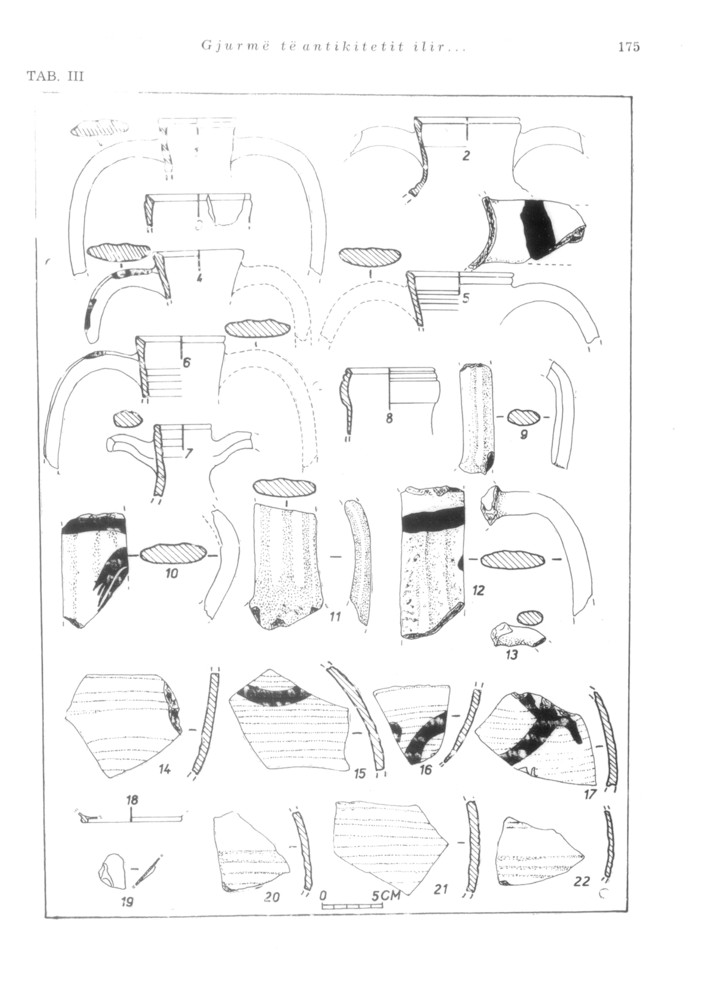
Fragmented pottery, tiles, and bricks were found in the layers above the ancient pavement. The large amphorae and other vessels (Tab. II, 1–22) are particularly noteworthy. The vessels are mostly handmade, with thick walls (4–5½ cm), coarse fabric, and decorated with impressed or incised motifs (zigzag, horizontal or vertical lines, etc.). Some walls show relief decoration. Horizontal or vertical bands, as well as oval or circular impressions 2.25 cm in diameter, are common.
Examples of such decorative motifs are also found in other Illyrian fortresses (Kaninë, Pogradec, Berat, Vlora, Durrës, etc.) and in some prehistoric settlements (Kruja, Lezhë), etc.
… dating to the 7th–8th centuries. In this layer, coarse pottery and some other finds from the 5th–6th centuries and the Roman period were also recovered.
Among the pottery, there are some fragments of Arab-Norman type. The coarse pottery with thick walls and impressed decoration shows similarities with material from the 12th–18th centuries. Also found were fragments of tiles with relief decoration and painted motifs (Tab. III, 1–3, 5, 8), as well as pieces of pottery with black glaze or other types (Tab. III, 4–7, 9–13), along with fragments of tiles and bricks with relief or incised decoration (Tab. III, 14–19), etc.
A particularly interesting object is a small bronze coin (13 cm in diameter? — likely a measurement error in original, probably a small coin or medallion), found at point B (Tab. II, 20), which belongs to the late antique period and a medieval coin (possibly a Komnenian one) (Tab. XIII).
The data and observations gathered during our visits to the fortress and its surroundings are of great interest, especially because systematic archaeological excavations have not yet been carried out inside the fortress.
Among the pottery and other finds, there is material from different periods and cultures, but the main phases of the fortress appear to belong to the prehistoric Illyrian period (see Tab. IV–I) and the medieval period (9th–10th centuries). The walls and other structures of the fortress show several construction phases. Traces of these phases appear in fragmented form, but they provide important data for the study of the fortress and the surrounding area.
Conclusion: The fortress and its surroundings, from the prehistoric and antique periods (5th–6th centuries) through the medieval period (9th–10th centuries), contain very important archaeological material. The fortress walls and the finds inside them provide valuable data on the history and development of this important Illyrian and medieval center.
Footnotes
- G. Karaiskaj, 5000 vjet fortifikime në Shqipëri…
- B. Jubani, Illyrian Pottery…
… (and other references to Albanian archaeological publications).
In the Middle Ages, with the strengthening of the feudal system and the principalities in our country (13th–14th centuries), the importance of Gjirokastra as a fortress and a military and administrative center grew. During this period the fortress was further fortified and new defensive structures were added. The preserved walls, the large number of ceramic fragments and other finds provide important data about life inside the fortress, the walls, the towers and the different phases of its development.
For the identification of this fortress in historical sources, the earliest mention is found in the form Argyrokastro (Αργυρόκαστρον) by the Byzantine chronicler John Kantakouzenos in 1336. He speaks of this fortress and the surrounding region. Other ancient and geographical sources also mention it. V. Tomaschek, H. Čeka and others have tried to identify the ancient predecessor of Gjirokastra, but so far no clear evidence of an ancient settlement has been found at this site. The name Argyrokastro (or Argyros) is thought to derive from the Greek “argyros” = silver. According to local legend and some archaeological data, the name may be related to silver mines that once existed in the area.
In the Ottoman period, the fortress played an important military role, especially during the time of Ali Pasha of Tepelena.
The data and observations gathered so far from surface surveys and limited cleaning work, although not the result of systematic excavations, are of great importance. They help us better understand the history of the Drino valley, where the Epirote tribe lived and where Argyrokastro was the ethno-cultural and administrative center.
VESTIGES OF ILLYRIAN ANTIQUITY AND THE MIDDLE AGES IN THE FORTRESS OF GJIROKASTRA
The fortress of Gjirokastra rises on a rocky hill at an altitude of 310 m. Located almost in the center of the city, it controls most of the Drino valley. The walls, with a perimeter of about 1,300 m, enclose an area of around 2.5 hectares. In general, they are well preserved.
For the first time in 1983 and 1984, small-scale archaeological sondages were carried out along the walls. These brought to light archaeological material (mainly pottery) as well as some remains of walls and tiles. The study of this material and its typological classification has enabled the author to determine the main periods of development of life on this hill.
Although the excavations were limited in scale, the pottery collected from various points of the fortress, consisting of vessels for daily use or for storing goods, as well as tiles, has allowed the identification of the main chronological phases of the development of the fortress. Thus, life on this hill began in a small settlement during the Iron Age and continued through the Illyrian urban period (4th–1st centuries BC).
Later, during the Late Antiquity (5th–6th centuries) and the Early Middle Ages (9th–10th centuries), the hill was provided with a rampart and later reinforced. The gradual transformation of the site into a fortified settlement is linked to the importance it acquired, especially during the Middle Ages, when it became the main military and administrative center of the Drino region.
Based on the information provided by the excavations carried out so far, and also taking into account the points of view and opinions expressed by other researchers, the author estimates that the Drino valley, where the Epirote tribe lived, of which Argyrokastro was the ethno-cultural center, constitutes an important historical unit.
This completes the full English translation of the article by Damian Komata published in Iliria Nr. 2, 1988.
Reference
https://www.persee.fr/doc/iliri_1727-2548_1988_num_18_2_1503?fbclid=Iw

