
Summary
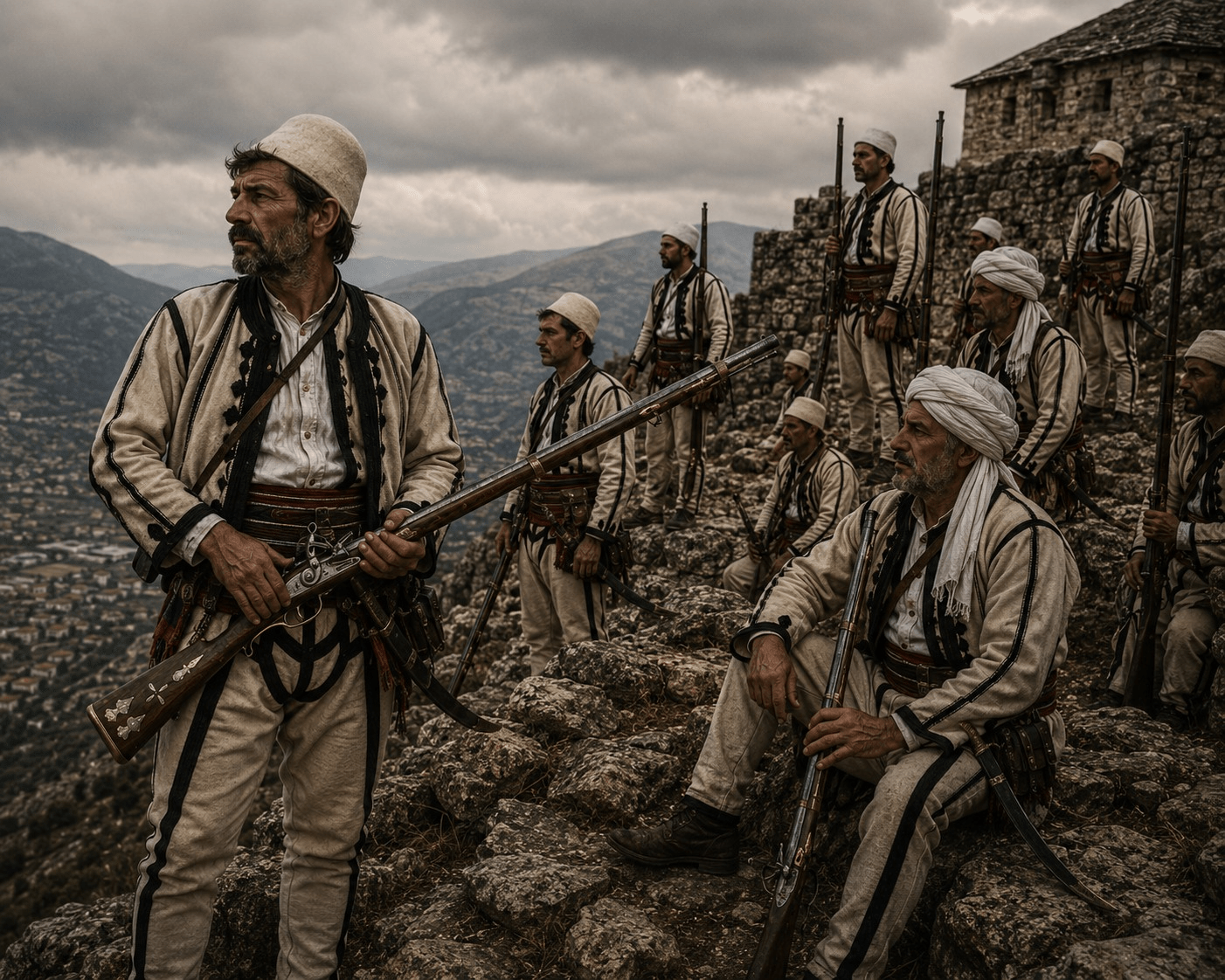
Albanians under the Ottoman Empire endured systematic violence, forced assimilation, and attempts at political erasure. Edith Durham and Henry Fanshawe Tozer’s documents detail the closure of Albanian schools, public beatings, forced conscription, home burnings, heavy taxes, and the banning of the words “Albania” and “Albanian.” After the Young Turk Revolution, policies of aggressive Ottomanization intensified. Albanians survived not because of imperial favor, but through resistance — preserving their language, identity, and culture despite repression. These historical records show Ottoman rule was marked by subjugation, not harmony, and serve as a call to remember the price of national survival.
From the closure of Albanian schools to public beatings, forced labor, deportations, the burning of homes, and the attempt to erase the name “Albanian” from public space, the documents of Edith Durham and Henry Fanshawe Tozer reveal a bitter truth: the Albanians did not emerge from the Ottoman Empire as a favored people, but as a people who survived.
History should not be written with nostalgia. History should be written with documents.
And when documents speak, propaganda must fall silent.
In the work The Struggle for Scutari, published in London in 1914, Edith Durham does not write from diplomatic salons but from Albanian soil — from Shkodra, the Highlands, Kosovo, Elbasan, Korça, and the areas where she saw firsthand the consequences of war, state violence, and assimilation projects. Already in the preface, she describes the reality as a space where the region’s rulers used deception, betrayal, cruelty, and brutality to control a corner of land that had become a place of misery. She adds that describing the sufferings she had witnessed herself would require several volumes.
This is not an emotional commentary. It is historical testimony.
Durham clearly identifies the problem: the Ottoman Empire in Europe was not a Turkish nation-state with equal citizens, but an imperial structure that ruled over Greeks, Bulgarians, Albanians, Serbs, Vlachs, Jews, and Roma. According to her, the Turk remained in the Balkans by exploiting hatreds among the peoples, pitting them against one another, while failing to fully assimilate them. Even those who became Muslim preserved their language and many national customs.
This is the central historical point: the Albanian did not dissolve. He did not disappear. He did not become Ottoman. He survived.
But survival should not be confused with comfort. Because the documents show that this survival passed through violence, oppression, poverty, the banning of Albanian-language schools, and the effort to turn the Albanian into an “Osmanli” without a national name.
Durham writes that Albanians had demanded national recognition and the right to schools, but were suppressed. This is direct evidence of the struggle against Albanian national education. She shows that Albanians were not seeking luxury or privilege; they sought to learn in their own language, to be recognized as a nation, and not to remain a nameless people in Ottoman administration.
And the Ottoman response was not reform. It was repression.
After the Young Turk Revolution, when many believed the constitution would bring freedom, the reality became even harsher. Durham describes how the Young Turks began an open policy of forced Ottomanization. A Young Turk officer explained to her that the Empire had to be consolidated and there were two paths: education or the sword. Since education required time, only the sword remained. This is the essence of imperial mentality: not accommodation with the peoples, but their subjugation.
In Albania, this policy was translated into concrete actions.
In Shkodra, after the arrival of Xhavid Pasha, the population was disarmed. Peasants handed over their rifles — often their most valuable possession — without compensation. Immediately afterward, the Ottoman government sent troops into the mountains to register men for forced military service and to collect taxes from rich and poor alike. Durham also mentions retroactive taxes, imprisonment without trial, blackmail, and injustices worse than before.
Then comes one of the heaviest testimonies: public beatings. Durham writes that the Turks established public beating as punishment and that more than one well-known Shkodran was beaten in front of the government buildings to the sounds of the military band. This was not merely physical punishment. It was public humiliation. It was a political message: the Ottoman state wanted to show the city that the Albanian’s body, honor, and dignity were in the hands of the authorities.
Then came the blow against the language.
The Normal School of Elbasan, opened with enthusiasm as an important institution for Albanian education, was forcibly closed. Other Albanian schools were also shut down. Albanian newspapers were suppressed one after another; editors, according to Durham, often ended up in prison without trial. It was even forbidden to mention the words “Albania” or “Albanians” in the press. Everyone had to be called “Osmanli.”
This is pure political assimilation.
When a power forbids your name, closes your schools, suppresses your newspapers, imprisons your editors, and forces you to identify with the empire’s name, it is not administering you. It is attempting to erase you as a national subject.
That is why Durham’s document is so important: because it shows that the Albanian struggle was not simply a fight for borders. It was a fight for name, language, school, honor, and existence.
The other document, Henry Fanshawe Tozer’s Researches in the Highlands of Turkey (published in 1869), completes this picture. Tozer, an Oxford scholar, writes about his visits to Albanian lands — Mirdita, Prizren, Elbasan, Berat, and other territories under Ottoman rule. In his chapters appears an Albania without roads, without security, with weak administration, arbitrary power, and a population living amid violence, poverty, and pressure.
In Tozer’s documents, another harsh reality emerges: the Ottoman state was not a structure that built citizenship, but a system that often left a vacuum, anarchy, and subjugation. Albania is described as a “semi-subjugated” land, where central authority was weak and Albanian society was forced to defend itself with arms, clans, and local structures.
In this history, Albanian weapons were not merely a sign of “savagery,” as foreign propaganda often portrayed them. They were the consequence of the absence of a just state. When the empire does not provide security, a man keeps security in his belt.
But the heaviest dimension remains that of assimilation.
Durham shows that the Young Turks did not want free education for Albanians, but Turkish schools. Albanian resistance was not against knowledge, but against Ottomanization. She writes clearly that the children of insurgents attended the Albanian Normal School in Elbasan, while Turkish authorities proposed Turkish schools; thus the problem was not education itself, but language and identity.
This is the essence: the Albanian demanded Albanian-language schooling; the authorities demanded Turkish schooling. The Albanian demanded his own name; the authorities demanded “Osmanli.” The Albanian demanded national recognition; the authorities demanded imperial obedience.
In this sense, Ottoman violence against Albanians cannot be reduced only to battles, taxes, or military expeditions. It was a long-term project of control: control over weapons, over schools, over the press, over language, over memory, and over the citizen’s body.
When people are beaten publicly, when schools are closed, when newspapers are banned, when editors are imprisoned, when the houses of those who refuse conscription are burned, when villages are pushed toward emigration, and when the very word “Albanian” is banned from public space, we are not dealing with normal administration. We are dealing with national oppression.
And when this oppression aims to erase a people’s identity, it takes on an assimilative character and, in certain moments, a genocidal character.
It must be stated with historical clarity: the word “genocide” is a modern legal term, defined after the 20th century. But Durham’s and Tozer’s documents speak of acts, policies, and mentalities that today would be analyzed as systematic violence, ethnic cleansing, forced assimilation, and actions with genocidal character toward specific Albanian and Muslim populations in the Balkans.
In her preface, Durham writes that entire areas had been deliberately depopulated, because the aim of many Balkan states was to expel as many members of another race as possible; people were driven from their lands, robbed, and sought help, while after the war they faced hunger in the mountains.
This testimony relates to the period of the Balkan Wars, but it is a continuation of the same Albanian tragedy: a people caught between collapsing empires and neighboring states expanding over their lands.
In the end, the documents lead us to a clear conclusion: Albanians did not survive because the Ottoman Empire protected them. Albanians survived because they resisted.
They survived by preserving their language when the state did not recognize it.
They survived by opening schools when the authorities closed them.
They survived by publishing newspapers when censorship suppressed them.
They survived by keeping the name Albanian when the administration wanted to call them simply “Osmanli.”
They survived by not dissolving — neither by the Turk, nor the Slav, nor the Greek, nor any power that sought to turn them into a people without memory.
Therefore, the history of Ottoman rule over Albanians cannot be sold as a fairy tale of brotherhood. It was a history of occupation, subjugation, taxation, conscription, banning of the language, closure of schools, political imprisonments, and state violence.
Documents do not demand revenge. Documents demand memory.
Because a nation that forgets how its schools were closed may not understand tomorrow why its language is endangered. A nation that forgets how its name was banned may not understand tomorrow why its identity is being stolen. A nation that forgets the empire’s violence may tomorrow call the occupier “brother.”
And that would be the greatest insult to those who, for centuries, kept the Albanian name alive through blood, suffering, schools, besa, and national memory.

