
Summary
John Milios challenges the myth of ancient Hellenic continuity, arguing that modern Greek identity was a 19th-century political construct born from bourgeois revolution, Orthodox commerce, and Enlightenment ideology. Far from a pure ethnic uprising, the Greek War of Independence relied heavily on Albanian-speaking Arvanites, who formed the core of the naval fleet and key revolutionary figures like Markos Botsaris. Albanian served as the practical language of the navy into the 20th century. “Greekness” initially denoted Orthodox Christians broadly; the ethnic nation emerged later as the state retrofitted history to legitimize itself. Milios shows identity followed state formation, not primordial blood.
John Milios states it plainly: “The language of those inhabitants of the first Greek state was not only Greek (Demotic or Katharevousa), but also Albanian (Arvanitika)” — and Albanian “in essence comprised the language of the Greek naval fleet up to the beginning of the twentieth century.” The cradle of Greek sea power did its commanding in Albanian.
Markos Botsaris, canonized as a “Greek martyr” and posthumously made a general of Greece, left behind an 1809 manuscript: the Lexicon of the Roman and Colloquial Arvanitiki Languages — a Greek-Albanian phrase book written as a “tutorless method” of learning. Even Botsaris’s own pedagogy gives the game away. Albanian was native; Greek was the foreign language he was studying.
In 1827, with the war still raging, the revolutionary Greek state printed a bilingual Holy Scripture — Greek and Albanian — “by the printing establishment of the Administration,” as Milios documents. The official press of the new “Greek” nation was publishing scripture for its Albanian-speaking citizens. Bilingualism wasn’t a footnote. It was state policy.
Karl Reinhold, the German chief physician of the Greek Royal Navy, published in 1855 a Greek-Albanian dictionary with a title that drops the truth in the subhead: Noctes Pelasgicae: The Naval Dialect. For Reinhold — appointed by the new state itself — “the naval dialect” of Greece was Albanian. The fleet that won independence did not give orders in Greek.
This wasn’t a 1821 quirk that faded. Milios cites it directly: even the Greek admiral of the BALKAN WARS (1912-13), Pavlos Kountouriotis — the man who became President of Greece — commanded his fleet in Arvanitika. Nearly a century after independence, the working language of the Greek navy was still Albanian.
Thomas Gordon, the philhellene historian who actually fought in the war, mapped the Albanian-speaking heartland of Greece (cited by Milios): “Attica, Argolis, Boeotia, Phocis, and the isles of Hydra, Spezzia, Salamis, and Andros, are inhabited by Albanians. They likewise possess several villages in Arcadia, Achaia, and Messenia… many of them do not understand Greek.” That isn’t the periphery — that IS Greece.
In 1889 the Athens monthly Apollon published a poem honouring Princess Alexandra of Greece on her engagement to a Russian Grand Duke. It was written entirely in Albanian, with this declaration: “I extol you in Albanian, in a heroic language, which was spoken by the admiral Miaoulis, Botsaris and all of Souli.” Royal Greece praised its monarchs in Albanian — and called Albanian a heroic tongue.
Rigas Pheraios’s 1797 Constitution — the foundational document of Greek revolutionary thought — explicitly named the citizens of the future Hellenic Republic as “Hellenes, Bulgarians, Albanians, Wallachians, Armenians, Turks, and any other kind of genus.” Milios reads this carefully: Albanians were not a tolerated minority of revolutionary Hellas. They were CO-FOUNDERS of it, on equal civic footing.
The Orlov Revolt of 1770 was crushed for the Sultan by Albanian-speaking Muslim bands. Then those bands began looting Christian villages — and Theodoros Kolokotronis’s own father, Constantinos, fought alongside the Ottoman army to massacre them. Milios quotes Kolokotronis’s memoirs verbatim. The neat “Greek vs Turk” binary doesn’t survive five minutes in the actual archive.
After that 1779 victory, the Ottoman commander Hasan Bey ordered the corpses of the slaughtered Albanian fighters to be built into “a pyramid of four thousand heads cemented together with sand and lime.” Greek-speaking armatoloi — including the future revolutionary’s family — helped him build it. The first proto-“Greek” victory monument was a tower of Albanian skulls, mortared by Greeks for a Pasha.
Milios opens the book with his thesis in plain text: he is “Opposing the myth of Hellenic continuity.” For Milios Greekness is not the survival of an ancient people but a 19th-century political project, manufactured by Orthodox merchant capital, Enlightenment ideologues, and the apparatuses of a brand-new bourgeois state. Continuity is the propaganda; rupture is the reality.
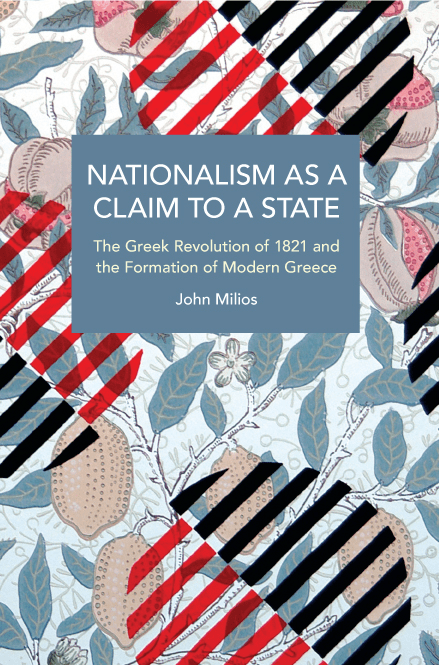
The very title is the argument: Nationalism as a Claim to a State. Milios inverts the official story: a Greek “nation” did NOT rise up to claim a state of its own. It was the political demand for a state — by merchants and intellectuals — that called the “nation” into being. The Greek people was the output of 1821, not its starting point.
Before 1821, Orthodox Christians of the Ottoman Empire called themselves Romioi — Romans. Milios is precise: the term meant “all Orthodox Christians of the empire (a non-national or non-ethnic categorisation)” — only LATER did it shrink to mean “Orthodox Greeks.” Greek ethnic identity is, on his evidence, younger than the United States.
The first “Greek” Enlightenment thinkers, Milios writes, “believed Greekness to be identified with Orthodoxy” — meaning every Orthodox Christian in the Ottoman Empire was, ipso facto, a Greek. Bulgarians, Serbs, Vlachs, Albanians — all “Greeks” by religion and trade. The label was a sect and a profession, not a bloodline. Modern ethno-Greekness emerges by SHRINKING this category, not extending it.
The “Greek national day” itself is a state fabrication. Milios documents the chain: “by decree signed on 15 March 1838 by King Otto and the Minister for Ecclesiastical Affairs G. Glarakis,” it was officially proclaimed that the Revolution had begun at the Aghia Lavra monastery on 25 March 1821. The actual day at Aghia Lavra in 1821? Nothing happened. The legend was decreed by a Bavarian king 17 years later.
Even the famous “continuity of Hellenism” — ancient → Byzantine → modern — wasn’t believed by the revolutionaries themselves. Milios traces the manufacture: 19th-century historians Spyridon Zambelios and Constantinos Paparrigopoulos retrofitted Byzantine “Greekness” into the national story AFTER independence — to justify expansion. Greek continuity is a school of historiography, not a fact of history.
Eric Hobsbawm, quoted approvingly by Milios, put it cleanly: “the entire educated and mercantile classes of the Balkans, the Black Sea area and the Levant, whatever their national origins, were hellenized” by Orthodox commerce and the Patriarchate. “Greekness” wasn’t a people. It was a class costume — adopted by anyone with goods to sell on a Mediterranean dock.
Belgrade, ~1800: “Serbian townsmen dressed in the Greek style, the Belgrade newspapers included the rubric Grecia, and the local Christian ‘higher strata’ were Grecophone until 1840.” Milios’s point: the same elite later became “Serbian” — once Serbia was a state. Identity followed the flag, not the blood. “Greek” and “Serb” are political categories worn like clothing, swapped at need.
The Megali Idea — Greece’s irredentist dream of swallowing all the Balkans and Anatolia, ended in the ashes of Smyrna in 1922 — grew directly out of the Enlightenment-era assumption that all Orthodox Christians under the Sultan were “really” Greeks. Milios traces the line: the bones of Greek imperial expansion were laid by counting other peoples (Bulgarians, Albanians, Vlachs, Slavs) as Greeks-in-waiting.
Milios’s bottom line, after 270 pages of careful Marxist political economy: the Greek Revolution was a bourgeois revolution that built a state, then summoned a “nation” to legitimize it. Modern Greeks were not liberated by 1821. They were politically MANUFACTURED out of capitalist commercial networks, Orthodox confessional identity, Enlightenment imitation of Paris and Rome, and the violence of mass mobilization.
References
John Milios. “Nationalism as a Claim to a State: The Greek Revolution of 1821 and the Formation of Modern Greece”.

