
Summary
The new Serbian government displayed arrogance toward foreign officials and political refugees, yet was gripped by fear. It offered limited pardons to exiles in Semlin, demanding petitions for forgiveness without reconciliation. The clearest sign of paranoia was the establishment of a political quarantine station outside Belgrade, where travelers and letters from Austria were inspected to prevent “contamination.” Prince Michael lived in reduced circumstances after leaving Semlin. English and French consuls visited Belgrade to resolve grievances, but their presence was misinterpreted as international recognition. One dragoman was arrested, highlighting the regime’s repressive and insecure nature typical of a reign of terror.

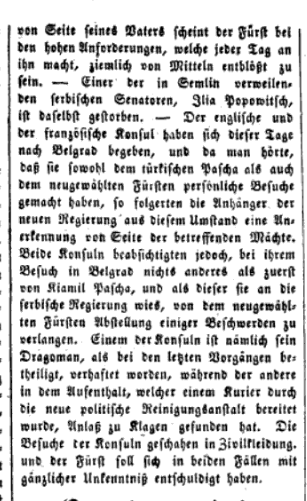
Cited from the article:
“Serbia
For all the arrogance that the new government of Serbia so glaringly displays, which manifested itself particularly against the investigating commissioner Baron Lieven and more recently against the refugees in Semlin by informing them that those who feel little guilty can now submit petitions for forgiveness and return to Serbia, but without any thought of reconciliation — with fear, the constant companion of every reign of terror, evident in all cases.
The clearest proof of this is provided by the latest order for a kind of political quarantine institution, which has been established outside Belgrade following the model of the quarantine facility near Semlin to prevent the spread of the plague. In this institution, travelers coming from Austria, as well as letters, must first be found clean before they can reach any place in Serbia.
Prince Michael has already left Semlin again to go to Meswar to his relatives there. The prince seems to be struggling with the high demands that every [reign] was due to his being quite destitute. One of those residing in Zemun, the Serbian senator Ilia Popovich, died there.
The English and French consuls have recently gone to Belgrade, and since it was heard that they paid personal visits to both the Turkish Pasha and the newly elected prince, the supporters of the new government inferred from this circumstance a recognition on the part of the respective powers.
However, both consuls intended nothing more during their visit to Belgrade than to demand, first from Kiamil Pasha and, when he referred them to the Serbian government, from the newly elected prince, the resolution of some grievances. One of the consuls’ dragoman was arrested for being involved in the recent events, while the other found cause for complaint during the stay arranged for a courier by the new political purge. The consuls’ visits took place in civilian clothes, and the prince is said to have excused himself in both cases with complete ignorance.”
Context
In the period following a major political upheaval, the new government of Serbia displayed a striking combination of outward arrogance and deep-seated fear. While projecting strength and defiance toward foreign powers and political opponents, the regime’s actions revealed a profound insecurity characteristic of many revolutionary or post-coup authorities.
One of the clearest manifestations of this fear was the establishment of a special political quarantine station outside Belgrade. Modeled after the plague quarantine facility near Semlin (Zemun), the new institution subjected all travelers arriving from Austria, as well as their letters and correspondence, to thorough inspection before they could enter the interior of Serbia. This measure aimed to prevent the spread of “dangerous” political ideas, exiles, or conspirators, illustrating the government’s anxiety about external influences and internal destabilization.
The regime’s arrogant posture was equally evident in its treatment of Serbian refugees in Semlin. Those wishing to return were informed that individuals who felt “little guilty” could submit petitions for forgiveness. However, these offers came without any genuine spirit of reconciliation, reflecting the harsh and unforgiving nature of the new order. This approach was typical of a reign of terror, where fear served as the constant companion of power.
Prince Michael (Mihailo Obrenović) had recently left Semlin and moved to Meswar to stay with relatives. Reports suggested he was struggling financially and appeared quite destitute, highlighting the precarious position of key figures associated with the previous order. Meanwhile, the death in Zemun of Serbian senator Ilia Popovich (Ilija Popović) further underscored the extent to which prominent Serbs had been forced into exile or semi-exile.
International reactions added another layer of complexity. English and French consuls visited Belgrade, prompting supporters of the new government to interpret the visits as implicit recognition by the Great Powers. In reality, the consuls’ purpose was far more practical: they sought the resolution of various grievances.
After first approaching the Turkish Pasha, Kiamil Pasha, who referred them to the Serbian authorities, the consuls met with the newly elected prince. One consul’s dragoman was arrested on suspicion of involvement in recent political events, while the other encountered difficulties due to the new political quarantine procedures. The consuls reportedly visited in civilian clothes, and the prince excused himself by claiming complete ignorance of the matters raised.
Overall, the report paints a picture of a nervous regime. Despite its bold and sometimes provocative demeanor toward foreign investigators like Baron Lieven and political refugees, the Serbian government remained gripped by paranoia. The creation of political controls on movement and communication, combined with selective pardons and arrests of even diplomatic staff, revealed a leadership more preoccupied with survival and suppression of opposition than with genuine stability or reform.
This episode reflects the turbulent political culture of 19th-century Serbia, where shifts in power frequently led to cycles of repression, exile, and suspicion — particularly in relation to neighboring Austria and the Ottoman Empire.
Reference
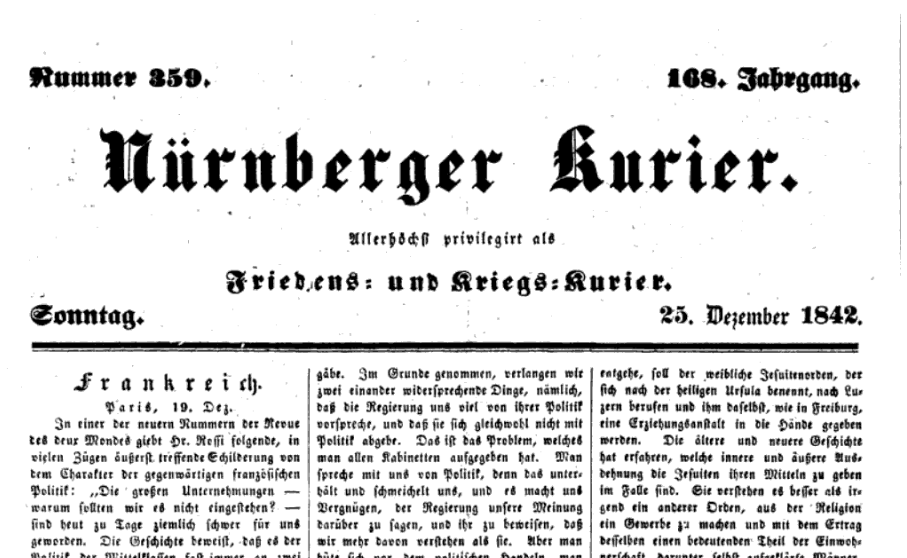
Nürnberger Kurier (Friedens- und Kriegs-Kurier) 1842″.

