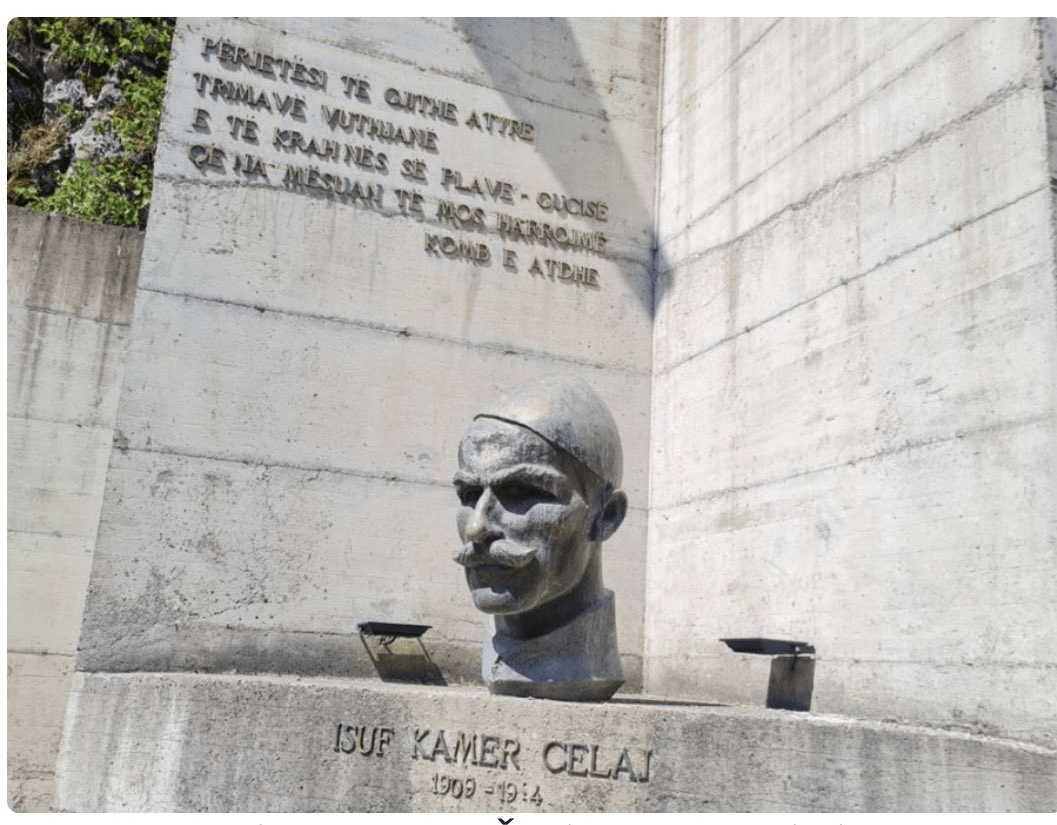

He was born in 1908 in the Tower of the Çelajs in Vuthaj. The Tower of the Çelajs is known throughout all Albanian lands for its besa (word of honor) and hospitality. This family gave a great deal to the national cause. In the Massacre of Previ on March 9, 1913, many men of this family were massacred because they refused to change their national identity. The Çelaj family extended from Vuthaj to Çerem.
This tower hosted many historical figures such as Bajram Curri, Sulejman Vokshi, Hasan Prishtina, and many others, where they discussed the fate of Albanian territories. Even when Kosovo was covered in smoke, Isa Boletini was welcomed as a guest in the Tower of the Çelajs.
Isuf Kamer grew up in the Tower of the Çelajs in a family of 60 members and enjoyed great respect from all the people of the Plavë and Gucia region. In 1938, Isuf went to Tirana to meet King Ahmet Zog of Albania to present the problems of the highlands and the mountain regions. Special attention was given to the relations between the Albanians of Plavë and Gucia with their brothers in Çerem and Valbona, as intergovernmental agreements regarding cross-border trade between Plavë-Gucia and the other side were not being implemented. The meeting, which lasted about one hour, quickly yielded results.
World War II was a great test for Vuthaj and especially for the brotherhood of the Çelajs. The Italians arrived in Plavë and Gucia. There, Albanian partisans found shelter, while Chetniks attacked. On April 6, Yugoslavia capitulated. In May of that year, the Italian army entered Plavë and Gucia from Albania. Shemso Ferri and Hasan Ferri sent a delegation to Tirana in the summer of 1941 to express the desire of the Albanian population of Plavë and Gucia to unite with Albania. The delegation consisted of seven people: Abdyl Gjonbalaj, Ibër Balidemaj, Rexhë Mazi, Abdyl Qerimi, Isuf Balidemaj, Avdo Avdiçi, and Isuf Kamer Çelaj.
Isuf Kamer Çelaj, taking advantage of his acquaintances with Mustafa Kruja and Hasan Prishtina (whom he had hosted in the Tower of the Çelajs), made possible a meeting at the Prime Minister’s office where they presented their requests: that Plavë and Gucia be administratively united with the Prefecture of Peja. The request was granted. The ties of the Çelaj family with the family of Çal Alia and Prenk Cali had been centuries-old.
In the summer of 1941 in Plavë, Prenk Cali — known throughout Albania — met with Isuf Kamer Çelaj and they planned the ways to defend Albanian lands from the Chetniks. In July 1941, large Chetnik forces attacked Plavë and Gucia. On this occasion, Isuf Kamer Çelaj gathered thousands of highlanders to help their brothers in Plavë and Gucia. The battle ended on July 13, 1941, with an Albanian victory. Isuf Kamer showed rare skill on the battlefield. He was elected commander of the unit, a duty he held until the end of his life.
Under the leadership of Riza Ferri, military organizational structures were created for the defense of the region, and a defense staff for Plavë-Gucia was formed. Isuf Kamer Çelaj was the commander of the Çerem unit, a unit that numbered over 300 volunteers. World War II saw clashes both with the occupiers and the liberators, as well as between Albanians and the Chetniks. In the fighting that took place at the stream north of Murina, in January 1944, the brave commander of the Çerem unit, Isuf Kamer Çelaj, fell heroically on the battlefield while leading Albanian volunteer forces against Montenegrin Chetnik forces.
In his final moments, he left a testament to his comrades: “I want you to bury me on the ridge of Vranica, where my soul can look on one side at Plavë and Gucia, and on the other side at Albania.” Despite the difficult weather conditions, the entire region of Plavë and Gucia attended his funeral.
Sources
https://adriancelaj.wordpress.com/2018/10/20/isuf-kamer-celaj-dhe-kulla-e-celajve/
Gjurmë Mërgimtarësh. Rexhep Dedushaj

