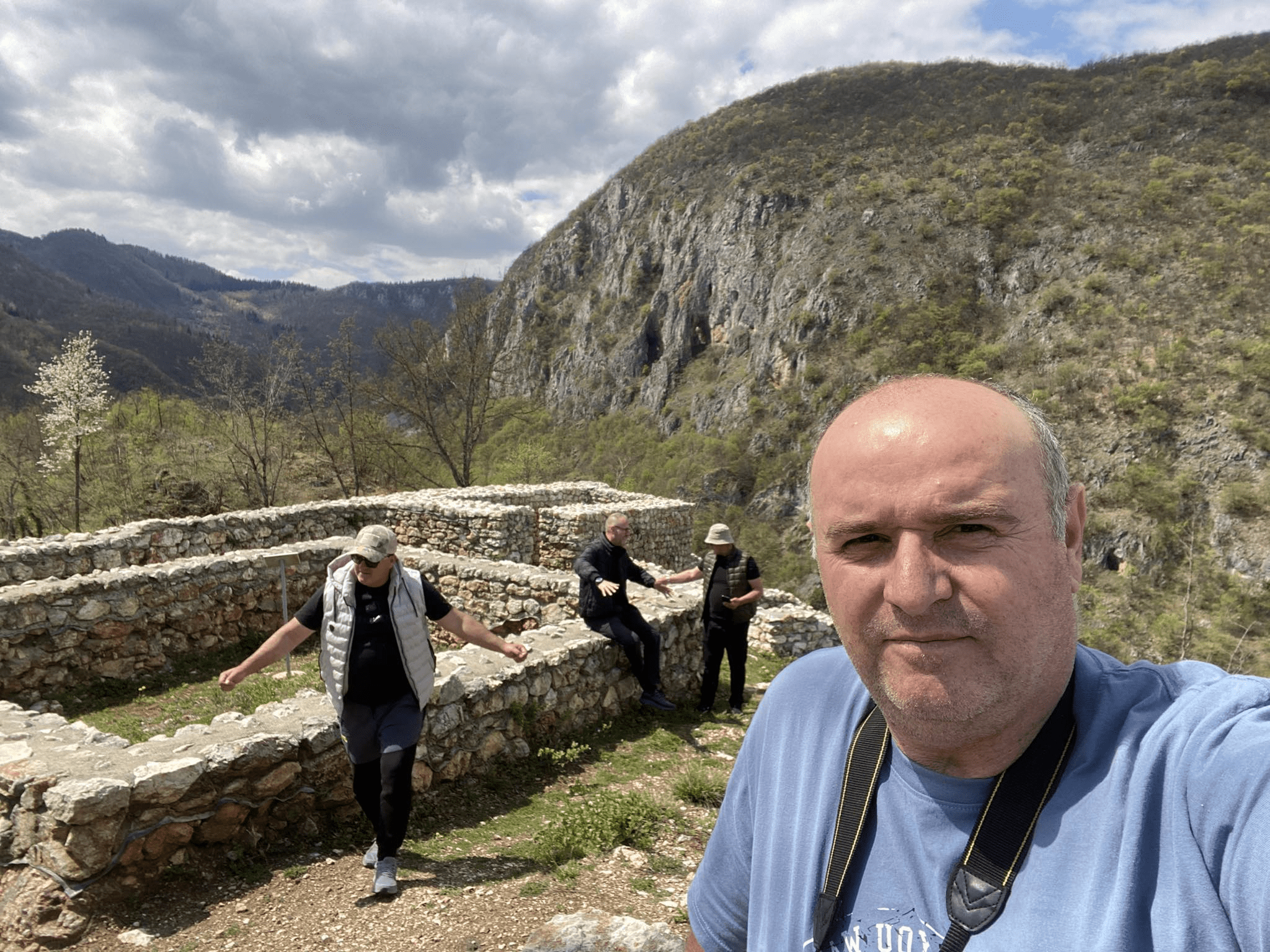

Image: Gazmend Çitaku in Berane at the “Tumbarica Castle”, a settlement from 1500 BC – 7th century AD.
In Italian geographical and administrative sources of the early 20th century, the town of Berane (in northeastern Montenegro) was occasionally referred to as “Berane (Alpi Albanesi)”. “Alpi Albanesi” is the traditional Italian name for the Accursed Mountains (Albanian: Bjeshkët e Namuna / Montenegrin: Prokletije), the dramatic mountain range that forms the natural border between Albania, Montenegro, and Kosovo.
Why Berane Was Linked to the “Albanian Alps”
Berane lies in the upper Lim River valley and has historically served as an important gateway to the highland regions of the Albanian Alps. It is geographically and culturally connected to Plavë) and Gucia, the Rugova highlands and the broader Accursed Mountains massif.
These areas were (and remain in many villages) inhabited by Albanian highland tribes such as the Kelmendi, Kuçi, Berisha, and others. The entire zone formed a natural ethnographic and tribal continuum with northern Albania, governed for centuries by the same Kanun customary law and clan structures.
History
The designation “Alpi Albanesi” reflected Italian strategic and ethnographic interest in the region during the interwar period. Italy viewed the Albanian Alps and adjacent areas (including Plav-Gucia-Berane) as part of a wider cultural and geographic sphere with strong Albanian characteristics. This perception was rooted in:
The significant Albanian-speaking population in the area.
The mountainous terrain that served as a natural continuation of the Albanian Alps.
Tribal and family connections stretching across modern borders.
By labeling Berane as part of the “Alpi Albanesi,” Italian sources emphasized its position as the northern administrative and cultural threshold of the Albanian mountain world.
Significance
This historical designation underscores the deep historical ties between Berane and core Albanian territories. Even after political borders were drawn, the region around Berane, Plav, Gucia, and Rugova continues to maintain strong linguistic, familial, and cultural links with the Albanian Alps.
Bibliography
Geofisica pura e applicata, Volumes 8–12. Istituto Geofisico Italiano, 1946.
Italian geographical and ethnographic sources, ca. 1928–1930s (referencing “Berane (Alpi Albanesi)”).

