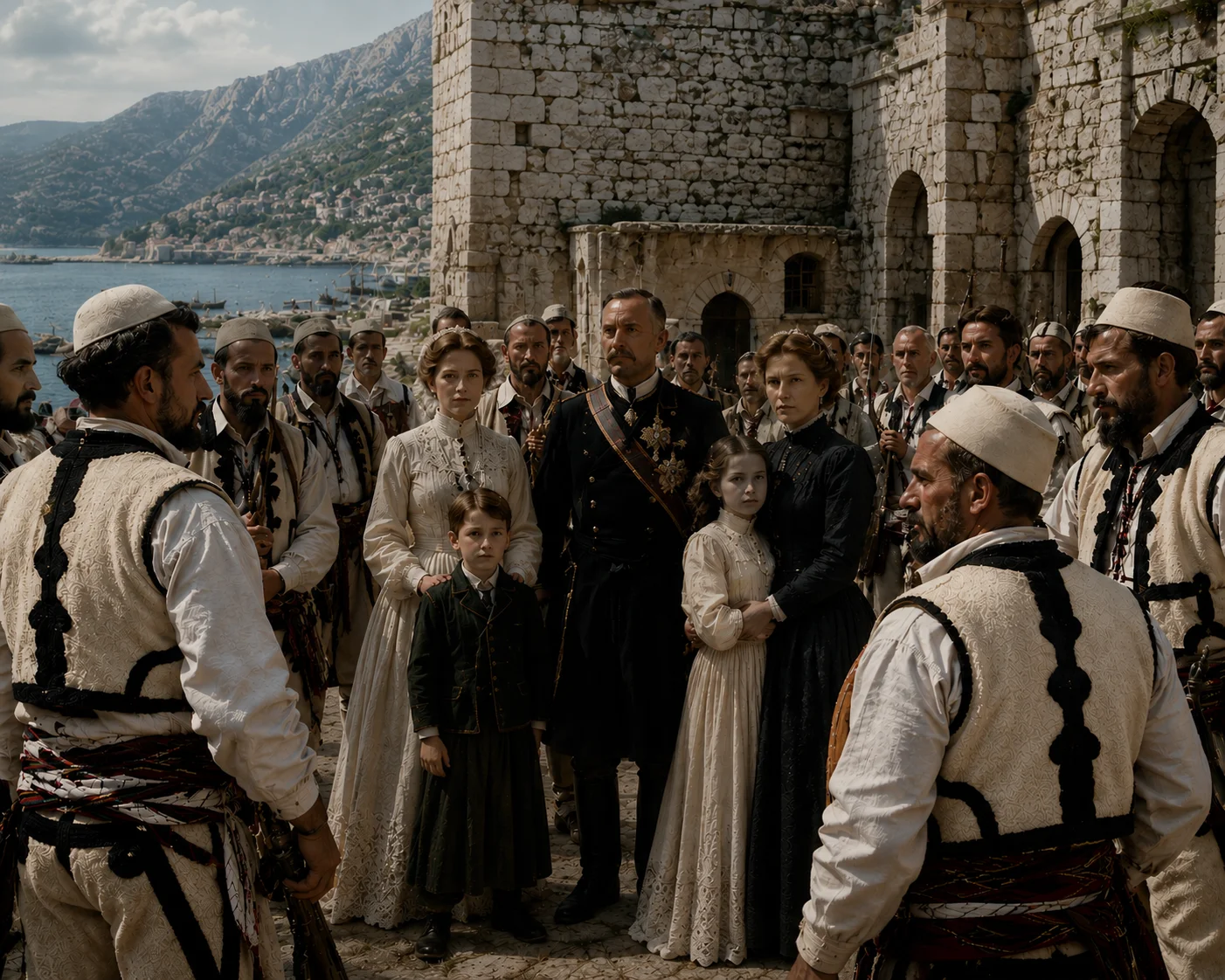

During the turbulent years of Montenegrin–Ottoman conflicts in the late 19th century, Prince Nikola I Petrović-Njegoš (later King of Montenegro) took a notable pragmatic step: he temporarily moved his family to Antivari (Tivari) for safety.
According to a contemporary report in the Allgemeine Zeitung (Munich), Prince Nikola placed his family “so to speak, under the protection of the Catholic Albanians” in the coastal town.
Context
Antivari and its surrounding villages had a significant Catholic Albanian population (often called Latini or Krbava Albanians). These communities maintained strong local autonomy and were known for their martial traditions. While Montenegrins were predominantly Orthodox Slavs in constant conflict with Muslim Ottoman forces and some Albanian tribes, relations with the Catholic Albanians of the coast were often more pragmatic and occasionally cooperative.
By entrusting his family to them, Prince Nikola demonstrated a degree of trust in these Catholic Albanian communities despite the broader ethnic and religious tensions of the era. This move occurred amid the wars of 1876–1878, when Montenegro was expanding southward and clashing with Ottoman troops and local Muslim Albanian irregulars.
Significance
This episode reveals the complex web of alliances in the southern Adriatic borderlands:
Religion did not always determine loyalty.
Catholic Albanians sometimes served as a neutral or protective buffer.
Pragmatism often prevailed over ideology in moments of crisis.
The decision highlights Prince Nikola’s tactical flexibility. Even while pursuing a policy of expanding Montenegrin territory at the expense of Ottoman and Albanian lands, he recognized the reliability of certain Albanian Catholic groups when his own family’s safety was at stake.
This small but telling detail humanizes the often black-and-white narratives of Balkan ethnic conflict in the 19th century.
Source
Allgemeine Zeitung. Munchen. 1882

