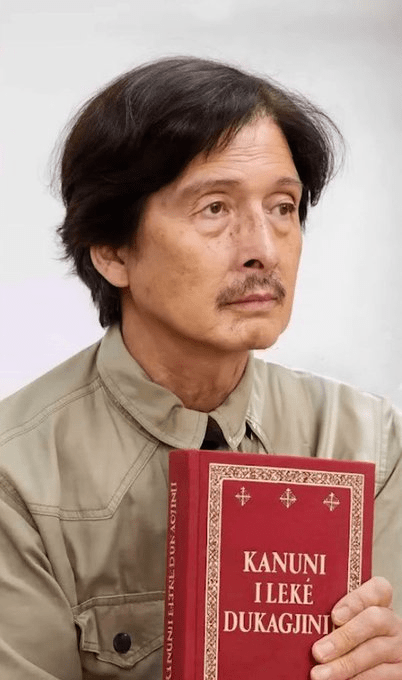

In 2000, Japanese scholar Kazuhiko Yamamoto, affiliated with Kyushu University, published a fascinating anthropological and philosophical analysis in the journal Design Issue of KID. His paper, titled “The Ethical Structure of the Kanun: Is It the Original Form of Ethics in Human Society?”, explores the customary code of the Gheg tribes in northern Albania and uses it to theorize about the foundations of ethics in pre-state societies.
What Is the Kanun?
The Kanun (specifically Kanuni i Lekë Dukagjinit) is an ancient, orally transmitted customary code that governed social life among the highland clans of northern Albania for centuries. Compiled in the early 20th century by Franciscan priest Shtjefën Gjeçov, it consists of over 1,200 articles covering everything from hospitality and family structure to justice, honor, and conflict resolution. In a rugged, tribal region where formal state authority was weak or absent, the Kanun served as the primary framework for maintaining social order.
Central to the Kanun is the practice of blood feuds (gjakmarrja). When an offense occurs—especially one involving honor or killing—the offended party (or their kin) has the right and obligation to seek revenge. This is not portrayed as chaotic violence but as a structured, ethical imperative to restore balance.
Core Ethical Concepts in the Kanun
Yamamoto identifies seven interlocking concepts that form the ethical backbone of the Kanun:
Oath: A sacred utterance invoking God, often accompanied by a ritual act. Breaking it brings dishonor and potential divine punishment.
Besa: A temporary truce or oath of ceasefire in blood feuds, granting safety and time for reflection or reconciliation.
Blood: A multifaceted symbol representing life, kinship, spilled life (in killings), and the debt that demands vengeance. “Blood is never unavenged.”
Honor: Paramount and non-negotiable. Insults to honor (e.g., being called a liar publicly, threats, or insults to family) demand blood or forgiveness; they cannot simply be paid off with goods.
Guest (Guest-God): Hospitality is sacred. “The house of the Albanian belongs to God and the guest.” A guest is treated with utmost respect, akin to a divine visitor.
Food (Commensality): Sharing bread and salt is a profound ritual that builds bonds, seals oaths, and symbolizes sharing life itself.
Revenge: The ultimate sanction, viewed as justice when it restores ethical equilibrium.
These elements interconnect: harming a guest or breaking an oath injures honor and “blood,” triggering revenge as a restorative act.
Pagan Roots and the Guest-God Theory
Yamamoto draws a striking parallel between Albanian traditions and ancient Japanese folklore, particularly folklorist Shinobu Orikuchi’s marebito (guest-god) theory. In this view, gods or ancestral spirits visit communities disguised as strangers or guests. Hosts must offer exceptional hospitality—including food and shelter—in a ritual of communion. In return, the guest-god bestows blessings.
In the Kanun, the guest is quasi-divine. Sharing food creates a spiritual bond. Through hospitality and blessings, a person gains a form of divinity (comparable to the Japanese kotodama, the spirit/power of words, or the Albanian ore spirit). Violating this divinity—through perjury, betrayal of besa, dishonor, or killing a protected guest—requires sacrificial blood to appease the gods and restore order.
This framework transforms revenge from mere retaliation into a sacred, ethical act. Blood feuds become a mechanism of justice in a society without strong state power, regulated by elders, mediators, and strict rules to prevent escalation into total war. Reconciliation rituals, often involving shared meals, further reinforce social bonds.
Ethics Before the State
Yamamoto engages with Western thinkers like Thomas Hobbes (who saw pre-state life as a “war of all against all” resolved by social contract), Rousseau, Nietzsche, and others. He argues that these theories overlook indigenous ethics that emerge organically in pagan, tribal societies rooted in animism, ancestor worship, and kinship.
In such societies:
Kin groups are transcendental entities spanning the living and the dead (ancestor-gods).
Revenge and blood sacrifice appease divine wrath.
Hospitality and commensality link humans to the divine.
The Kanun, functioning effectively for centuries, suggests that ethics and social order can arise spontaneously from cultural and religious traditions rather than solely from centralized authority. Yamamoto posits that these concepts—hospitality to strangers, the sanctity of oaths and honor, and restorative justice—may represent a widespread “original form” of human ethics found across Eurasia and beyond in primordial times.
Relevance
Though the Kanun was suppressed under communism, elements of blood feuds and besa persist in Albanian cultural memory and occasionally in practice, especially in remote areas or diaspora communities. Yamamoto’s work highlights universal themes: the tension between honor and forgiveness, the power of ritual and shared meals, and how societies without strong institutions maintain order through internalized codes.
It also fosters cross-cultural appreciation—linking the fierce hospitality of Albanian highlanders with Japanese omotenashi—and invites reflection on modern questions: How do we build trust and justice in fragmented societies? What role do honor, ritual, and personal obligation play alongside formal law?
Yamamoto’s article remains a thought-provoking contribution to anthropology, ethics, and comparative cultural studies, reminding us that “primitive” customary laws can encode sophisticated moral philosophies worthy of serious consideration.
Further Reading: The full paper is available via Kyushu University’s institutional repository (DOI: 10.15017/4060990). For context on the Kanun itself, see Gjeçov’s compilation or ethnographic works by Edith Durham.

