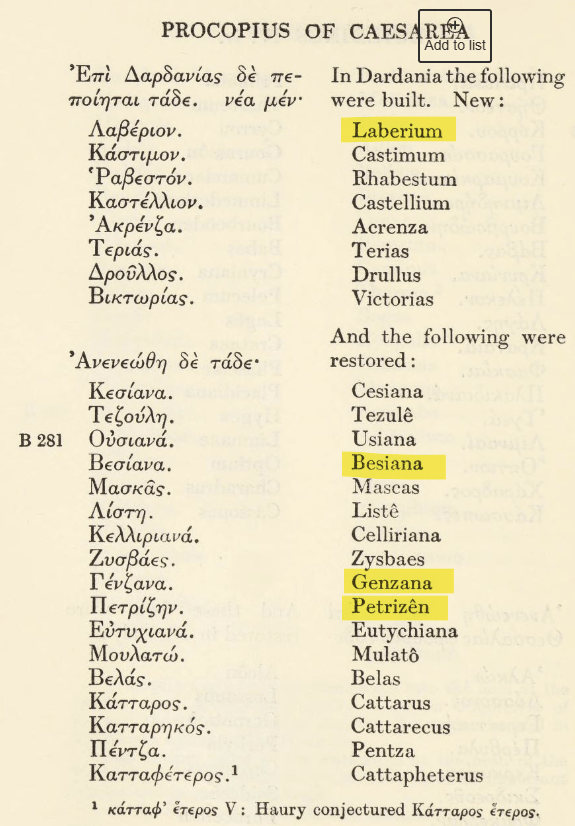

Transcribed:
“In Dardania the following were built:
- Laberium
- Castimum
- Rhabestum
- Castellium
- Acrenza
- Terias
- Drullus
- Victorias
And the following were restored:
- Cesiana
- Tezulê
- Usiana
- Besiana
- Mascas
- Listê
- Celliriana
- Zysbaes
- Genzana
- Petrizên
- Eutychiana
- Mulatô
- Belas
- Cattarus
- Cattarecus
- Pentza
- Cattapheterus
(Footnote:¹ κάτταρ’ ἕτερος V: Haury conjectured Κάτταρος ἕτερος.)
Summary
In his work On Buildings (De Aedificiis), the 6th-century Byzantine historian Procopius of Caesarea records a list of new fortifications built and older ones restored by Emperor Justinian I in the province of Dardania (roughly corresponding to parts of modern Kosovo, southern Serbia, and northern North Macedonia). There is not one Slavic or Serbian toponym here.
The highlighted names — Laberium, Besiana, Genzana, and Petrizên — stand out as potentially significant for Balkan toponymy and ethnic history. These records provide valuable primary evidence of the Roman/Byzantine defensive network in the central Balkans during Late Antiquity, a region that would later see major demographic shifts involving Slavic, Albanian, and other migrations.
Justinian’s Building Program in Dardania According to Procopius
Procopius of Caesarea, the most important historian of the Age of Justinian (r. 527–565), dedicated an entire treatise to cataloguing the emperor’s extensive construction and restoration projects across the empire. In the section dealing with the Balkans, he provides a detailed list of fortifications in the province of Dardania.
The passage distinguishes between entirely new constructions (“New”) and restorations of existing sites. The new forts include names such as Laberium, Castimum, Rhabestum, and Drullus, while among the restored sites are several with pre-Slavic or Illyrian roots, including the highlighted Besiana, Genzana, and Petrizên (Prizren)
Historical Significance
Dardania was the ancient homeland of the Dardanians, an Illyrian people. By Justinian’s time, the region had been under Roman rule for centuries and served as a vital buffer zone protecting the empire’s interior from barbarian incursions. Procopius’s list reflects Justinian’s massive effort to reinforce the Danubian and Balkan frontiers after the crises of the 5th–6th centuries.
Source
Procopius of Caesarea, De Aedificiis (Περὶ Κτισμάτων / On Buildings), Book IV, Chapter 4.

