Summary
In 1913, Serbian Minister Vladan Đorđević publicly argued in a pamphlet that Albanians were incapable of forming a viable independent state, despite being a distinct people. He advocated Serbian control over northern Albania based on medieval claims. Bulgarian diplomat M. Rizoff similarly proposed partitioning Albania between Greece and Serbia. These positions, expressed during and around the London Ambassadorial Conference, illustrate the strong chauvinistic and expansionist attitudes of certain Balkan politicians toward the newly emerging Albanian nation.
Serbian and Bulgarian Chauvinism at the 1913 London Conference
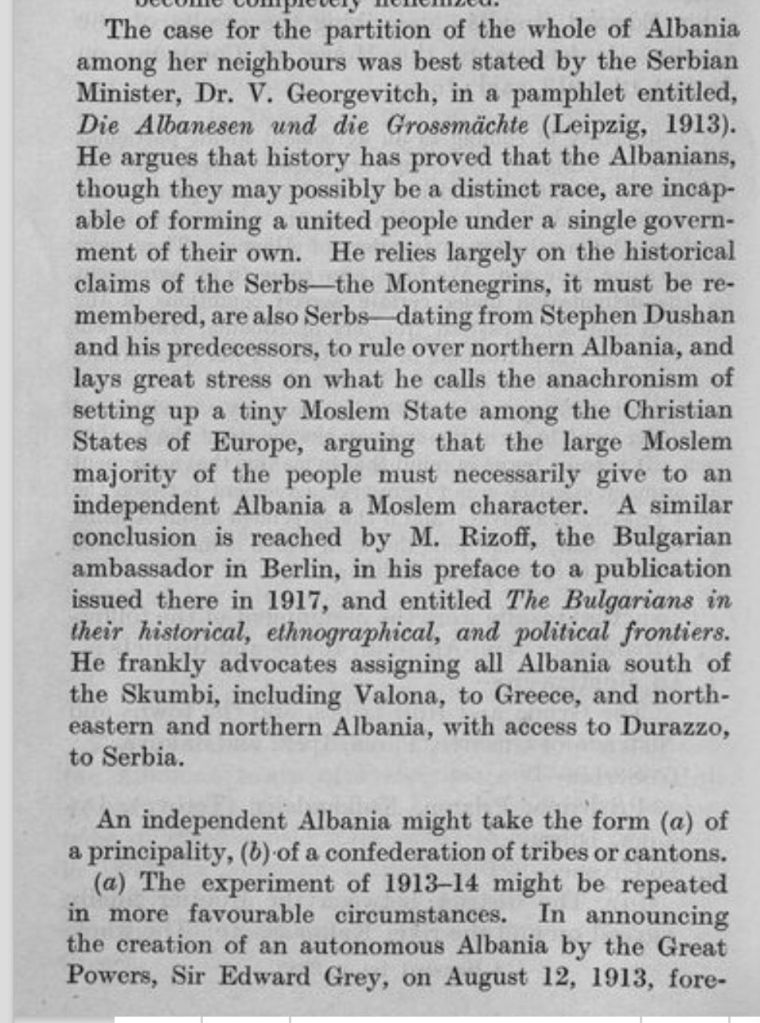
In 1913, during the London Conference of Ambassadors (held between 11 and 30 May), the Great Powers discussed the future of the newly declared Albanian state following the First Balkan War. While the conference ultimately recognized Albania’s independence, powerful neighboring states actively pushed for its complete partition. A 1920 publication vividly documents the openly chauvinistic positions of Serbian and Bulgarian officials toward the Albanian people.
One of the clearest expressions of this attitude came from Serbian Minister Dr. Vladan Đorđević (V. Georgevitch). In his pamphlet Die Albanesen und die Grossmächte (Leipzig, 1913), he argued that although Albanians might constitute a distinct race, they were “incapable of forming a united people under a single government of their own.” Đorđević relied heavily on historical claims dating back to the medieval Serbian Empire of Stefan Dušan, asserting Serbia’s right to rule over large parts of northern Albania. He strongly opposed the creation of even a small Albanian state, warning that it would inevitably take on a “Muslim character” in the heart of Christian Europe.
Similarly, M. Rizoff (Rizov), the Bulgarian ambassador in Berlin, expressed parallel ambitions in a 1917 publication. In the preface to The Bulgarians in their historical, ethnographical, and political frontiers, he advocated the division of Albania: the southern regions, including Vlorë (Valona), should be assigned to Greece, while north-eastern and northern Albania, with access to the port of Durrës (Durazzo), should go to Serbia.
These statements reveal the expansionist and dismissive mindset prevalent among certain Balkan political elites at the time. Albanian national aspirations were not viewed as legitimate expressions of self-determination but rather as obstacles to the territorial ambitions of their larger neighbors.
The arguments presented — questioning the Albanians’ capacity for self-rule, invoking medieval conquests, and framing the emergence of a Muslim-majority state as inherently problematic — exemplify the chauvinistic rhetoric used to justify potential partition.
The London Conference ultimately prevented the total dismemberment of Albania, though the new state was left significantly truncated, with large Albanian-populated territories awarded to Serbia, Montenegro, and Greece. The documented positions of Đorđević and Rizoff remain important historical testimonies to the diplomatic struggles surrounding the birth of modern Albania and the nationalist ideologies that sought to deny its existence.