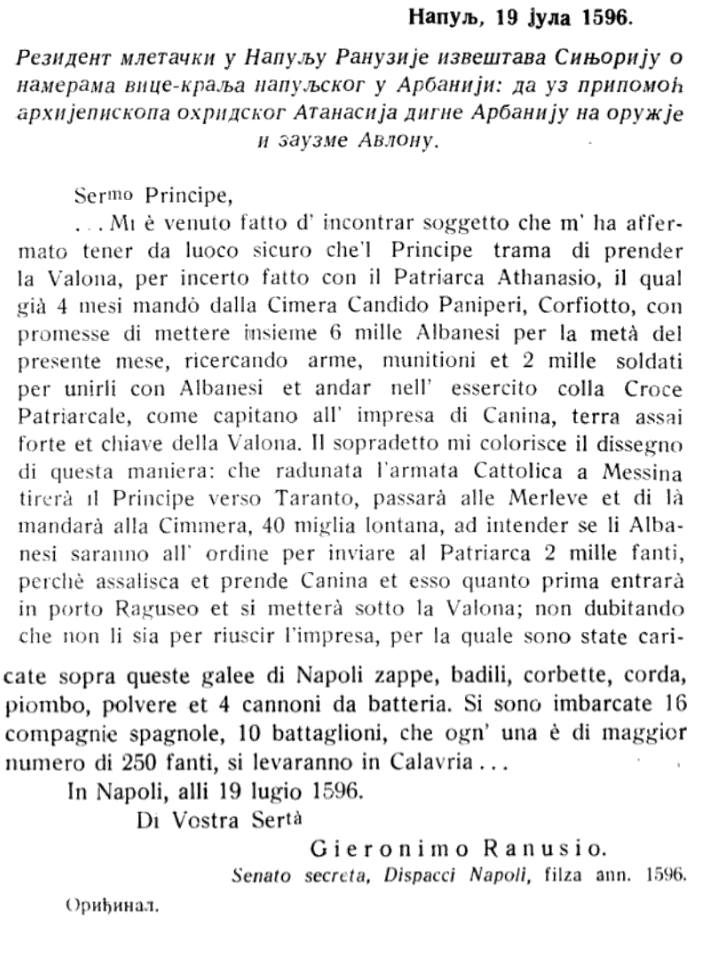

A 1596 dispatch from Geronimo Ranusio (Girolamo Ranusio) in Naples, dated 19 July, provides a vivid snapshot of anti-Ottoman plotting in the western Balkans. In it, Patriarch (Archbishop) Athanasius of Ohrid is reported to have sent Candido Paniperi, a Corfiot, to Himara months earlier. The goal: to assemble 6,000 “Albanesi” (Albanians), requesting arms, munitions, and 2,000 additional soldiers to join them in a coordinated effort, possibly targeting Valona (Vlorë) and Kanina.
This document, part of broader Spanish-Venetian intrigue during the Long Turkish War, refers to the famous Himara Revolt of 1596. Italian and Spanish sources consistently describe the fighters as Albanesi or Himariote Albanians.
Himara in the 15th–16th Centuries
Himara (Himarrë) and surrounding coastal villages in southern Albania formed a rugged, semi-autonomous region under loose Ottoman suzerainty. Its inhabitants — Orthodox Christians — enjoyed certain privileges due to their martial traditions and strategic location. They frequently revolted against Ottoman centralization and sought alliances with Christian powers (Venice, Spain, the Papacy).
Contemporary Western sources (Venetian, Spanish, Neapolitan) overwhelmingly label them as Albanians (Albanesi, Albanenses). They were integrated into the broader Albanian military diaspora of stratioti (mercenary light cavalry) serving in Italy and beyond. Albanian historians and many neutral scholars view this as evidence of Albanian ethnic and linguistic predominance in the region at the time, with possible bilingualism (Albanian and Greek due to Orthodox Church influence and proximity to Greek-speaking areas).
Greek historiography often frames Himara within “Northern Epirus,” emphasizing Orthodox Christian and cultural Hellenic ties, sometimes portraying the 1596 events as part of Greek resistance. Sources note that Archbishop Athanasius himself was of Greek origin from Mani. The population was likely mixed or fluid in self-identification, as was common in the pre-nationalist Balkans. Clan-based society, Orthodox faith, and local dialect(s) coexisted.
From 16th-Century “Albanesi” to Modern “Vorio Epirotes”
The Albanian-speaking Himariotes of the Ottoman era later (especially in the 19th–20th centuries and today) include communities identifying strongly as Greeks or “Northern Epirotes” (Vorio Epirotes).
This reflects broader dynamics in southern Albania:
Many villages in Himara (e.g., Dhermi, Palasë) today feature bilingual populations or Greek self-identification.
Greek organizations and the Albanian Greek minority emphasize historical, religious, and linguistic continuity with ancient Epirus and Byzantine traditions.
Albanian perspectives stress the Albanian toponym, language in many historical records, and demographic majority of Albanian-speakers in the wider region.
The 1596 document and revolt illustrate Himara’s role as a hotspot of resistance, where local warriors — called Albanians by their would-be allies — fought for autonomy. Centuries later, descendants or residents of the same villages navigate layered identities: Albanian citizens, Orthodox Christians, speakers of Albanian and/or Greek, and inheritors of a shared Paleo-Balkan, Roman, Byzantine, and Ottoman past.
Primary sources like Ranusio’s dispatch remain crucial evidence of how outsiders (and often the people themselves) perceived the Himariotes in the late 16th century: as Albanians.
Sources
Ranusio, Geronimo (Girolamo). “Dispatch to the Prince, Naples, 19 July 1596.” Senato Secreta, Dispacci Napoli, filza ann. 1596. Archivio di Stato di Napoli. Original Italian document reproduced in various Balkan historical collections.
Floristán, José Manuel. “Anti-Ottoman Uprisings of Himara and the Albanians: Connections with Spain. Archival Evidence of the Warfare of the Himariote Albanians.” Balkan Academia, February 8, 2026.
Schmitt, Oliver Jens. The Albanians: A Modern History. London: I.B. Tauris, 2020. (For broader discussion of early modern Albanian identity and Himara.)Frashëri, Kristo. Various works on Himara and Albanian revolts (frequently cited in Albanian historiography).

