by Lorena Tota
Summary
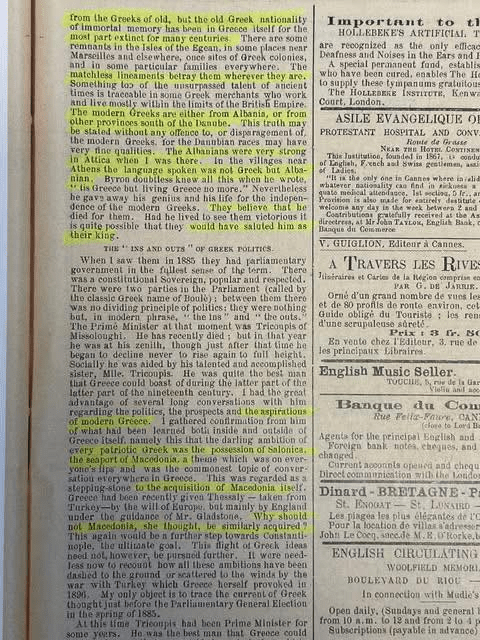
In a January 10, 1902, article in the Cannes Gazette, Sir Richard Temple challenged the romantic notion of ethnic continuity between ancient Hellas and modern Greece. He asserted that modern Greeks largely descended from Albanian settlers and populations from provinces south of the Danube (Slavic elements), noting that Albanian was still spoken in villages near Athens. Temple portrayed Greece as a composite Balkan nation rather than a direct heir of classical civilization and highlighted that Greek nationalists viewed Macedonia as a territory to be conquered, not an ancestral homeland. The passage underscores early 20th-century European observations of a significant ethnic and cultural disconnect between ancient and modern Greece.

The Albanian and Slavic Roots of Modern Greece
In the Cannes Gazette of January 10, 1902, Sir Richard Temple shattered the romantic myth of an ethnically unchanged Greece with remarkable bluntness. He stated plainly that “The modern Greeks are either from Albania, or from other provinces south of the Danube”, while noting that in villages near Athens “the language spoken was not Greek but Albanian”.

Far from describing a nation populated by the direct heirs of ancient Hellas, Temple portrayed modern Greece as a composite Balkan state shaped largely by Albanian and Danubian (Slavic) elements. Even more revealing was his admission that Macedonia itself was viewed by Greek nationalists not as an ancestral homeland, but as a territory to be acquired. Written before nationalist narratives hardened into official doctrine, the passage remains a deeply uncomfortable reminder that early twentieth-century European observers often saw a profound gap between ancient Greece and the modern state claiming its legacy