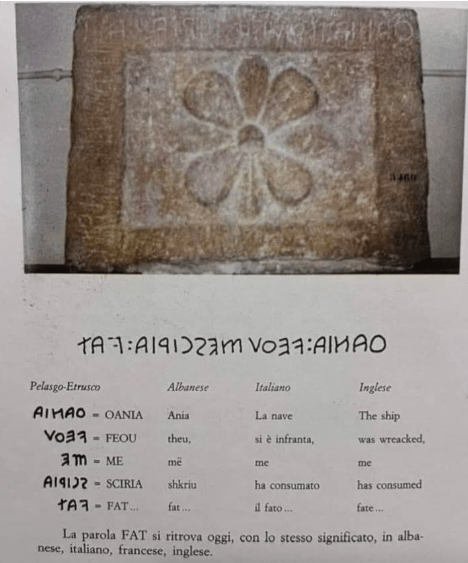

This artifact is a carved stone slab featuring an Etruscan (or Pelasgo-Etruscan) inscription accompanied by a central floral/rosette motif. According to the interpretive table presented alongside the artifact:
Inscription: TAT: A191023M VO3A: AINAO
Proposed Pelasgo-Etruscan to Albanian reading and translation:
- AINAO = OANIA (Albanian: Ania) → Italian: La nave / English: The ship
- VO3A = FEOU (Albanian: theu) → Italian: si è infranta / English: was wrecked
- 3M = ME (Albanian: më) → Italian: me / English: me
- A191023 = SCIRIA (Albanian: shkriu) → Italian: ha consumato / English: has consumed
- TAT = FAT (Albanian: fat…) → Italian: il fato… / English: fate…
Full proposed translation:
“The ship was wrecked, consumed me… fate…”
The interpretation claims that the word FAT (fate) carries the same meaning in Albanian, Italian, French, and English. Proponents of this reading, notably associated with Nermin Vlora Falaschi’s work, argue that this demonstrates a direct linguistic link between ancient Etruscan (viewed here as Pelasgo-Etruscan) and modern Albanian, allowing the decipherment of previously obscure inscriptions through Albanian vocabulary and grammar.
This stone is presented as supporting evidence for the theory that Albanian preserves significant elements of an ancient Balkan language connected to Etruscan civilization.

