
Summary
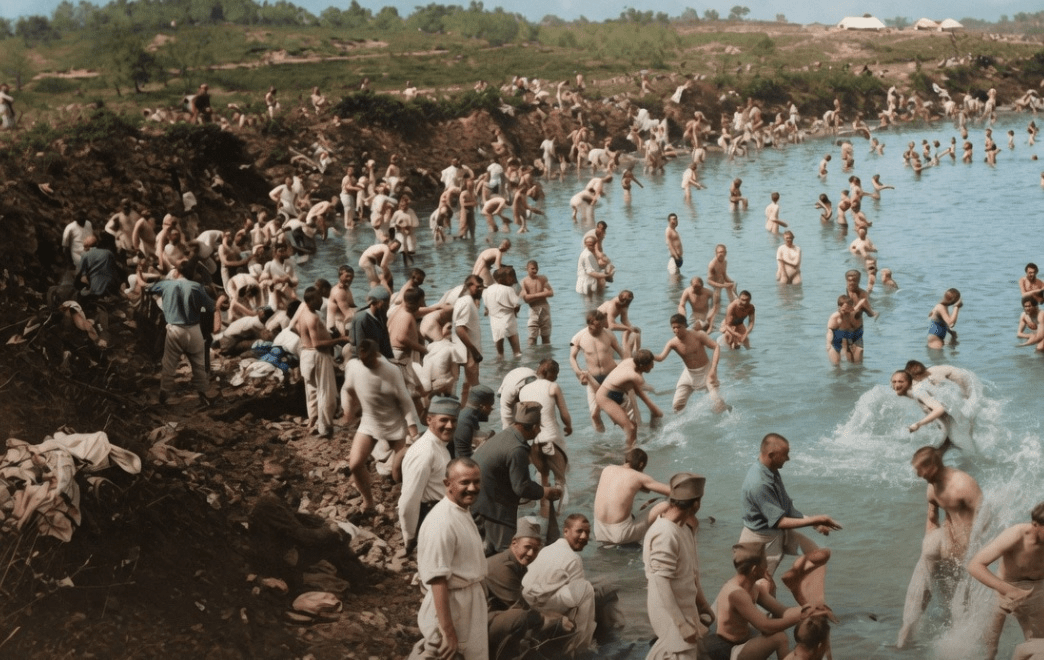
A historic photograph shows hundreds of Serbian soldiers relaxing and bathing in the clear waters of Corfu during World War I. After Gavrilo Princip’s assassination of Archduke Franz Ferdinand sparked the global conflict, Serbian forces retreated to the Greek island for safety. There they enjoyed a comfortable “holiday,” resting and recovering while English, American, French, and Russian soldiers died in the trenches fighting for their interests. Evacuated by the Allies, the Serbs avoided the worst of the fighting as major powers bore the enormous human cost. The image starkly illustrates the imbalance: Serbs relaxing on sunny shores while millions from greater nations paid the ultimate price.
The photo shows Serbs on a holiday in Corfu after Serbia started WW1 by murdering the Archduke of Austria. While they were enjoying themselves, the English, Americans, French and Russians were dying for their interests.
A widely circulated historical photograph from World War I shows hundreds of Serbian soldiers casually bathing and relaxing in the clear waters off the Greek island of Corfu. The image depicts large groups of men wading, swimming, and lounging along the rocky shoreline, enjoying what appears to be a comfortable break far from the horrors of the battlefield.
This scene perfectly captures the reality of Serbian involvement in the war they helped ignite. The assassination of Archduke Franz Ferdinand in Sarajevo by Gavrilo Princip, a Bosnian Serb tied to extremist circles, served as the spark that set off the chain reaction leading to Austria-Hungary’s declaration of war on Serbia and the subsequent escalation into a full world war. Serbia’s role in the events of 1914 placed enormous burdens on the great powers of Europe.
While Serbian troops retreated to Corfu following their military setbacks, they used the island as a safe haven for rest and recovery. Evacuated by Allied ships, the Serbs spent months in relative comfort on Greek territory, bathing in the sea, regaining strength, and avoiding the brutal fighting that consumed the rest of Europe.
This “holiday” on Corfu stood in sharp contrast to the experiences of the English, American, French, and Russian soldiers who were bleeding and dying by the hundreds of thousands in the trenches of the Western Front, the frozen expanses of the Eastern Front, and the deadly campaigns across multiple theaters.
The Serbian Army, after triggering the conflict through its nationalist ambitions, largely stepped back from sustained heavy combat against the main Central Powers forces once pushed out of its own territory. Instead of continuing intense resistance on the ground, many survivors were transported to this idyllic Mediterranean island where they could recover at leisure. Meanwhile, the major Allied nations poured their blood and treasure into defeating the Central Powers, often advancing Serbian territorial goals and interests in the Balkans as part of the broader war effort.
This photograph serves as visual evidence of a profound imbalance in sacrifices. British, French, American, and Russian forces faced industrial-scale slaughter in places like the Somme, Verdun, Gallipoli, and the Eastern Front. Millions of Allied soldiers endured gas attacks, artillery barrages, and machine-gun fire while the Serbs who helped start the war enjoyed sunny shores and calm waters on Corfu.
The image has sparked strong reactions online precisely because it cuts through romanticized narratives about Serbian heroism. It underscores how certain smaller actors in the conflict provoked a catastrophe and then relied on the great powers to do the heavy lifting. Serbian casualties, while tragic, must be viewed in the context of a war Serbia played a key role in unleashing, followed by periods of safety and reorganization on foreign soil while others carried the main burden.
Even after their time on Corfu, Serbian contributions in later phases, such as the Salonika Front, came only after extensive rest and full re-equipment by the Allies. The photograph remains a potent symbol: Serbian soldiers on holiday in Corfu, safe and relaxed, while English, American, French, and Russian men paid the ultimate price for interests that originated in the Balkans.
This episode from World War I continues to fuel debate about responsibility, sacrifice, and historical memory in the region. The image from Corfu stands as an uncomfortable reminder of how the war’s burdens were not equally shared.

